AAWSAP DIRD, Advanced Nuclear Propulsion for Manned Deep Space Missions, March 2010
DOW-UAP-D126 · page 25 of 37
Text
This text came with the file. It may have mistakes. When the text and the image disagree, the image is right.
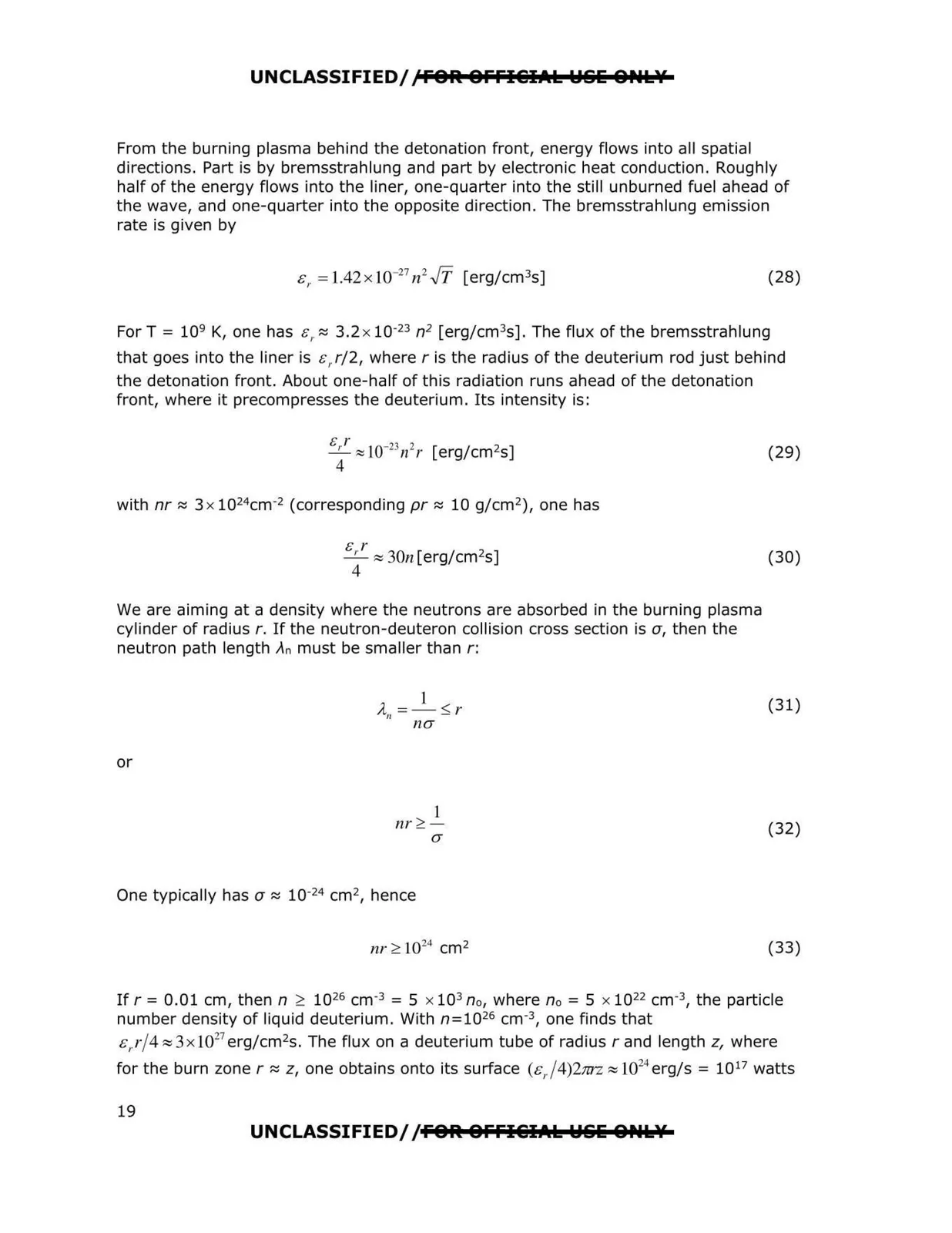
UNCLASSIFIED/,'FOR OFFl&IAk le.ISi: OPtklf From the burning plasma behind the detonation front, energy flows into all spatial directions. Part is by bremsstrahlung and part by electronic heat conduction. Roughly half of the energy flows into the liner, one-quarter into the still unburned fuel ahead of the wave, and one-quarter into the opposite direction. The bremsstrahlung emission rate is given by (28) For T = 109 K, one has &, ;::: 3.2 x 10⁻²³ n2 [erg/cm 3s]. The flux of the bremsstrahlung that goes into the liner is &,r/2, where r is the radius of the deuterium rod just behind the detonation front. About one-half of this radiation runs ahead of the detonation front, where it precompresses the deuterium. Its intensity is: E r 23 ' - '-::::10- n·r [erg/cm 2s] (29) 4 with nr;::: 3x 1024cm·2 (corresponding pr;::: 10 g/cm 2), one has Er - '- :a:: 30n[erg/cm 2s] (30) 4 We are aiming at a density where the neutrons are absorbed in the burning plasma cylinder of radius r. If the neutron-deuteron collision cross section is a, then the neutron path length An must be smaller than r: 1 (31) l,,=-<;;,r nc, or 1 nr ~ c, (32) One typically has a;::: 10·24 cm 2, hence nr ~ 1024 cm 2 (33) If r = 0.01 cm, then n ~ 1026 cm·3 = 5 x 10³ no, where no = 5 x 1022 cm·3, the particle number density of liquid deuterium. With n=1026 cm·3, one finds that s,.r/4 :a:: 3x l027 erg/cm 2s. The flux on a deuterium tube of radius rand length z, where for the burn zoner ;::: z, one obtains onto its surface (s,. /4)2nrz :a:: 1024 erg/s = 1017 watts UNCLASSIFIED//FOR OFFI&I.t.k le.ISi: OPU.¥ 19