AAWSAP DIRD, Advanced Nuclear Propulsion for Manned Deep Space Missions, March 2010
DOW-UAP-D126 · page 27 of 37
Text
This text came with the file. It may have mistakes. When the text and the image disagree, the image is right.
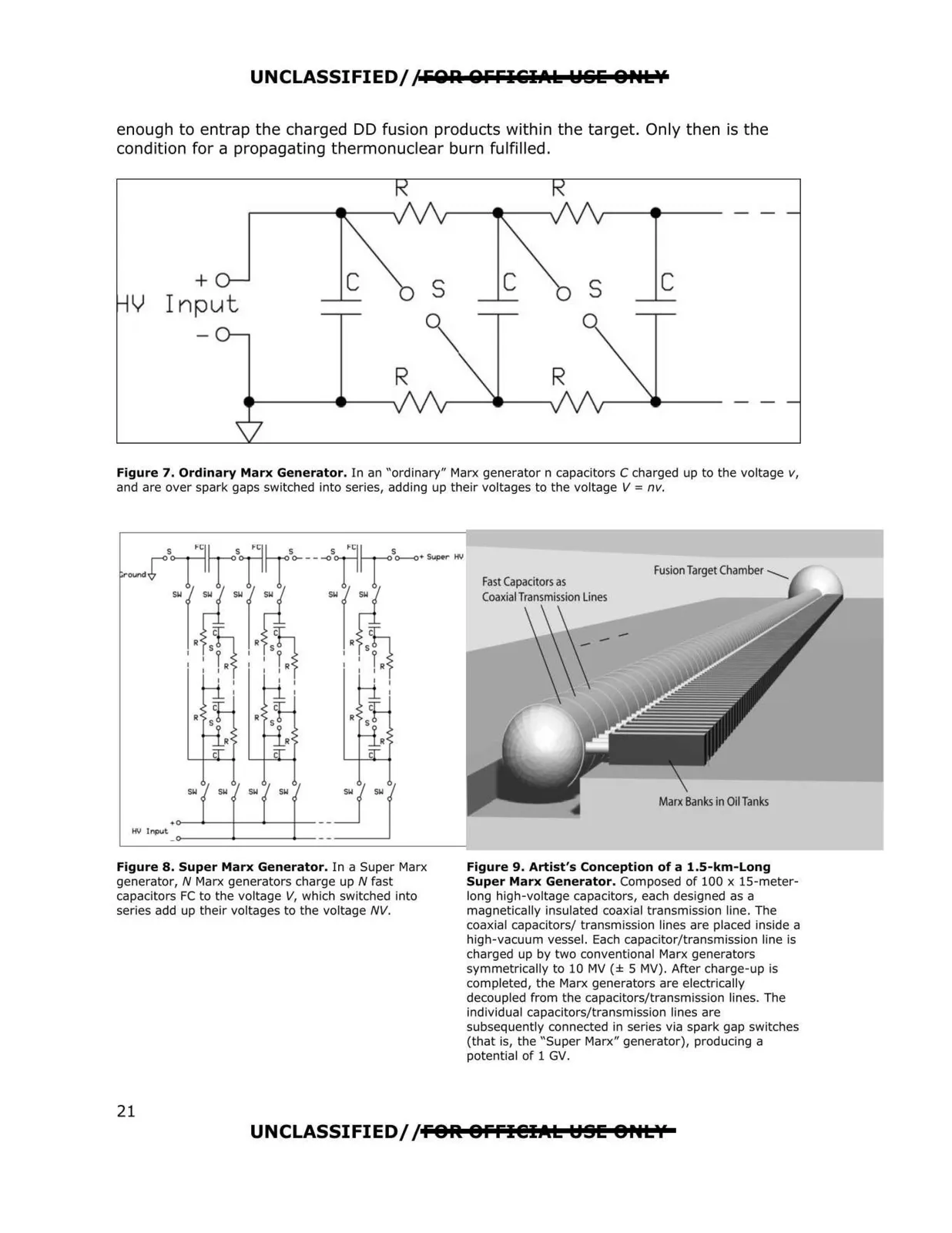
UNCLASSIFIED/,<FOA QFFl&I.t.k WSli 8,.kV enough to entrap the charged DD fusion products within the target. Only then is the condition for a propagating thermonuclear burn fulfilled. + V Input Figure 7. Ordinary Marx Generator. In an "ordinary" Marx generator n capacitors C charged up to the voltage v, and are over spark gaps switched into series, adding up their voltages to the voltage V = nv. s~~s,.;ih-,s s~ h--os ourdr l. I I l. l.11 l. o- -- -o l. I I l. o--o•Su1>4rHII ~ r.a Tij ~ r.a .. I rIRf I rIRf .. ' rI·f I I I I I I Fast Capacitors as Fusion Target Chamber .........__ Coaxial Transmission Lines Figure 8. Super Marx Generator. In a Super Marx generator, N Marx generators charge up N fast capacitors FC to the voltage V, which switched into series add up their voltages to the voltage NV. Figure 9. Artist's Conception of a 1.5-km-Long Super Marx Generator. Composed of 100 x 15-meter long high-voltage capacitors, each designed as a magnetically insulated coaxial transmission line. The coaxial capacitors/ transmission lines are placed inside a high-vacuum vessel. Each capacitor/transmission line is charged up by two conventional Marx generators symmetrically to 10 MV (± 5 MV). After charge-up is completed, the Marx generators are electrically decoupled from the capacitors/transmission lines. The individual capacitors/transmission lines are subsequently connected in series via spark gap switches (that is, the "Super Marx" generator), producing a potential of 1 GV. UNCLASSIFIED//FOR OFFl@IAL Y!H! OHL'/ 21