AAWSAP DIRD, Advanced Nuclear Propulsion for Manned Deep Space Missions, March 2010
DOW-UAP-D126 · page 32 of 37
Text
This text came with the file. It may have mistakes. When the text and the image disagree, the image is right.
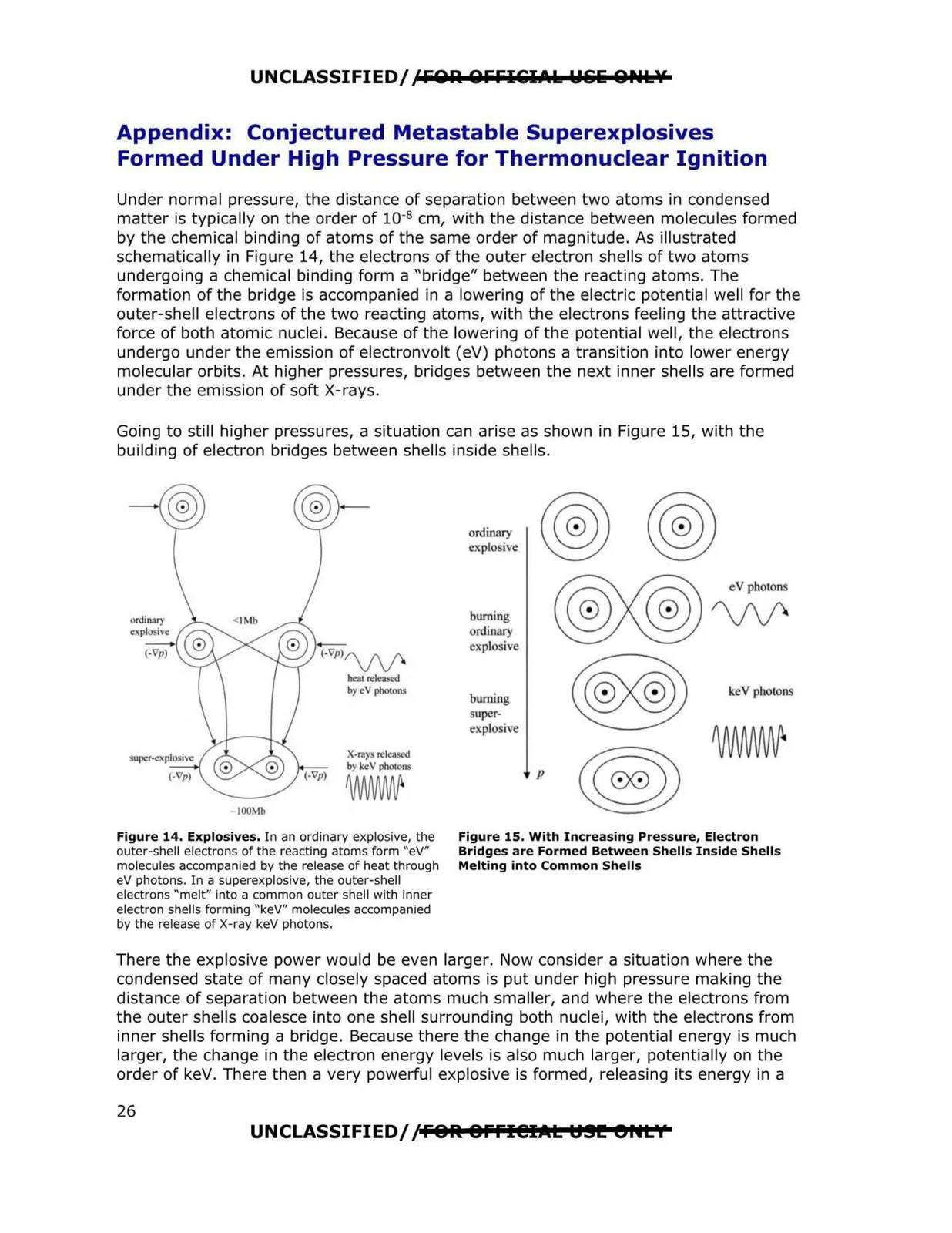
UNCLASSIFIED/fFOA OFFI€1Ak WIiii QNLY Appendix: Conjectured Metastable Superexplosives Formed Under High Pressure for Thermonuclear Ignition Under normal pressure, the distance of separation between two atoms in condensed matter is typically on the order of 10-s cm, with the distance between molecules formed by the chemical binding of atoms of the same order of magnitude. As illustrated schematically in Figure 14, the electrons of the outer electron shells of two atoms undergoing a chemical binding form a "bridge" between the reacting atoms. The formation of the bridge is accompanied in a lowering of the electric potential well for the outer-shell electrons of the two reacting atoms, with the electrons feeling the attractive force of both atomic nuclei. Because of the lowering of the potential well, the electrons undergo under the emission of electronvolt (eV) photons a transition into lower energy molecular orbits. At higher pressures, bridges between the next inner shells are formed under the emission of soft X-rays. Going to still higher pressures, a situation can arise as shown in Figure 15, with the building of electron bridges between shells inside shells. ordinary explosi,c -mys released by keV photoll!I - 100Mb ordinary explosive burning ordinary explosi e burning. super ex plosive p eV photons /\pJ\ keVphotons Figure 14. Explosives. In an ordinary explosive, the Figure 15. With Increasing Pressure, Electron outer-shell electrons of the reacting atoms form "eV" Bridges are Formed Between Shells Inside Shells molecules accompanied by the release of heat through Melting into Common Shells eV photons. In a superexplosive, the outer-shell electrons " melt" into a common outer shell with inner electron shells forming "keV" molecules accompanied by the release of X-ray keV photons. There the explosive power would be even larger. Now consider a situation where the condensed state of many closely spaced atoms is put under high pressure making the distance of separation between the atoms much smaller, and where the electrons from the outer shells coalesce into one shell surrounding both nuclei, with the electrons from inner shells forming a bridge. Because there the change in the potential energy is much larger, the change in the electron energy levels is also much larger, potentially on the order of keV. There then a very powerful explosive is formed, releasing its energy in a UNCLASSIFIED//FOR. 8FFIE!IJltt U:!E fJHL I 26