AAWSAP DIRD, Advanced Nuclear Propulsion for Manned Deep Space Missions, March 2010
DOW-UAP-D126 · page 33 of 37
Text
This text came with the file. It may have mistakes. When the text and the image disagree, the image is right.
UNCLASSIFIED//Pelt 9ffl@IAL YSE er•tlf
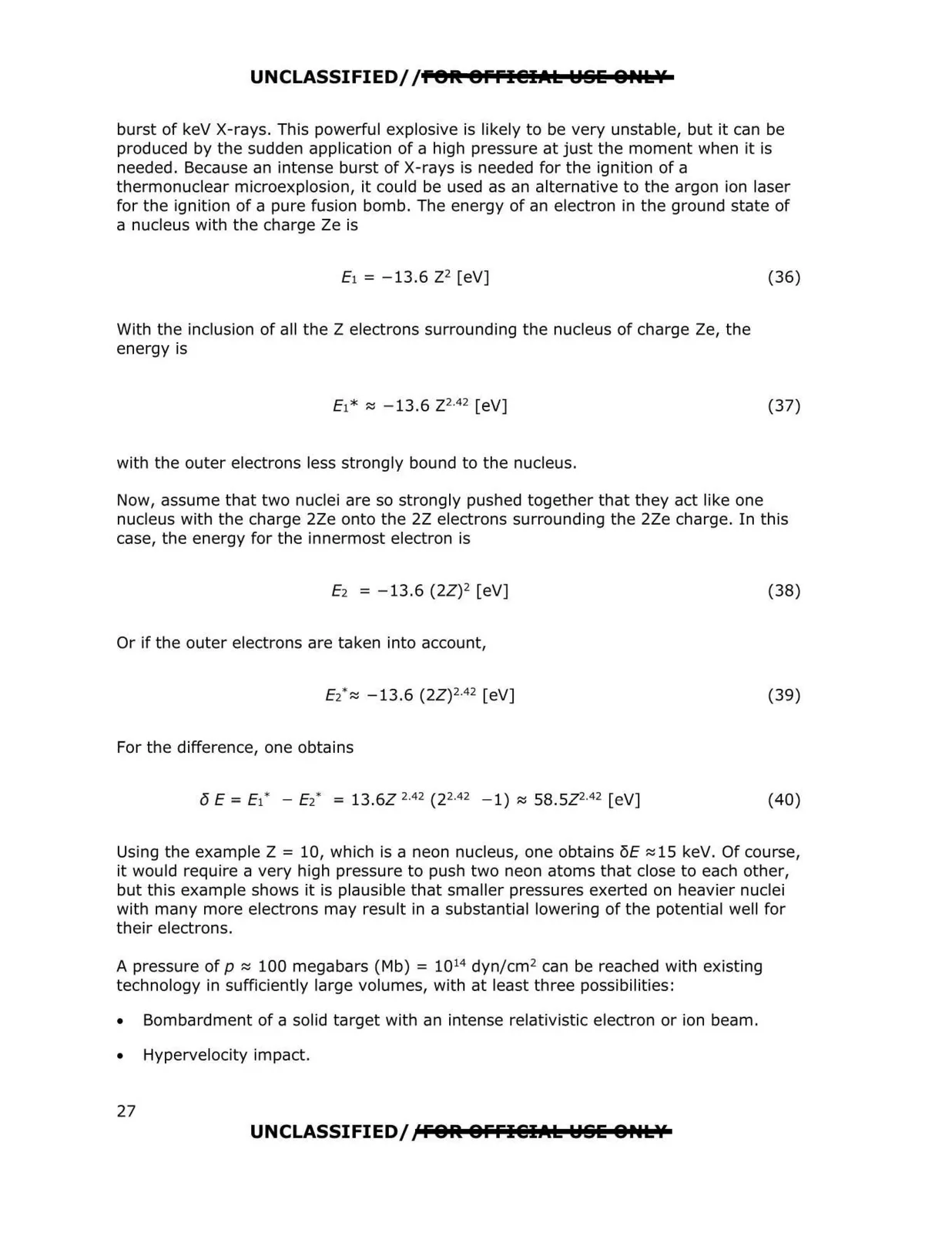
burst of keV X-rays. This powerful explosive is likely to be very unstable, but it can be
produced by the sudden application of a high pressure at just the moment when it is
needed. Because an intense burst of X-rays is needed for the ignition of a
thermonuclear microexplosion, it could be used as an alternative to the argon ion laser
for the ignition of a pure fusion bomb. The energy of an electron in the ground state of
a nucleus with the charge Ze is
Ei = - 13.6 z2 [eV]
(36)
With the inclusion of all the Z electrons surrounding the nucleus of charge Ze, the
energy is
Ei* ~ - 13.6 22.42 [eV]
(37)
with the outer electrons less strongly bound to the nucleus.
Now, assume that two nuclei are so strongly pushed together that they act like one
nucleus with the charge 2Ze onto the 2Z electrons surrounding the 2Ze charge. In this
case, the energy for the innermost electron is
fa = -13.6 (2Z) 2 [eV]
(38)
Or if the outer electrons are taken into account,
fa*~ -13.6 (2Z) 2.42 [eV]
(39)
For the difference, one obtains
o E = E1* -
E2* = 13.6Z 2.42 (2 2.42 -1) ~ 58.SZ2.42 [eV]
(40)
Using the example Z = 10, which is a neon nucleus, one obtains oE ~ 15 keV. Of course,
it would require a very high pressure to push two neon atoms that close to each other,
but this example shows it is plausible that smaller pressures exerted on heavier nuclei
with many more electrons may result in a substantial lowering of the potential well for
their electrons.
A pressure of p ~ 100 megabars (Mb) = 1014 dyn/cm2 can be reached with existing
technology in sufficiently large volumes, with at least three possibilities:
•
Bombardment of a solid target with an intense relativistic electron or ion beam.
•
Hypervelocity impact.
UNCLASSIFIED/;'FOR OFFI@IAL Y§E OHLl/
27