AAWSAP DIRD, An Introduction to the Statistical Drake Equation, March 2010
DOW-UAP-D127 · page 13 of 55
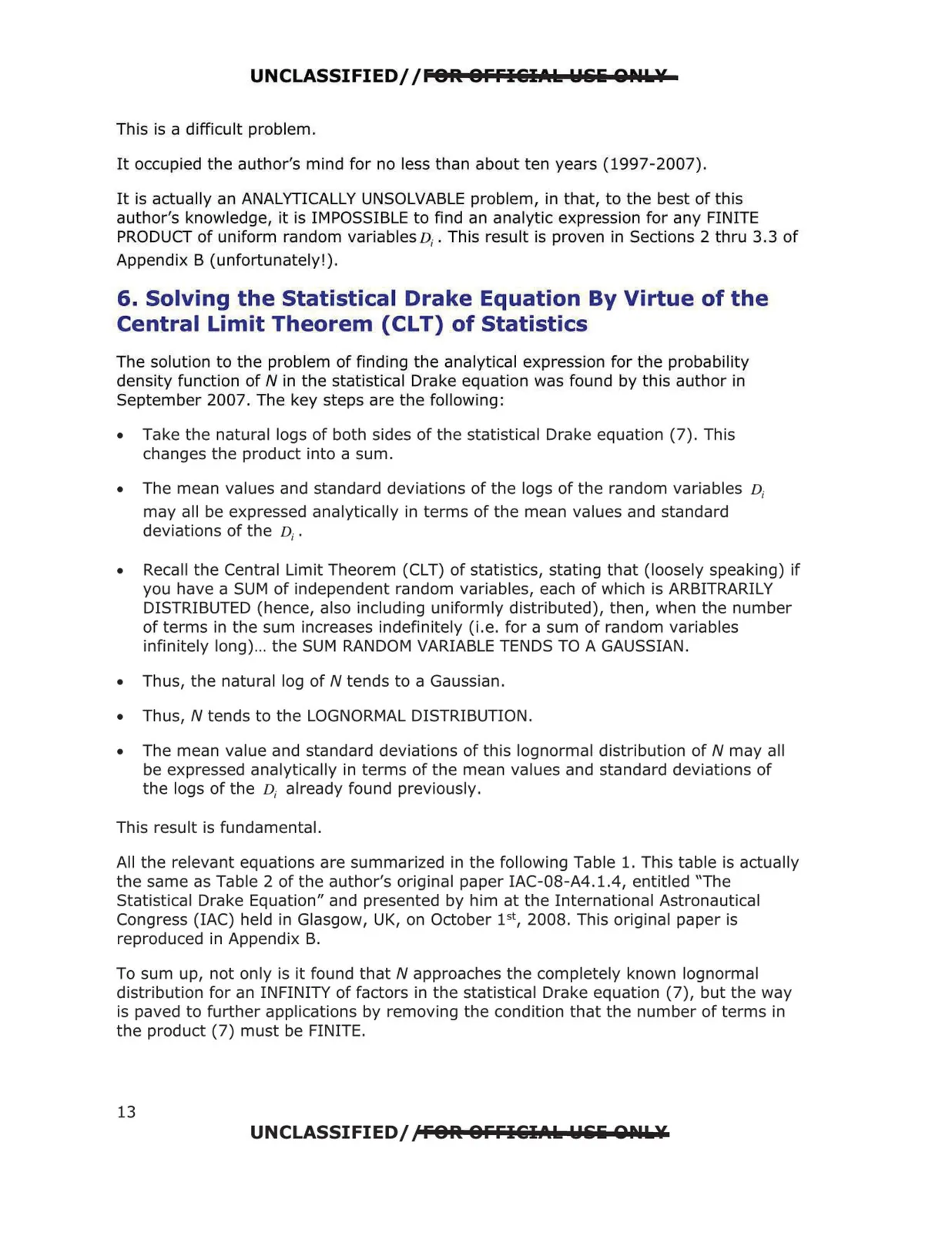
Text
This text came with the file. It may have mistakes. When the text and the image disagree, the image is right.
UNCLASSIFIED//FOR OFFI&I.t.k W~i Q~lk¥
This is a difficult problem.
It occupied the author's mind for no less than about ten years (1997-2007).
It is actually an ANALYTICALLY UNSOLVABLE problem, in that, to the best of this
author's knowledge, it is IMPOSSIBLE to find an analytic expression for any FINITE
PRODUCT of uniform random variablesD; . This result is proven in Sections 2 thru 3.3 of
Appendix B (unfortunately!) .
6. Solving the Statistical Drake Equation By Virtue of the
Central Limit Theorem (CLT) of Statistics
The solution to the problem of finding the analytical expression for the probability
density function of N in the statistical Drake equation was found by this author in
September 2007. The key steps are the following:
•
Take the natural logs of both sides of the statistical Drake equation (7). This
changes the product into a sum.
•
The mean values and standard deviations of the logs of the random variables D;
may all be expressed analytically in terms of the mean values and standard
deviations of the D; .
•
Recall the Central Limit Theorem (CLT) of statistics, stating that (loosely speaking) if
you have a SUM of independent random variables, each of which is ARBITRARILY
DISTRIBUTED (hence, also including uniformly distributed), then, when the number
of terms in the sum increases indefinitely (i.e. for a sum of random variables
infinitely long) .. . the SUM RANDOM VARIABLE TENDS TO A GAUSSIAN.
•
Thus, the natural log of N tends to a Gaussian.
•
Thus, N tends to the LOGNORMAL DISTRIBUTION.
•
The mean value and standard deviations of this lognormal distribution of N may all
be expressed analytically in terms of the mean values and standard deviations of
the logs of the D, already found previously.
This result is fundamental.
All the relevant equations are summarized in the following Table 1. This table is actually
the same as Table 2 of the author's original paper IAC-08-A4.1.4, entitled "The
Statistical Drake Equation" and presented by him at the International Astronautical
Congress (IAC) held in Glasgow, UK, on October l5t, 2008. This original paper is
reproduced in Appendix B.
To sum up, not only is it found that N approaches the completely known lognormal
distribution for an INFINITY of factors in the statistical Drake equation (7), but the way
is paved to further applications by removing the condition that the number of terms in
the product (7) must be FINITE.
UNCLASSIFIED//FOR 8FFI&l.t.k Wii QNk¥
13