AAWSAP DIRD, An Introduction to the Statistical Drake Equation, March 2010
DOW-UAP-D127 · page 18 of 55
Text
This text came with the file. It may have mistakes. When the text and the image disagree, the image is right.
UNCLASSIFIED//FOR OFFIEil.t.k Wii Q~lls¥
8. Finding the Probability Distribution of the Et-Distance By
Virtue of the Statistical Drake Equation
Having solved the statistical Drake equation by finding the lognormal distribution, we
are now in a position to solve the ET-DISTANCE problem by resorting to statistics again,
rather than just to the purely deterministic Distance Law (5), as we did in Section 2.
This is "scientifically more serious" than just the purely deterministic Distance Law (5)
inasmuch as the new statistical Distance Law will yield a PROBABILITY DENSITY for the
Distance, with the relevant mean value and standard deviation. In other words, the
Distance Law (5) itself becomes a random variable whose probability distribution, mean
value and standard deviation must be computed by "replacing" into (5) the fact that N
is now known to follow the lognormal distribution. This is mathematically described in
detail in Section 7 of Appendix A.
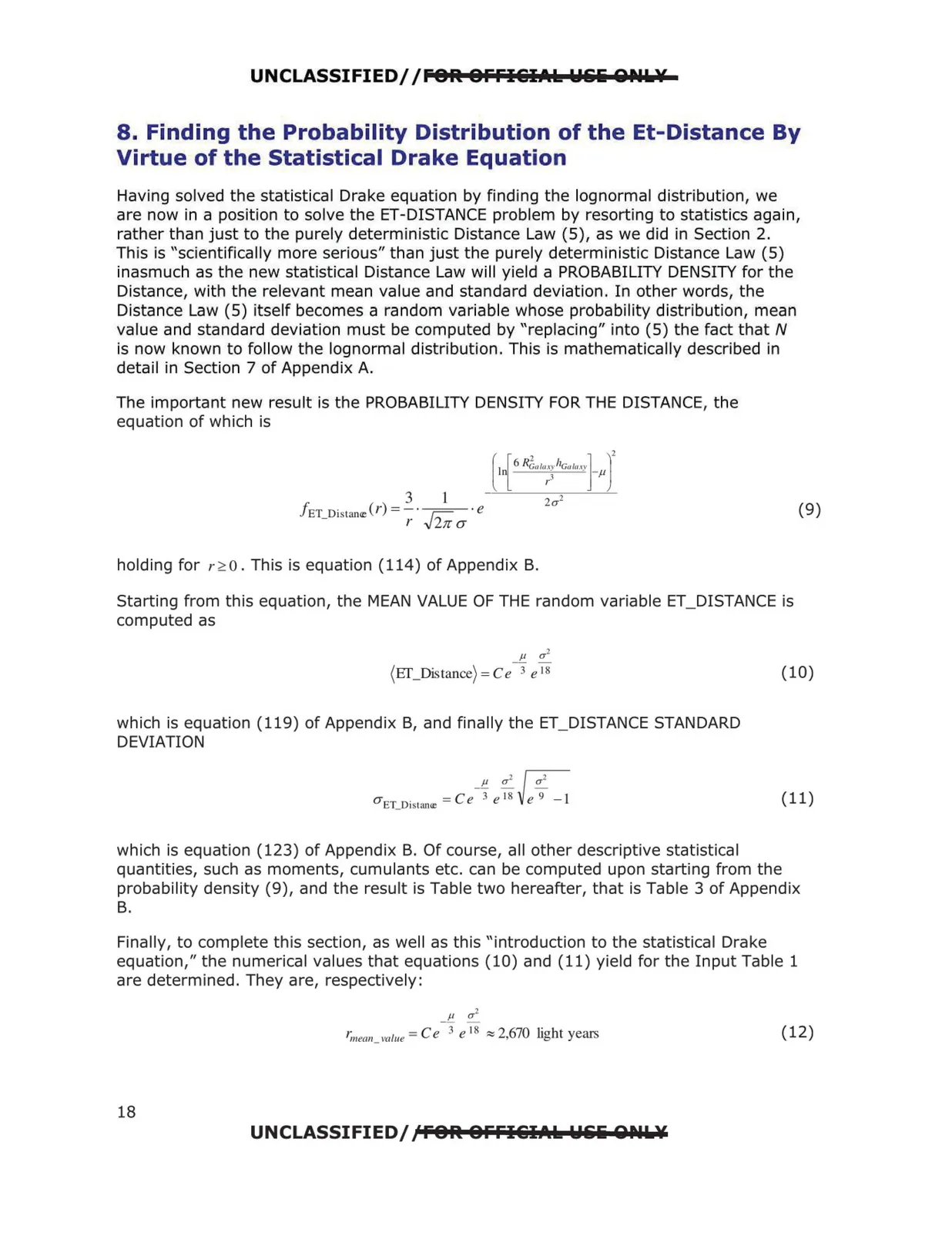
The important new result is the PROBABILITY DENSITY FOR THE DISTANCE, the
equation of which is
(9)
holding for r ;,: O. This is equation (114) of Appendix B.
Starting from this equation, the MEAN VALUE OF THE random variable ET_DISTANCE is
computed as
J.I
cr2
(Er_Distance) =Ce3 e""jg
(10)
which is equation (119) of Appendix B, and finally the ET_DISTANCE STANDARD
DEVIATION
_!!. a2Kr2
-
3
18
9
CJ ET_Distanu: - Ce
e
e
- l
(11)
which is equation ( 123) of Appendix B. Of course, all other descriptive statistical
quantities, such as moments, cumulants etc. can be computed upon starting from the
probability density (9), and the result is Table two hereafter, that is Table 3 of Appendix
B.
Finally, to complete this section, as well as this "introduction to the statistical Drake
equation," the numerical values that equations (10) and (11) yield for the Input Table 1
are determined. They are, respectively:
_}!_
CTl
r,11ea11 _ m lue =Ce 3 e 18 ;::: 2,670 light years
(12)
UNCLASSIFIED//FOR OFFIEil.t.k Wii QNls¥
18