AAWSAP DIRD, An Introduction to the Statistical Drake Equation, March 2010
DOW-UAP-D127 · page 17 of 55
Text
This text came with the file. It may have mistakes. When the text and the image disagree, the image is right.
UNCLASSIFIED/ /FOR OFFI&IAk Wlii QPU,¥
(]''
surprised to find out that it equals (N) = e11 e2 ::::: 4589 .559 ~ 4590 communicating
civilizations now in the galaxy. This is the important number, and it is HIGHER than the
3500 provided by the classical Drake equation. Thus, in conclusion, THE STATISTICAL
EXTENSION of the classical Drake equation INCREASES OUR HOPES to find an
extraterrestriaI civiIization !
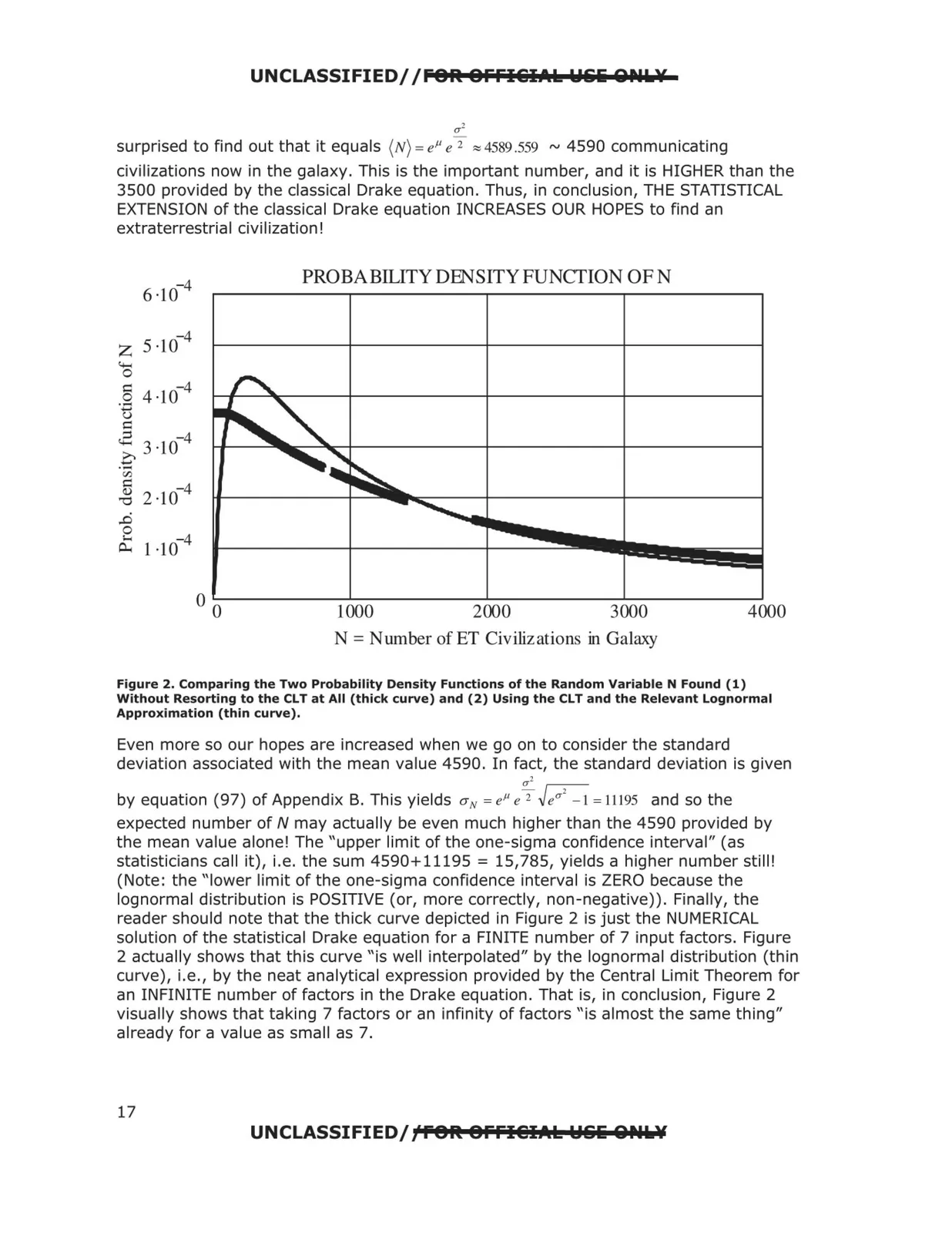
PROBABILITY DENSITY FUNCTION OF N
1000
2000
3000
4000
N = Number of ET Civilizations in Galaxy
Figure 2. Comparing the Two Probability Density Functions of the Random Variable N Found (1)
Without Resorting to the CLT at All (thick curve) and (2) Using the CLT and the Relevant Lognormal
Approximation (thin curve).
Even more so our hopes are increased when we go on to consider the standard
deviation associated with the mean value 4590. In fact, the standard deviation is given
,,.,
by equation (97) of Appendix B. This yields er"' = e11 e2 ✓e"
2 -1 =11195 and so the
expected number of N may actually be even much higher than the 4590 provided by
the mean value alone! The "upper limit of the one-sigma confidence interval" (as
statisticians call it), i.e. the sum 4590+11195 = 15,785, yields a higher number still!
(Note: the "lower limit of the one-sigma confidence interval is ZERO because the
lognormal distribution is POSITIVE (or, more correctly, non-negative)). Finally, the
reader should note that the thick curve depicted in Figure 2 is just the NUMERICAL
solution of the statistical Drake equation for a FINITE number of 7 input factors. Figure
2 actually shows that this curve "is well interpolated" by the lognormal distribution (thin
curve), i.e., by the neat analytical expression provided by the Central Limit Theorem for
an INFINITE number of factors in the Drake equation. That is, in conclusion, Figure 2
visually shows that taking 7 factors or an infinity of factors "is almost the same thing"
already for a value as small as 7.
UNCLASSIFIED/ /FOil OFFI@IAb W&i QNI.¥
17