AAWSAP DIRD, An Introduction to the Statistical Drake Equation, March 2010
DOW-UAP-D127 · page 22 of 55
Text
This text came with the file. It may have mistakes. When the text and the image disagree, the image is right.
UNCLASSIFIED/ /fOR OFFI&IAk Wlii QPU,¥
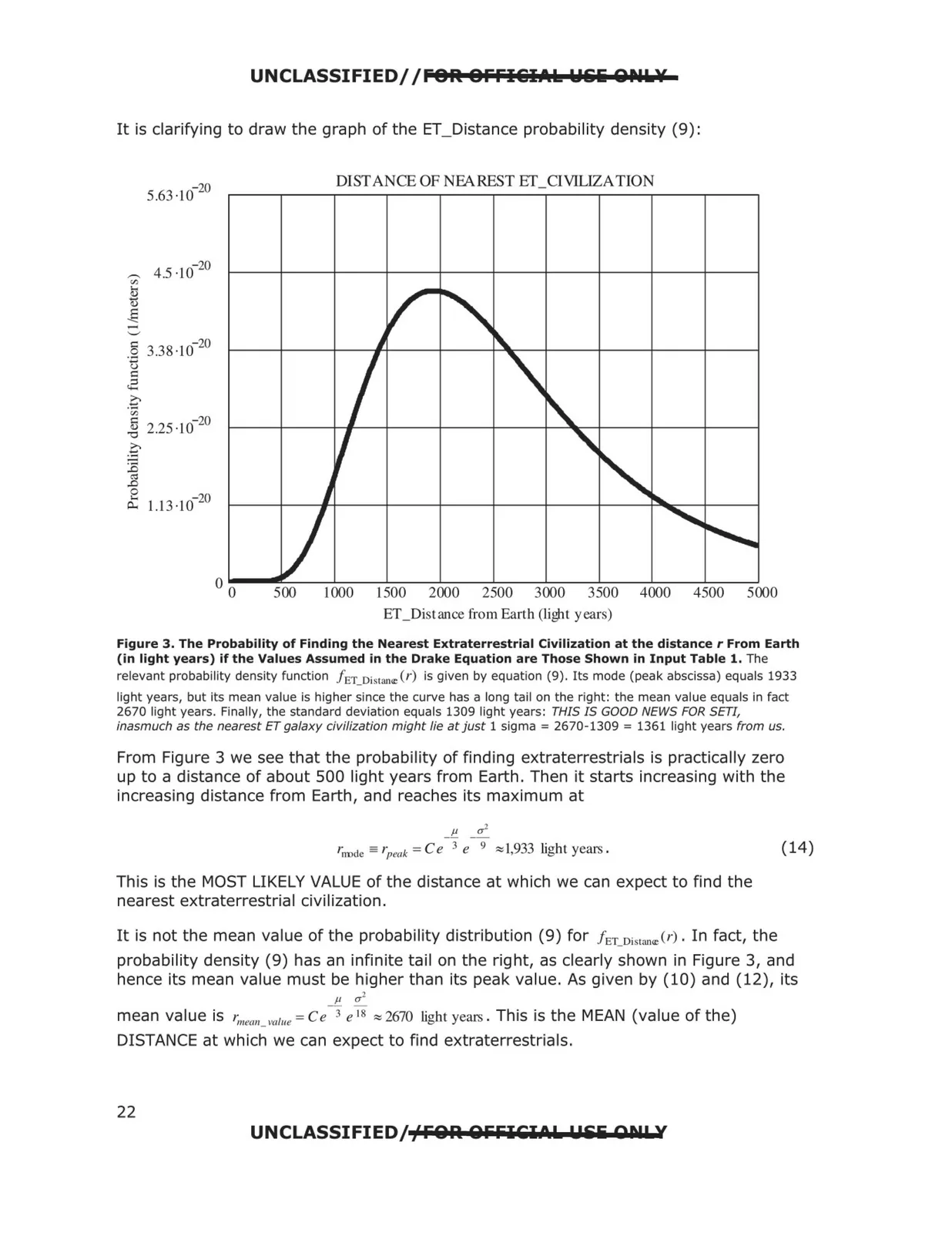
It is clarifying to draw the graph of the ET_Distance probability density (9):
DISTANCE OF NEAREST Ef_CIVILIZA TION
5.63 ·10-20
500
1000
1500
2000
2500
3000
3500
4000
4500
5000
ET _Distance from Earth (light years)
Figure 3. The Probability of Finding the Nearest Extraterrestrial Civilization at the distance r From Earth
(in light years) if the Values Assumed in the Drake Equation are Those Shown in Input Table 1. The
relevant probability density function fET_Disian.,( r) is given by equation (9). Its mode (peak abscissa) equals 1933
light years, but its mean value is higher since the curve has a long tail on the right: the mean value equals in fact
2670 light years. Finally, the standard deviation equals 1309 light years: THIS IS GOOD NEWS FOR SETI,
inasmuch as the nearest ET galaxy civilization might lie at just 1 sigma = 2670-1309 = 1361 light years from us.
From Figure 3 we see that the probability of finding extraterrestrials is practically zero
up to a distance of about 500 light years from Earth. Then it starts increasing with the
increasing distance from Earth, and reaches its maximum at
_l!_ ~
r=de = r peak = Ce 3 e 9 :::: 1,933 light years.
(14)
This is the MOST LIKELY VALUE of the distance at which we can expect to find the
nearest extraterrestrial civilization.
It is not the mean value of the probability distribution (9) for fET_Distan.,( r). In fact, the
probability density (9) has an infinite tail on the right, as clearly shown in Figure 3, and
hence its mean value must be higher than its peak value. As given by (10) and (12), its
....!:!..
0'2
mean value is r,,,en,,_mlue = Ce 3 e 18 c::,2670 light years. This is the MEAN (value of the)
DISTANCE at which we can expect to find extraterrestrials.
UNCLASSIFIED/ ;'FQA QFFICiIPL. !Iii 011! Y
22