AAWSAP DIRD, An Introduction to the Statistical Drake Equation, March 2010
DOW-UAP-D127 · page 23 of 55
Text
This text came with the file. It may have mistakes. When the text and the image disagree, the image is right.
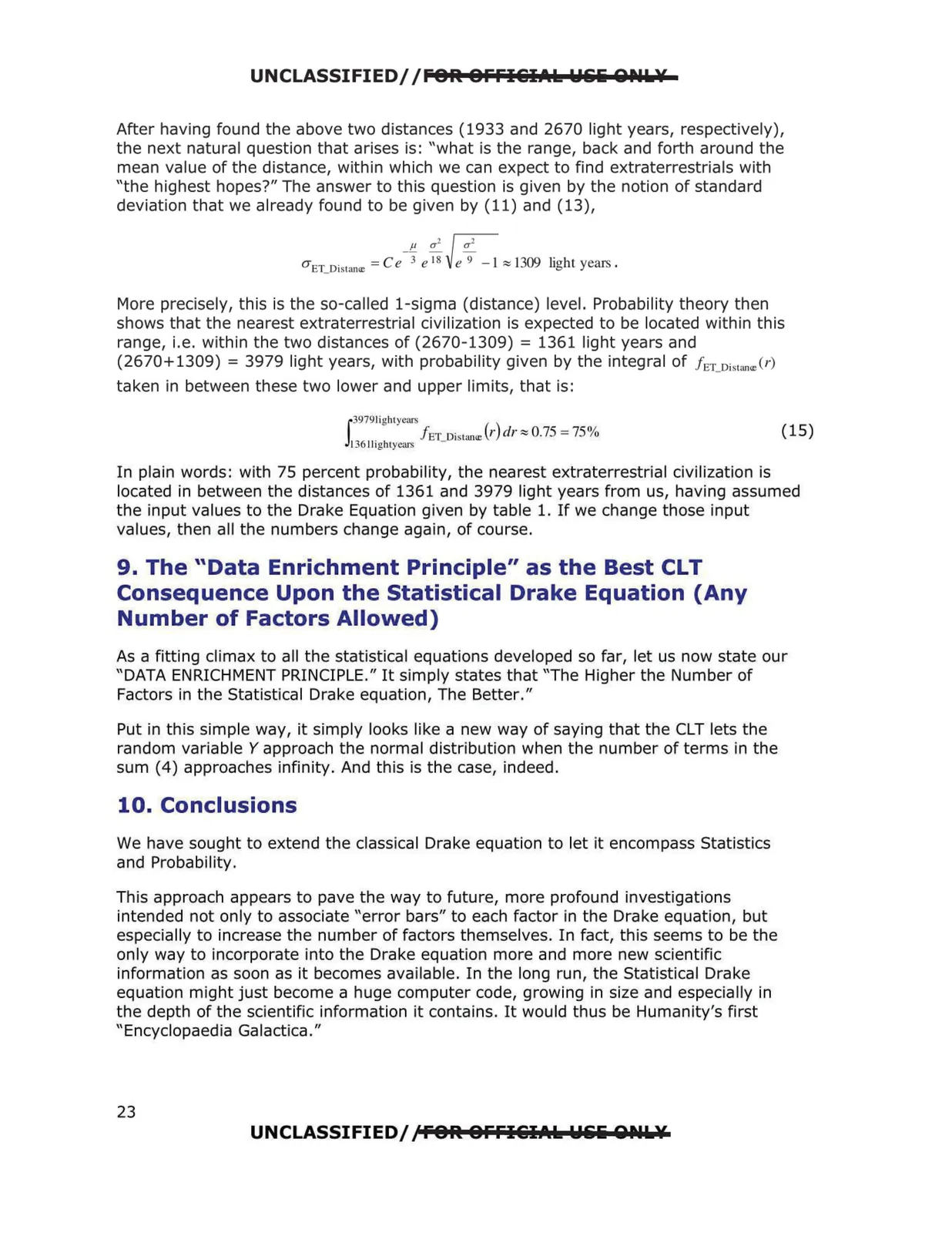
UNCLASSIFIED//FOR OFFIEiIAk Wlii QPU,¥ After having found the above two distances (1933 and 2670 light years, respectively), the next natural question that arises is: "what is the range, back and forth around the mean value of the distance, within which we can expect to find extraterrestrials with "the highest hopes?" The answer to this question is given by the notion of standard deviation that we already found to be given by (11) and (13), I' 0'2 ~ CTET_Distance = Ce 3 e •8 Ve 9 -1 ""1309 light years . More precisely, this is the so-called 1-sigma (distance) level. Probability theory then shows that the nearest extraterrestrial civilization is expected to be located within this range, i.e. within the two distances of (2670-1309) = 1361 light years and (2670+1309) = 3979 light years, with probability given by the integral of fET_oistance(r) taken in between these two lower and upper limits, that is: i 3979 1igh1 years fET Disiance (r) dr:::: 0.75 = 75 % (15) l36 1 ligbtycars In plain words: with 75 percent probability, the nearest extraterrestrial civilization is located in between the distances of 1361 and 3979 light years from us, having assumed the input values to the Drake Equation given by table 1. If we change those input values, then all the numbers change again, of course. 9. The "Data Enrichment Principle" as the Best CLT Consequence Upon the Statistical Drake Equation (Any Number of Factors Allowed) As a fitting climax to all the statistical equations developed so far, let us now state our "DATA ENRICHMENT PRINCIPLE." It simply states that "The Higher the Number of Factors in the Statistical Drake equation, The Better." Put in this simple way, it simply looks like a new way of saying that the CLT lets the random variable Y approach the normal distribution when the number of terms in the sum (4) approaches infinity. And this is the case, indeed. 10. Conclusions We have sought to extend the classical Drake equation to let it encompass Statistics and Probability. This approach appears to pave the way to future, more profound investigations intended not only to associate "error bars" to each factor in the Drake equation, but especially to increase the number of factors themselves. In fact, this seems to be the only way to incorporate into the Drake equation more and more new scientific information as soon as it becomes available. In the long run, the Statistical Drake equation might just become a huge computer code, growing in size and especially in the depth of the scientific information it contains. It would thus be Humanity's first "Encyclopaedia Galactica." UNCLASSIFIED//FOR OFFIEiIAk Wlii QPlls¥ 23