AAWSAP DIRD, An Introduction to the Statistical Drake Equation, March 2010
DOW-UAP-D127 · page 29 of 55
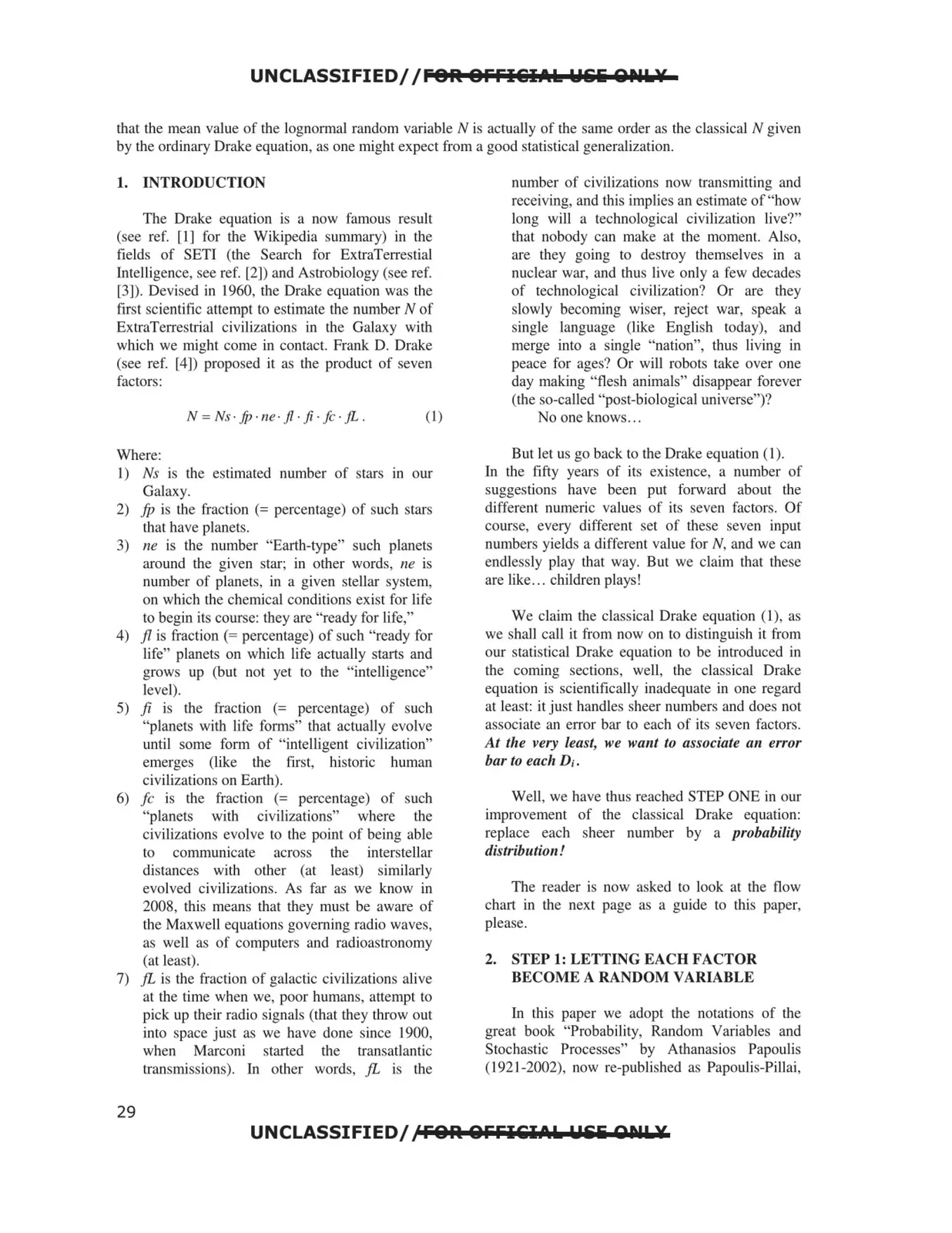
Text
This text came with the file. It may have mistakes. When the text and the image disagree, the image is right.
UNCLASSIFIED/ /fOR OFFI&IAk Wlii QPU,¥
that the mean value of the lognormal random variable N is actually of the same order as the classical N given
by the ordinary Drake equation, as one might expect from a good statistical generalization.
1. INTRODUCTION
The Drake equation is a now famous result
(see ref. [1] for the Wikipedia summary) in the
fields of SETI (the Search for ExtraTetTestial
Intelligence, see ref. [2]) and Astrobiology (see ref.
[3]). Devised in l 960, the Drake equation was the
first scientific attempt to estimate the number N of
ExtraTerrestrial civilizations in the Galaxy with
which we might come in contact. Frank D. Drake
(see ref. [4]) proposed it as the product of seven
factors:
N=Ns-fp-ne·fl·fi·fc·fL.
(1)
Where:
I) Ns is the estimated number of stars in our
Galaxy.
2) fp is the fraction (= percentage) of such stars
that have planets.
3) ne is the number "Earth-type" such planets
around the given star; in other words, ne is
number of planets, in a given stellar system,
on which the chemical conditions exist for life
to begin its course: they are "ready for life,"
4) fl is fraction(= percentage) of such "ready for
life" planets on which life actually starts and
grows up (but not yet to the "intelligence"
level).
5) fl is the fraction (= percentage) of such
"planets with life fom1S" that actually evolve
until some form of "intelligent civilization"
emerges
(like
the first, historic
human
civilizations on Earth).
6) Jc is the fraction (= percentage) of such
"planets
with
civilizations"
where
the
civilizations evolve to the point of being able
to
communicate
across
the
interstellar
distances with other (at least) similarly
evolved civilizations. As far as we know in
2008, this means that they must be aware of
the Maxwell equations governing radio waves,
as well as of computers and radioastronomy
(at least).
7) fl is the fraction of galactic civilizations alive
at the time when we, poor humans, attempt to
pick up their radio signals (that they throw out
into space just as we have done since l 900,
when
Marconi
started
the
transatlantic
transmissions). In other words, fl is the
number of civilizations now transmitting and
receiving, and this implies an estimate of"how
long will a technological civilization live?"
that nobody can make at the moment. Also,
are they going to destroy themselves in a
nuclear war, and thus live only a few decades
of technological civilization? Or are they
slowly becoming wiser, reject war, speak a
single language (like English today), and
merge into a single "nation", thus living in
peace for ages? Or will robots take over one
day making "flesh animals" disappear forever
(the so-called "post-biological universe")?
No one knows ...
But let us go back to the Drake equation (1).
In the fifty years of its existence, a number of
suggestions have been put forward about the
different numeric values of its seven factors. Of
course, every different set of these seven input
numbers yields a different value for N, and we can
endlessly play that way. But we claim that these
are like ... children plays!
We claim the classical Drake equation (1), as
we shall call it from now on to distinguish it from
our statistical Drake equation to be introduced in
the coming sections, well, the classical Drake
equation is scientifically inadequate in one regard
at least: it just handles sheer numbers and does not
associate an error bar to each of its seven factors.
At the very least, we want to associate an error
bar to each D;.
Well, we have thus reached STEP ONE in our
improvement of the classical Drake equation:
replace each sheer number by a probability
distribution!
The reader is now asked to look at the flow
chart in the next page as a guide to this paper,
please.
2. STEP 1: LETTING EACH FACTOR
BECOME A RANDOM VARIABLE
In this paper we adopt the notations of the
great book "Probability, Random Variables and
Stochastic Processes" by Athanasios Papoulis
(1921-2002), now re-published as Papoulis-Pillai,
UNCLASSIFIED/ ,'FOR: QFFIGI CL. Wii ODIL:¥
29