AAWSAP DIRD, An Introduction to the Statistical Drake Equation, March 2010
DOW-UAP-D127 · page 30 of 55
Text
This text came with the file. It may have mistakes. When the text and the image disagree, the image is right.
UNCLASSIFIED/ /fOR OFFI&IAk Wlii QPU,¥
ref. [5]. The advantage of this notation is that it
makes a neat distinction between probabilistic ( or
statistical: it's the same thing here) variables,
always denoted by capitals, from non-probabilistic
(or "detenninistic") variables, always denoted by
lower-case letters. Adopting the Papoulis notation
also is a tribute to him by this author, who was a
Fulbright Grantee in the United States with him at
the
Polytechnic
[nstitute
(now
Polytechnic
University) of New York in the years 1977-78-79.
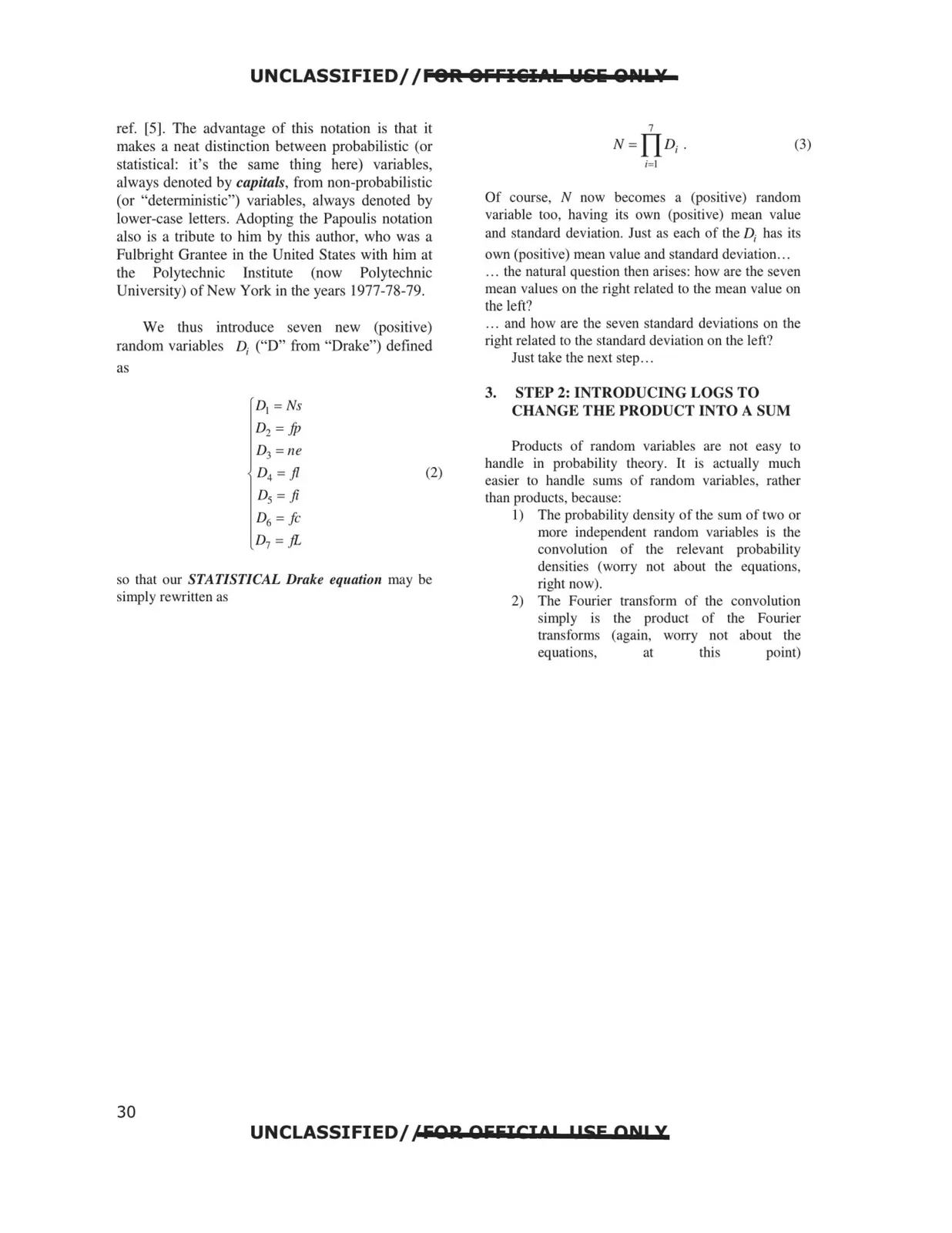
We thus introduce seven new (positive)
random variables D; ("D" from "Drake") defined
as
D1 = Ns
D2 =fp
D3 =ne
D4 = fl
(2)
Ds =fl
D6 =Jc
D7 =fL
so that our STATISTICAL Drake equation may be
simply rewritten as
(3)
Of course, N now becomes a (positive) random
variable too, having its own (positive) mean value
and standard deviation. Just as each of the D; has its
own (positive) mean value and standard deviation ...
... the natural question then arises: how are the seven
mean values on the right related to the mean value on
the left?
... and how are the seven standard deviations on the
right related to the standard deviation on the left?
Just take the next step ...
3.
STEP 2: INTRODUCING LOGS TO
CHANGE THE PRODUCT INTO A SUM
Products of random variables are not easy to
handle in probability theory. It is actually much
easier to handle sums of random variables, rather
than products, because:
1) The probability density of the sum of two or
more independent random variables is the
convolution of the relevant probabifay
densities (worry not about the equations,
right now).
2) The Fourier transform of the convolution
simply is the product of the Fourier
transforms (again, worry not about the
equations,
at
this
point)
UNCLASSIFIED//EOR OFFICIO! !!SF ON! X
30