AAWSAP DIRD, An Introduction to the Statistical Drake Equation, March 2010
DOW-UAP-D127 · page 49 of 55
Text
This text came with the file. It may have mistakes. When the text and the image disagree, the image is right.
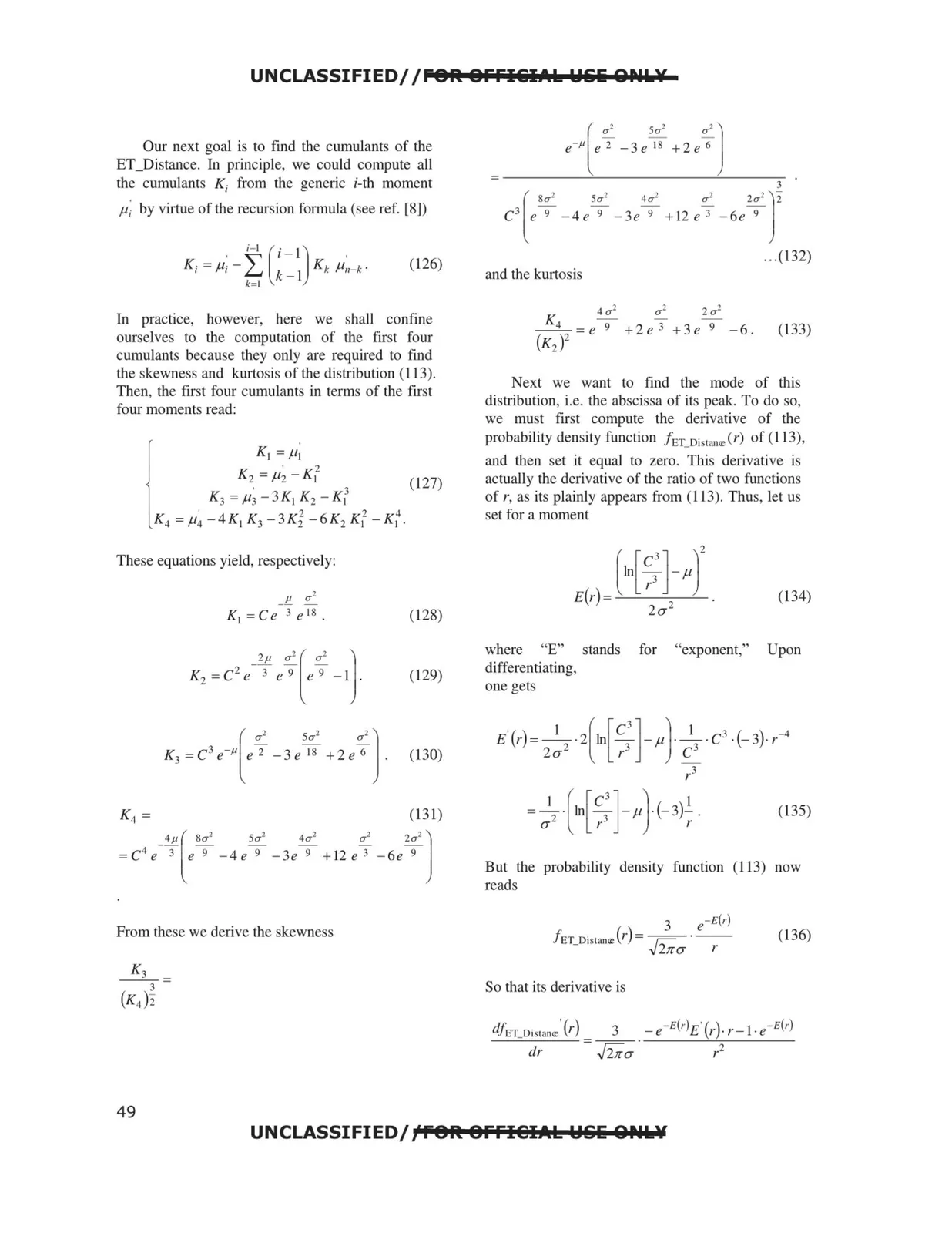
3 UNCLASSIFIED/ /FOR OFFI&IAk Wlii QPU,¥ a 2 5,,.2 a'] Our next goal is to find the cumulants of the e- P[ e 2 - 3 e 18 + 2 e 6 ET _Di stance. 1n principle, we could compute all the cumulants K; from the generic i-th moment µ; by virtue of the recursion formula (see ref. [8]) ' i- 1 ( i -1) ' (126) k=i k - 1 K; = JI; -z: Kk J.111-k · ln practice, however, here we shall confine ourselves to the computation of the fust four cumulants because they only are required to find the skewness and kurtosis of the distribution ( 113). Then, the first four cumulants in terms of the first four moments read: These equations yield, respectively: _!!_ a 2 K .=Ce3el8_ (128) (129) (130) Sa ' 5a2 4a2 a 2 2a2 ]2 C3 [ e- 9- -4e9 -3e9 +12 e3 -6e_9_ ... (132) and the kurtosis 4 0"2 2 a 2 K (K 4)2 =e 9 +2e 3 +3e 9 -6 . (133) 2 Next we want to find the mode of this distribution, i.e. the abscissa of its peak. To do so, we must fust compute the derivative of the probability density function fET_Oistame(r) of (113), and then set it equal to zero. This derivative is actually the derivative of the ratio of two functions of r, as its plainly appears from (113). Thus, let us set for a moment (134) where "E" stands for "exponent," Upon differentiating, one gets (13 1) = - 1 •[ln[£.] - µ)·(- 3).!.. (135) c,2 ,-3 ,. 2 4a2 4p [ sa 5a2 a' 2a'] =C4 e-3 e- 9- -4 e- 9- - 3e_9_ + 12 e3 - 6e_9_ But the probability density function (113) now reads 3 e-E(r) From these we derive the skewness fET Distana:(r)= ~ ·-- (136) - ..,;2,rc, r So that its derivative is dfET_Disiana:, (r) 3 -e- E(r) E' (r)· r-1 ·e- E(r) dr = &a. ,.2 UNCLASSIFIED//POil OFFI@IAb W&I! 91'11.¥ 49