AAWSAP DIRD, An Introduction to the Statistical Drake Equation, March 2010
DOW-UAP-D127 · page 48 of 55
Text
This text came with the file. It may have mistakes. When the text and the image disagree, the image is right.
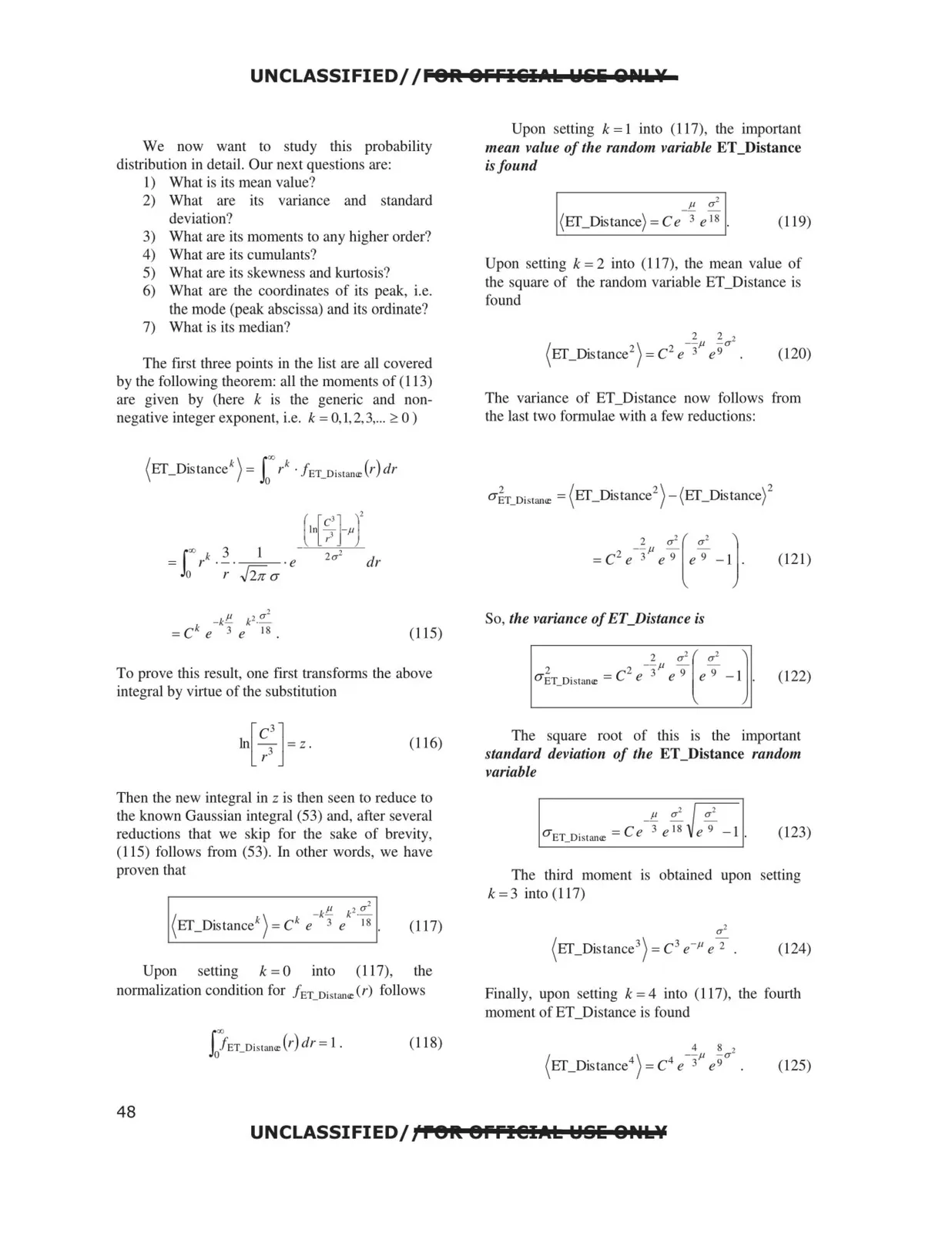
UNCLASSIFIED/ /fOR OFFI&IAk Wlii QPU,¥ We now want to study this probability distribution in detail. Our next questions are: l) What is its mean value? 2) What are its variance and standard deviation? 3) What are its moments to any higher order? 4) What are its cumulants? 5) What are its skewness and kurtosis? 6) What are the coordinates of its peak, i.e. the mode (peak abscissa) and its ordinate? 7) What is its median? The first three points in the list are all covered by the following theorem: all the moments of ( 113) are given by (here k is the generic and non negative integer exponent, i.e. k = 0, I, 2, 3, ... ~ 0) (Er_Distance*) = f' / ·f ET_Distana,(r)dr (1n[ ~ ]-µr dr =fr*-r~(T -e (115) To prove this result, one first transforms the above integral by virtue of the substitution (116) Then the new integral in z is then seen to reduce to the known Gaussian integral (53) and, after several reductions that we skip for the sake of brevity, (115) follows from (53). In other words, we have proven that µ 2 (J2 (Er_Distancek) = Ck e - k3 / •18 . (117) Upon setting k = 0 into (117), the normalization condition for f ET_Distan"' (r) follows if ET Distame(r)dr = l . (118) 0 Upon setting k = l into (117), the important mean val11e of the random variable ET_Distance isfo1111d f.-l a z (Ef_Distance) =Ce3 e18 . (119) Upon setting k = 2 into (l 17), the mean value of the square of the random variable ET _Distance is found 2 2 2 - p - (1 (Ef_Distance2 ) = C2 e 3 e 9 (120) The variance of ET_Distance now follows from the last two formulae with a few reductions: CT~T_Distan"' = (Ef_Distance2 )-(Ef_Distance)2 (121) So, the variance ofET_Distance is (122) The square root of this is the important standard deviation of the ET_Distance random variable _f!_ (11 ,-;i- (TET_Di S(ana, =C e 3 e• 8 ~e9 -1 . (123) The third moment is obtained upon setting k = 3 into ( 117) (12 (Er_Distance3 ) = C3 e-p e2 (124) Finally, upon setting k =4 into ( 117), the fourth moment of ET _Distance is found 4 8 l (Er_Distance4)=C4 e3 -µ e9(1 (125) UNCLASSIFIED//POR 9Pfl@IAL H§E 8PUs:¥ 48