AAWSAP DIRD, An Introduction to the Statistical Drake Equation, March 2010
DOW-UAP-D127 · page 5 of 55
Text
This text came with the file. It may have mistakes. When the text and the image disagree, the image is right.
UNCLASSIFIED//fOR OFFI&IAk Wlii QPU,¥
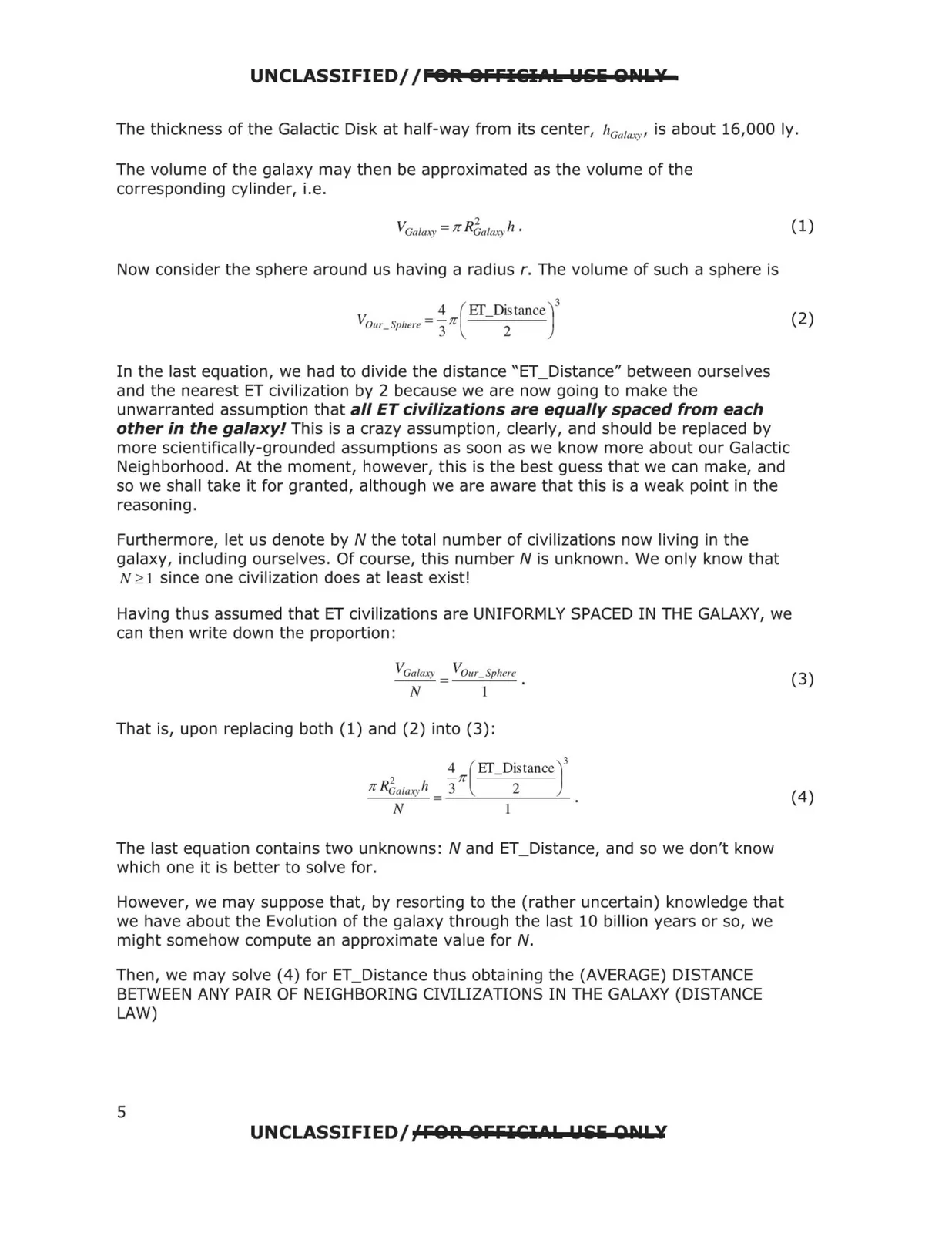
The thickness of the Galactic Disk at half-way from its center, h a " 1t'-'Y ' is about 16,000 ly.
The volume of the galaxy may then be approximated as the volume of the
corresponding cylinder, i.e.
(1)
Now consider the sphere around us having a radius r. The volume of such a sphere is
4 ( Ef Distance) 3
Vo ur _ Sphere = 3n
-
(2)
2
In the last equation, we had to divide the distance "ET _Distance" between ourselves
and the nearest ET civilization by 2 because we are now going to make the
unwarranted assumption that all ET civilizations are equally spaced from each
other in the galaxy! This is a crazy assumption, clearly, and should be replaced by
more scientifically-grounded assumptions as soon as we know more about our Galactic
Neighborhood. At the moment, however, this is the best guess that we can make, and
so we shall take it for granted, although we are aware that this is a weak point in the
reasoning.
Furthermore, let us denote by N the total number of civilizations now living in the
galaxy, including ourselves. Of course, this number N is unknown. We only know that
N ~ 1 since one civilization does at least exist!
Having thus assumed that ET civilizations are UNIFORMLY SPACED IN THE GALAXY, we
can then write down the proportion:
Va a/a.,y
Vo ,,r_Sphere
-- = -~-
(3)
N
That is, upon replacing both (1) and (2) into (3):
3
4 ( Ef- Dis lance )
2
-
i'l" _ ___
i'l" RGa/axy h = 3
2
(4)
N
1
The last equation contains two unknowns: N and ET_Distance, and so we don't know
which one it is better to solve for.
However, we may suppose that, by resorting to the (rather uncertain) knowledge that
we have about the Evolution of the galaxy through the last 10 billion years or so, we
might somehow compute an approximate value for N.
Then, we may solve (4) for ET_Distance thus obtaining the (AVERAGE) DISTANCE
BETWEEN ANY PAIR OF NEIGHBORING CIVILIZATIONS IN THE GALAXY (DISTANCE
LAW)
UNCLASSIFIED/;'FQA QFFICiIPL. !Iii 011! Y
5