AAWSAP DIRD, An Introduction to the Statistical Drake Equation, March 2010
DOW-UAP-D127 · page 6 of 55
Text
This text came with the file. It may have mistakes. When the text and the image disagree, the image is right.
UNCLASSIFIED//fOR OFFI&IAk Wlii QPU,¥
3 6 R2
h
Ef ff
(N)
Ca!a,y
_ ,stance
=
VN
C
(5)
VN
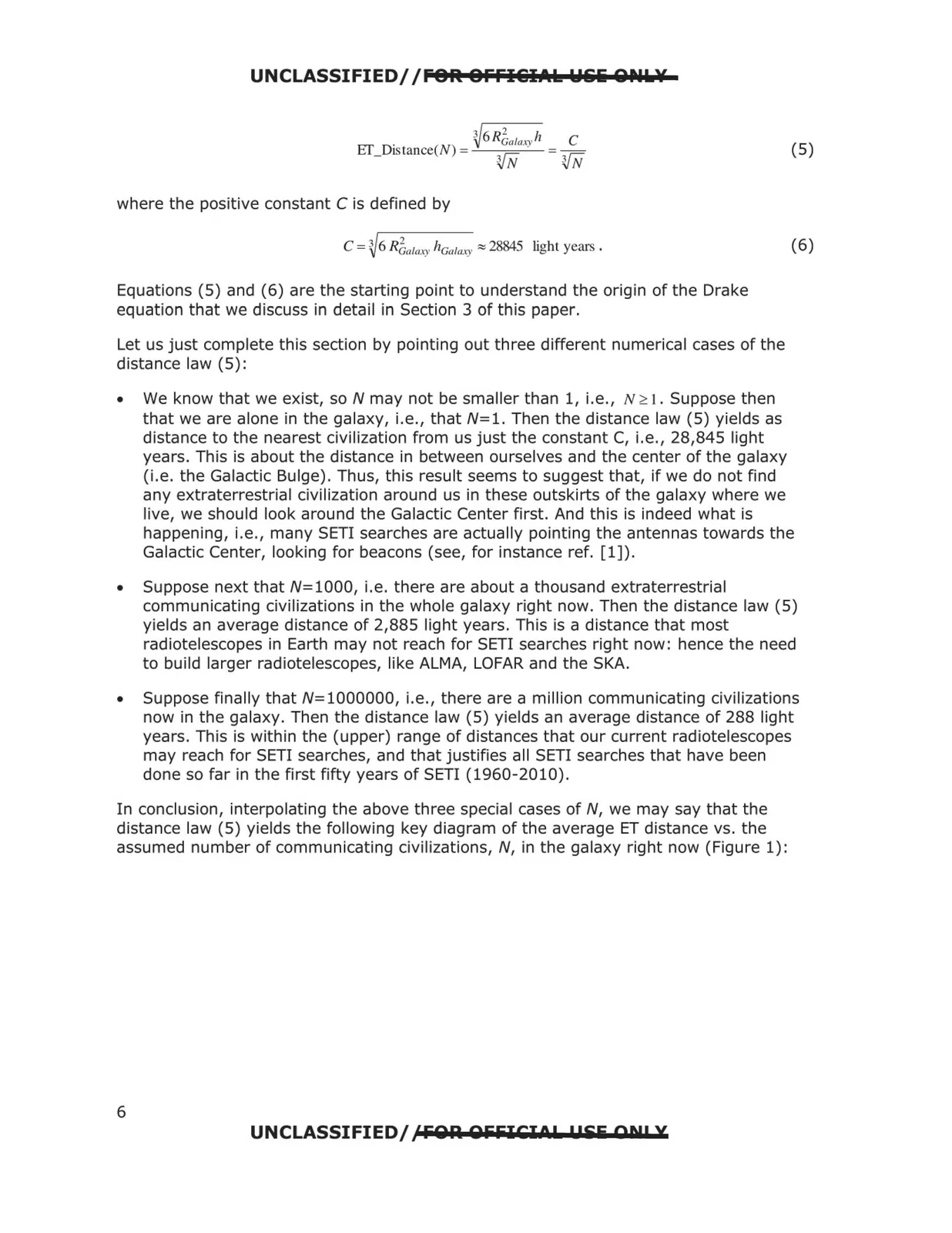
where the positive constant C is defined by
C =V6 R ~ala.,y h ca/axy ,., 28845 light years .
(6)
Equations (5) and (6) are the starting point to understand the origin of the Drake
equation that we discuss in detail in Section 3 of this paper.
Let us just complete this section by pointing out three different numerical cases of the
distance law (5):
•
We know that we exist, so N may not be smaller than 1, i.e., N ~ 1. Suppose then
that we are alone in the galaxy, i.e., that N=l. Then the distance law (5) yields as
distance to the nearest civilization from us just the constant C, i.e., 28,845 light
years. This is about the distance in between ourselves and the center of the galaxy
(i. e. the Galactic Bulge) . Thus, this result seems to suggest that, if we do not find
any extraterrestrial civilization around us in these outskirts of the galaxy where we
live, we should look around the Galactic Center first. And this is indeed what is
happening, i.e., many SETI searches are actually pointing the antennas towards the
Galactic Center, looking for beacons (see, for instance ref. [1]).
•
Suppose next that N=l000, i.e. there are about a thousand extraterrestrial
communicating civilizations in the whole galaxy right now. Then the distance law (5)
yields an average distance of 2,885 light years. This is a distance that most
radiotelescopes in Earth may not reach for SETI searches right now: hence the need
to build larger radiotelescopes, like ALMA, LOFAR and the SKA.
•
Suppose finally that N=l00000O, i.e., there are a million communicating civilizations
now in the galaxy. Then the distance law (5) yields an average distance of 288 light
years. This is within the (upper) range of distances that our current radiotelescopes
may reach for SETI searches, and that justifies all SETI searches that have been
done so far in the first fifty years of SETI (1960-2010).
In conclusion, interpolating the above three special cases of N, we may say that the
distance law (5) yields t he following key diagram of the average ET distance vs. the
assumed number of communicating civilizations, N, in the galaxy right now (Figure 1):
UNCLASSIFIED/ J'FOA. OFlilCI0 I. P !SE ON! X
6