AAWSAP DIRD, An Introduction to the Statistical Drake Equation, March 2010
DOW-UAP-D127 · page 7 of 55
Text
This text came with the file. It may have mistakes. When the text and the image disagree, the image is right.
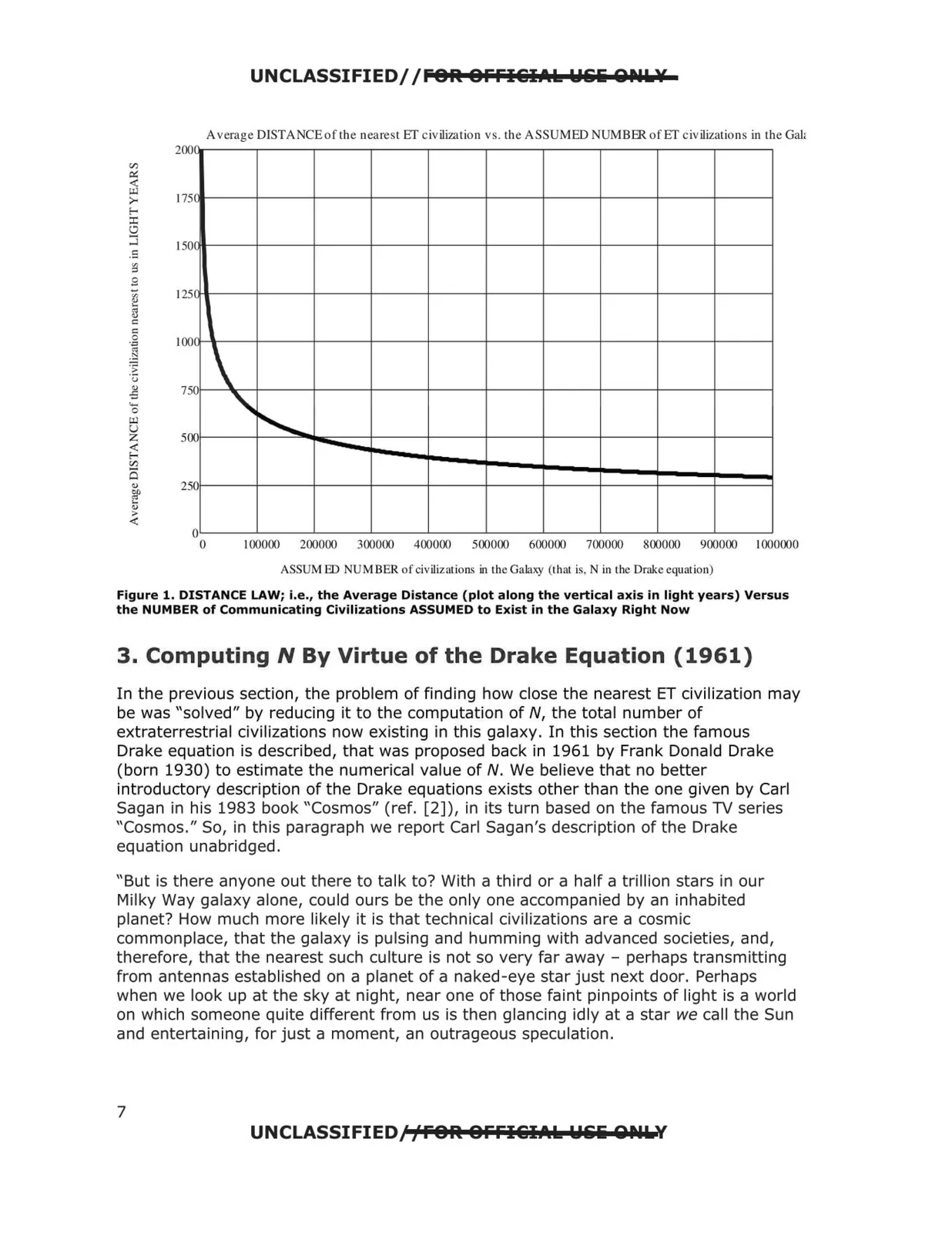
0 l \ ' "- ~ UNCLASSIFIED/ /FOR OFFIEiIAk Wlii QPU,¥ Average DIST A CE of the nearest ET civilization vs. the ASSUMED NUMBffi of ET civilizations in the Gah Cl) 0::: <( UJ >! :I: :i .!:: !'.l g ~ !'l= 200 175 150 125 100 750 500 25 0 0 0 I 00000 200000 300000 400000 500000 600000 700000 800000 900000 I 000000 ASS MED NUMBER of civiliz ations in the Galaxy (that is, Nin the Drake equation) Figure 1. DISTANCE LAW; i.e., the Average Distance (plot along the ver-1:ical axis in light years) Versus the NUMBER of Communicating Civilizations ASSUMED to Exist in the Galaxy Right Now 3. Computing N By Virtue of the Drake Equation (1961) In the previous section, the problem of finding how close the nearest ET civilization may be was "solved" by reducing it to the computation of N, the total number of extraterrestrial civilizations now existing in this galaxy. In this section the famous Drake equation is described, that was proposed back in 1961 by Frank Donald Drake (born 1930) to estimate the numerical value of N. We believe that no better introductory description of the Drake equations exists other than the one given by Carl Sagan in his 1983 book "Cosmos" (ref. [2]), in its turn based on the famous TV series "Cosmos." So, in this paragraph we report Carl Sagan's description of the Drake equation unabridged. "But is there anyone out there to talk to? With a third or a half a trillion stars in our Milky Way galaxy alone, could ours be the only one accompanied by an inhabited planet? How much more likely it is that technical civilizations are a cosmic commonplace, that the galaxy is pulsing and humming with advanced societies, and, therefore, that the nearest such culture is not so very far away - perhaps transmitting from antennas established on a planet of a naked-eye star just next door. Perhaps when we look up at the sky at night, near one of those faint pinpoints of light is a world on which someone quite different from us is then glancing id ly at a star we call the Sun and entertaining, for just a moment, an outrageous speculation. UNCLASSIFIED//FOR OFFIEiIAk Wlii QPllsV 7