AAWSAP DIRD, Anomalous Acute and Subacute Field Effects on Human Biological Tissues, March 2010
DOW-UAP-D128 · War Dept. · Mar 11, 2010 · document · 38 pages · Release 6
What the war.gov catalog says
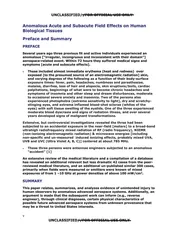
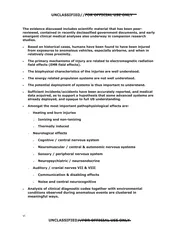
This document is a Defense Intelligence Reference Document (DIRD), a technical reference format used by the Defense Intelligence Agency (DIA) to capture baseline knowledge on a specific topic for later analytic use. DIRDs are best understood as reference and synthesis products rather than as original research. It is one of 38 DIRDs produced under the Advanced Aerospace Weapon System Applications Program (AAWSAP) between 2009 and 2011. Because AAWSAP’s scope permitted a broad range of supporting topics, not every DIRD in the series directly concerns aerospace systems or future threat assessment. The following summary reflects the DIRD’s scope and framing at the time of writing and should not be read as implying current validation of the concepts discussed. This DIRD surveys reported acute and subacute injuries allegedly associated with close exposure to anomalous field effects, attempting to draw tentative parallels between these claimed symptoms and the known physiological effects of intense radiofrequency .and microwave exposure on human tissue. By reviewing medical and biophysical literature on heating, burns, neurological effects, and sensory disturbances, the report speculates on theoretical mechanisms by which intense electromagnetic fields might account for some of the reported injury patterns, though it does not establish a direct causal link between the reported injuries and any specific source. It hypothesizes that clinical symptoms and reported exposure circumstances might allow for highly constrained, limited inferences regarding the characteristics of an unknown emitter or propulsion system. Notably, the document’s findings rely heavily on case comparisons lacking physical examinations, untestable exposure conditions, and a mix of established science and more controversial literature. These comparisons are then extended to anomalous-craft scenarios, attempting to map known electromagnetic injury mechanisms onto anomalous encounter claims that lack independent scientific validation in the report.
From the file
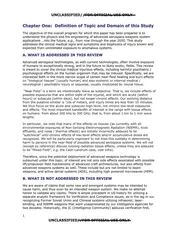
It is our contention that characteristics of the fields or mechanisms associated with close encounters with anomalous craft can even sometimes carefully be gleaned from archival records where effects on human physiology have been carefully reported. p. 10
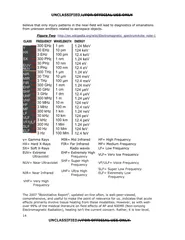
The range 3 GHz-30 GHz (wavelengths 10 cm-I cm) is termed super high frequency and includes radar, satellite, and other microwave communication systems. p. 15
This text came with the file. It may have mistakes. When the text and the image disagree, the image is right.