AAWSAP DIRD, Metallic Spintronics, March 2010
DOW-UAP-D129 · page 9 of 27
Text
This text came with the file. It may have mistakes. When the text and the image disagree, the image is right.
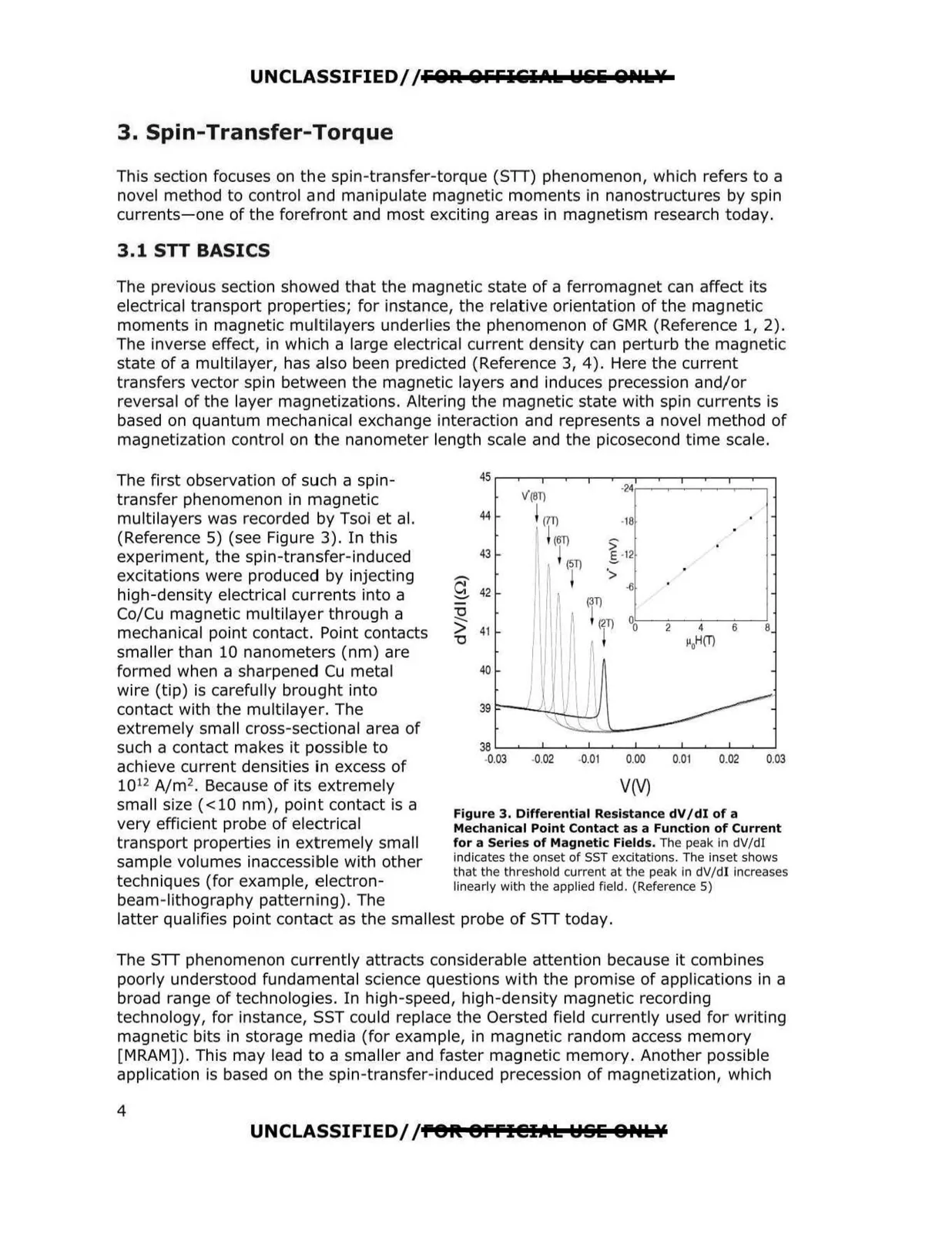
UNCLASSIFIED//FOA OFFl&ilAk Wlili O,.kY 3. Spin-Transfer-Torque This section focuses on the spin-transfer-torque (STT) phenomenon, which refers to a novel method to control and manipulate magnetic moments in nanostructures by spin currents-one of the forefront and most exciting areas in magnetism research today. 3.1 STT BASICS The previous section showed that the magnetic state of a ferromagnet can affect its electrical transport properties; for instance, the relative orientation of the magnetic moments in magnetic multilayers underlies the phenomenon of GMR (Reference 1, 2). The inverse effect, in which a large electrical current density can perturb the magnetic state of a multilayer, has also been predicted (Reference 3, 4). Here the current transfers vector spin between the magnetic layers and induces precession and/or reversal of the layer magnetizations. Altering the magnetic state with spin currents is based on quantum mechanical exchange interaction and represents a novel method of magnetization control on the nanometer length scale and the picosecond time scale. 45 ,---,---,---,---,---,--,,---,--~-,---,---,---, The first observation of such a spin transfer phenomenon in magnetic multilayers was recorded by Tsoi et al. 44 (Reference 5) (see Figure 3). In this experiment, the spin-transfer-induced 43 excitations were produced by injecting a 42 high-density electrical currents into a Co/Cu magnetic multilayer through a ~ mechanical point contact. Point contacts ~ 41 smaller than 10 nanometers (nm) are formed when a sharpened Cu metal 40 wire (tip) is carefully brought into contact with the multilayer. The 39 extremely small cross-sectional area of 38~~~~~-~~~~~~-~ such a contact makes it possible to -0.03 -0.02 -0.01 0.00 0.01 0.02 0.03 achieve current densities in excess of 1012 A/m 2. Because of its extremely VM sma ll size ( <10 nm), point contact is a Figure 3. Differential Resistance dV / di of a very efficient probe of electrical Mechanical Point Contact as a Function of Current transport properties in ext remely small for a Series of Magnetic Fields. The peak In dV/dl indicates the onset of SST excitations. The inset shows sample volumes inaccessible with other that the threshold current at the peak In dV/dl Increases techniques (for example, electron linearly with the applied field. (Reference 5) beam-lithography patterning). The latter qualifies point contact as the smallest probe of STT today. The STT phenomenon currently attracts considerable attention because it combines poorly understood fundamental science questions with the promise of applications in a broad range of technologies. In high-speed, high-density magnetic recording technology, for instance, SST could replace the Oersted field currently used for writing magnetic bits in storage media (for example, in magnetic random access memory [MRAM]). This may lead to a sma ller and faster magnetic memory. Another possible application is based on the spin-transfer-induced precession of magnetization, which 4 UNCLASSIFIED/ /P'Olt Offl@IAL ~SE 8PtLY