AAWSAP DIRD, Advanced Space Propulsion Based on Vacuum (Spacetime Metric) Engineering, March 2010
DOW-UAP-D132 · page 14 of 17
Text
This text came with the file. It may have mistakes. When the text and the image disagree, the image is right.
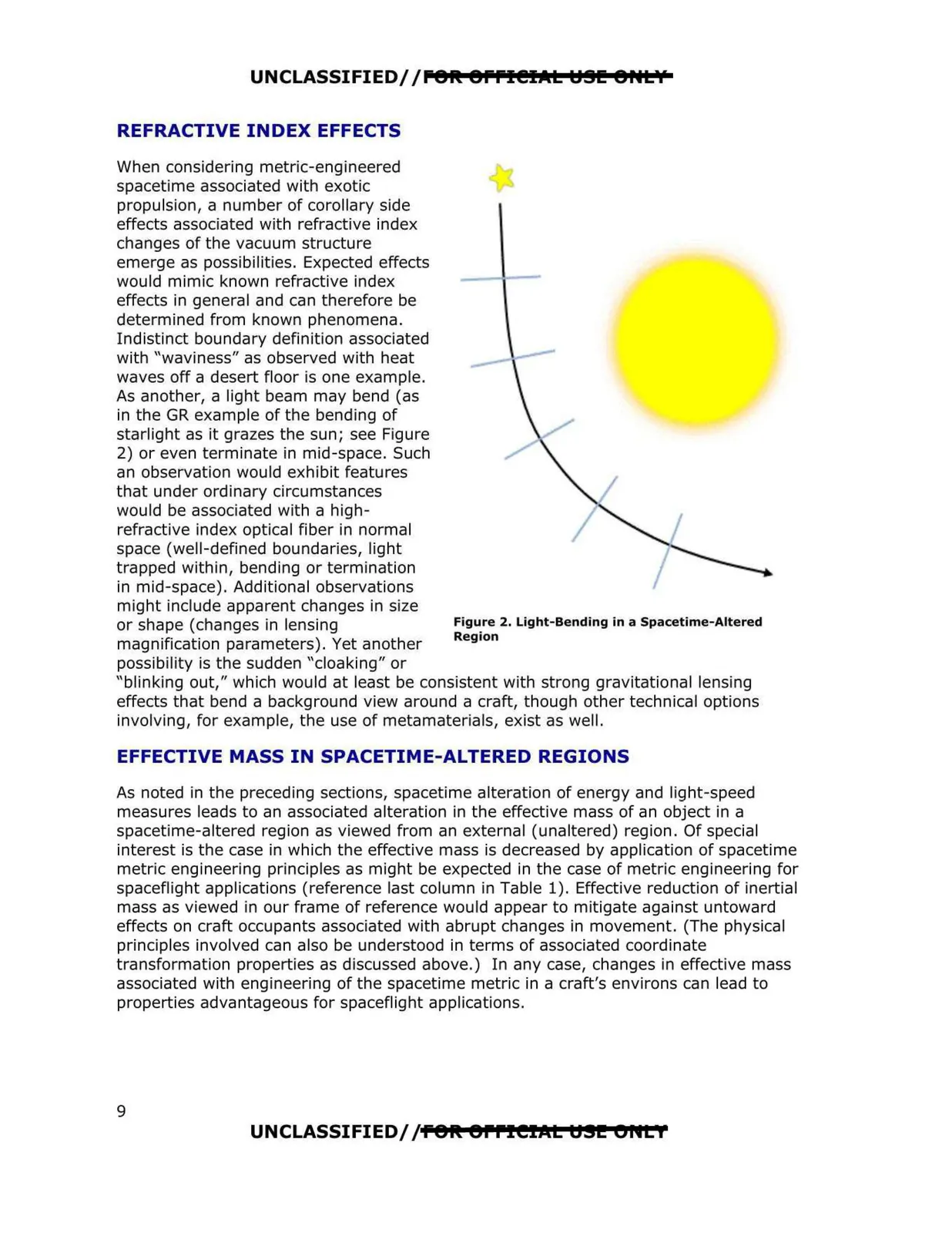
UNCLASSIFIED//P81t errl@IAL l!ISI!!! 8HL'I - REFRACTIVE INDEX EFFECTS When considering metric-engineered spacetime associated with exotic propulsion, a number of corollary side effects associated with refractive index changes of the vacuum structure emerge as possibilities. Expected effects would mimic known refractive index effects in general and can therefore be determined from known phenomena. Indistinct boundary definition associated with "waviness" as observed with heat waves off a desert floor is one example. As another, a light beam may bend (as in the GR example of the bending of starlight as it grazes the sun; see Figure \ 2) or even terminate in mid-space. Such an observation would exhibit features that under ordinary circumstances would be associated with a high refractive index optical fiber in normal space (well-defined boundaries, light trapped within, bending or termination I ,~ in mid-space). Additional observations might include apparent changes in size Figure 2. Light-Bending in a Spacetime-Altered or shape (changes in lensing Region magnification parameters). Yet another possibility is the sudden "cloaking" or "blinking out," which would at least be consistent with strong gravitational lensing effects that bend a background view around a craft, though other technical options involving, for example, the use of metamaterials, exist as well. EFFECTIVE MASS IN SPACETIME-ALTERED REGIONS As noted in the preceding sections, spacetime alteration of energy and light-speed measures leads to an associated alteration in the effective mass of an object in a spacetime-altered region as viewed from an external (unaltered) region. Of special interest is the case in which the effective mass is decreased by application of spacetime metric engineering principles as might be expected in the case of metric engineering for spaceflight applications (reference last column in Table 1). Effective reduction of inertial mass as viewed in our frame of reference would appear to mitigate against untoward effects on craft occupants associated with abrupt changes in movement. (The physical principles involved can also be understood in terms of associated coordinate transformation properties as discussed above.) In any case, changes in effective mass associated with engineering of the spacetime metric in a craft's environs can lead to properties advantageous for spaceflight applications. UNCLASSIFIED//P81t err1e11et U:!I!!! ()fl[ I 9