AAWSAP DIRD, Advanced Space Propulsion Based on Vacuum (Spacetime Metric) Engineering, March 2010
DOW-UAP-D132 · War Dept. · Mar 29, 2010 · document · 17 pages · Release 6
What the war.gov catalog says
This document is a Defense Intelligence Reference Document (DIRD), a technical reference format used by the Defense Intelligence Agency (DIA) to capture baseline knowledge on a specific topic for later analytic use. DIRDs are best understood as reference and synthesis products rather than as original research. It is one of 38 DIRDs produced under the Advanced Aerospace Weapon System Applications Program (AAWSAP) between 2009 and 2011. Because AAWSAP’s scope permitted a broad range of supporting topics, not every DIRD in the series directly concerns aerospace systems or future threat assessment. The following summary reflects the DIRD’s scope and framing at the time of writing and should not be read as implying current validation of the concepts discussed. This DIRD examines the idea of vacuum or spacetime-metric engineering: the possibility that an unspecified future technology might alter the structure of spacetime in ways useful for propulsion, power generation, or extremely rapid long-distance travel. Using general relativity as a model-independent framework, it explores the physical effects that would theoretically follow if such metric changes could be artificially induced, including altered time rates, changes in effective mass, modified light propagation, gravity-like effects, and warp-drive propulsion. The document does not propose any mechanism for generating these effects and treats these physical consequences as an assumed result of spacetime manipulation rather than as the outcome of a practical engineering pathway. It also emphasizes that the energy requirements predicted by current theory to create such effects are far beyond existing technological capability.
From the file
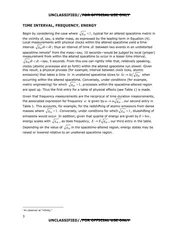
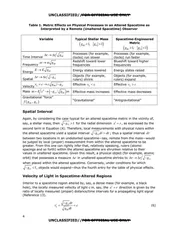
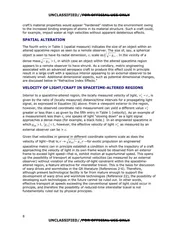
SPATIAL ALTERATION The fourth entry in Table 1 (spatial measure) indicates the size of an object within an altered spacetime region as seen by a remote observer. p. 13
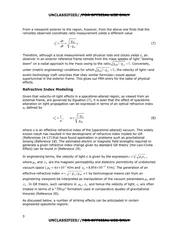
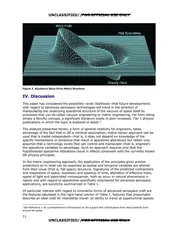
In other words, effective transport at speeds exceeding the conventional speed of light could occur in principle, and therefore the possibility of reduced-time interstellar travel is not fundamentally ruled out by physical principles. p. 13
This text came with the file. It may have mistakes. When the text and the image disagree, the image is right.