AAWSAP DIRD, Advanced Space Propulsion Based on Vacuum (Spacetime Metric) Engineering, March 2010
DOW-UAP-D132 · page 16 of 17
Text
This text came with the file. It may have mistakes. When the text and the image disagree, the image is right.
UNCLASSIFIED/ /FOR. err1e1At l:191!! er•t I
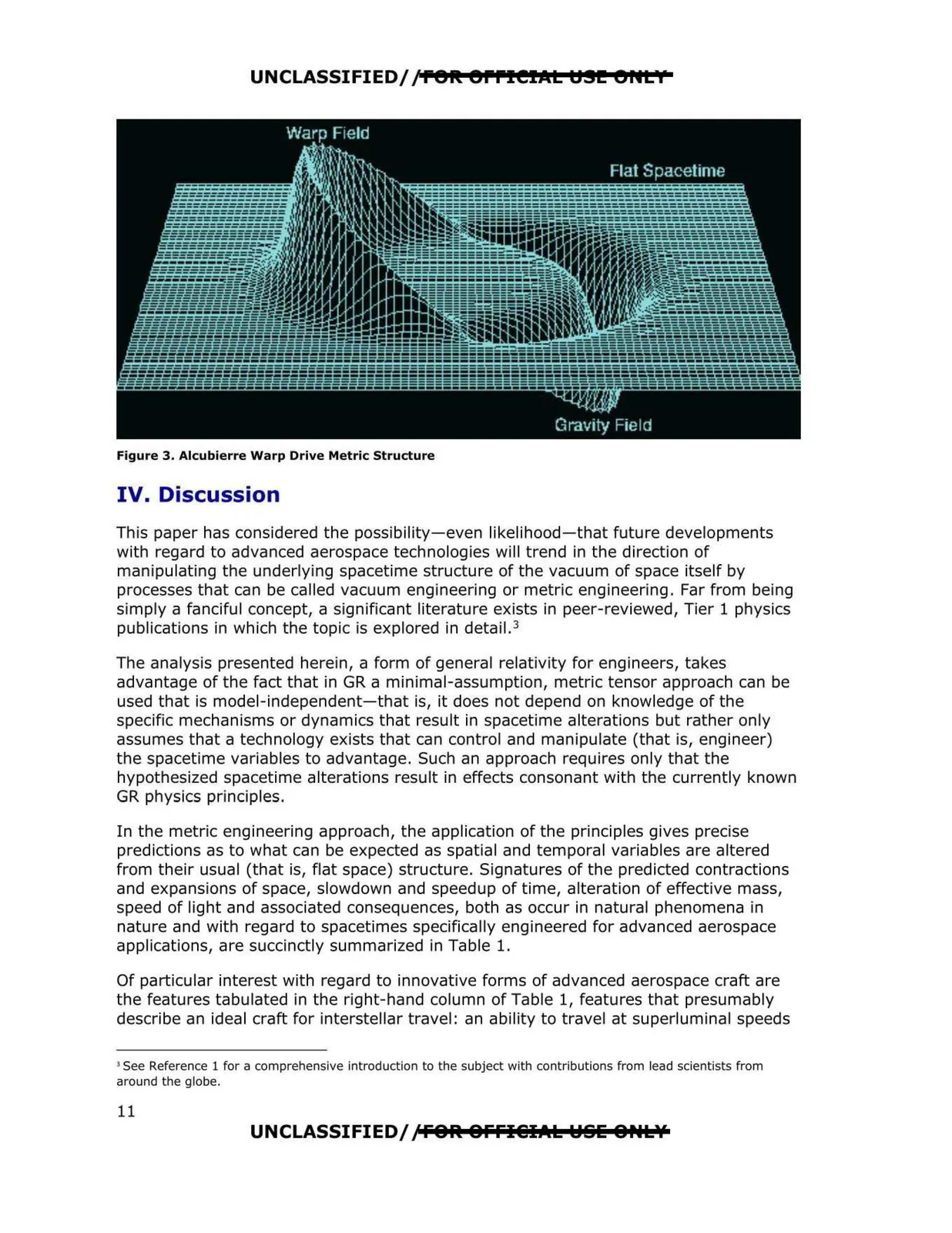
Figure 3. Alcubierre Warp Drive Metric Structure
IV. Discussion
This paper has considered the possibility-even likelihood-that future developments
with regard to advanced aerospace technologies will trend in the direction of
manipulating the underlying spacetime structure of the vacuum of space itself by
processes that can be called vacuum engineering or metric engineering. Far from being
simply a fanciful concept, a significant literature exists in peer-reviewed, Tier 1 physics
publications in which the topic is explored in detail. 3
The analysis presented herein, a form of general relativity for engineers, takes
advantage of the fact that in GR a minimal-assumption, metric tensor approach can be
used that is model-independent-that is, it does not depend on knowledge of the
specific mechanisms or dynamics that result in spacetime alterations but rather only
assumes that a technology exists that can control and manipulate (that is, engineer)
the spacetime variables to advantage. Such an approach requires only that the
hypothesized spacetime alterations result in effects consonant with the currently known
GR physics principles.
In the metric engineering approach, the application of the principles gives precise
predictions as to what can be expected as spatial and temporal variables are altered
from their usual (that is, flat space) structure. Signatures of the predicted contractions
and expansions of space, slowdown and speedup of time, alteration of effective mass,
speed of light and associated consequences, both as occur in natural phenomena in
nature and with regard to spacetimes specifically engineered for advanced aerospace
applications, are succinctly summarized in Table 1.
Of particular interest with regard to innovative forms of advanced aerospace craft are
the features tabulated in the right-hand column of Table 1, features that presumably
describe an ideal craft for interstellar travel: an ability to travel at superluminal speeds
' See Reference 1 for a comprehensive introduction to the subject with contributions from lead scientists from
around the globe.
UNCLASSIFIED/,'FOR OFFI@IAI: WSE OHl:l/
11