AAWSAP DIRD, Advanced Space Propulsion Based on Vacuum (Spacetime Metric) Engineering, March 2010
DOW-UAP-D132 · page 6 of 17
Text
This text came with the file. It may have mistakes. When the text and the image disagree, the image is right.
UNCLASSIFIED/,'FOR OFFI@IAL YSE OHL¥
I. Spacetime Modification - Metric Tensor Approach
Despite the daunting energy requirements to restructure the spacetime metric to a
significant degree, one can investigate the forms that such restructuring would take to
be useful for spaceflight applications and determine their corollary attributes and
consequences. Thus we embark on a "Blue Sky," general-relativity-for-engineers
approach, as it were.
As a mathematical evaluation tool, the metric tensor that describes the measurement of
spacetime intervals is used . Such an approach, well known from studies in general
relativity (GR), has the advantage of being model independent-that is, it does not
depend on knowledge of the specific mechanisms or dynamics that result in spacetime
alterations but rather only assumes that a technology exists that can control and
manipulate (that is, engineer) the spacetime metric to advantage. Before discussing the
predicted characteristics of such engineered spacetimes, beginning in Section III, a
brief mathematical digression for those interested in the mathematical structure behind
the discussion to follow is introduced.
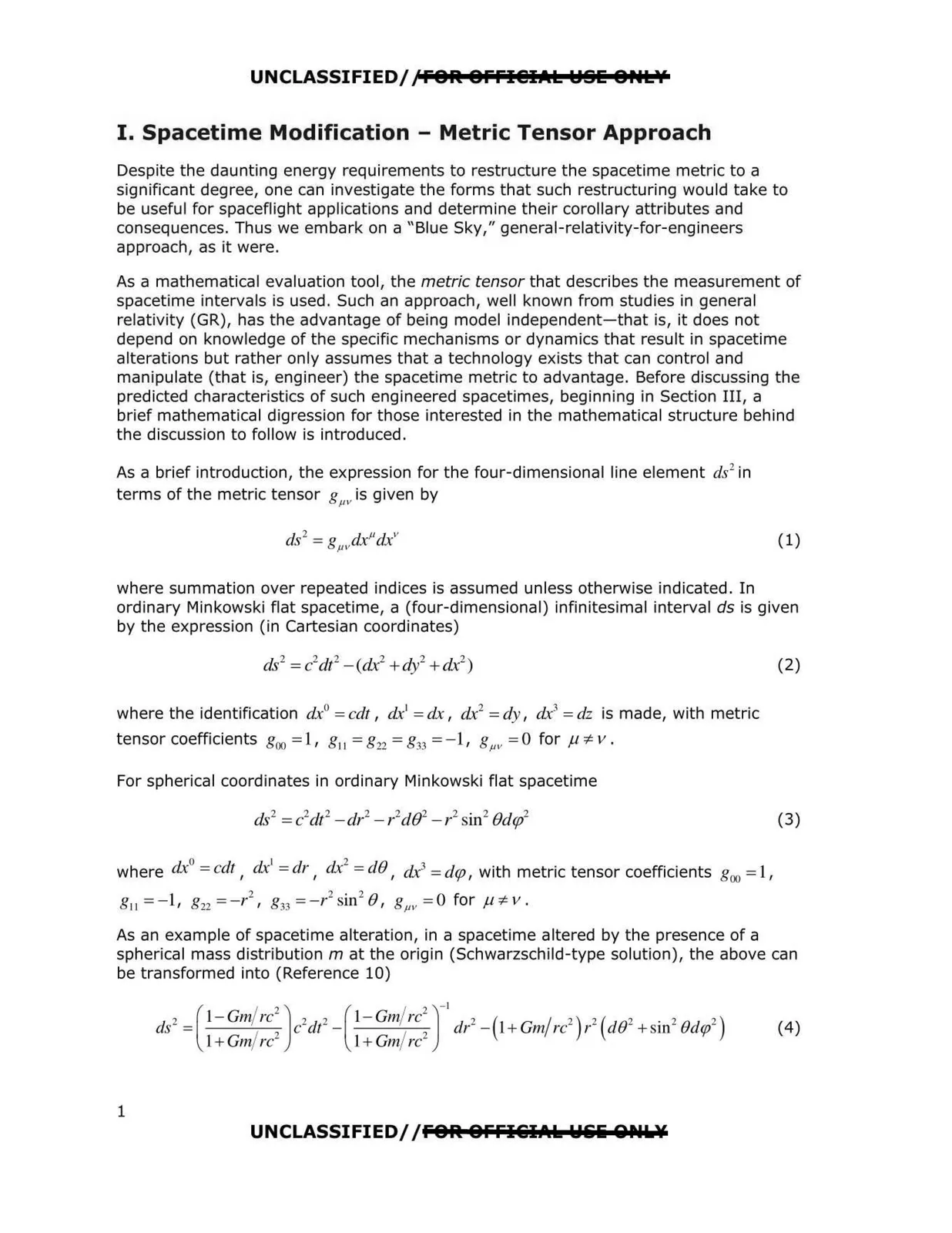
As a brief introduction, the expression for the four-dimensional line element ds2 in
terms of the metric tensor gµ ., is given by
ds2 =g dx"dx"
{l)
µv
where summation over repeated indices is assumed unless otherwise indicated. In
ordinary Minkowski flat spacetime, a (four-dimensional) infinitesimal interval ds is given
by the expression (in Cartesian coordinates)
c/s2 =c2dt2 - (dx2 +dy2 +dx2 )
(2)
where the identification dx0 = cdt , dx' = dx, dx2 =dy , dx3 =dz is made, with metric
tensor coefficients g00 =1, g I I = g22 = g33 = - 1, gµ v =0 for µ --t= v.
For spherical coordinates in ordinary Minkowski flat spacetime
ds2 =c2dt 2 -dr2 - r2d02 - r 2 sin 2 0dql
(3)
where dx0 = cc/t , dx' = dr, dx 2 = d0, dx3 =d(f), with metric tensor coefficients g00 =1,
g11 = -1, g22 = -r2 , g33 = -r2 sin 2 0, gµv = O for µ -t; v.
As an example of spacetime alteration, in a spacetime altered by the presence of a
spherical mass distribution mat the origin (Schwarzschild-type solution), the above can
be transformed into (Reference 10)
UNCLASSIFIED//FOR OFFI&I.t.k Wliliii 8Nk¥
1