AAWSAP DIRD, The Space Communication Implications of Quantum Entanglement and Nonlocality, March 2010
DOW-UAP-D133 · page 13 of 32
Text
This text came with the file. It may have mistakes. When the text and the image disagree, the image is right.
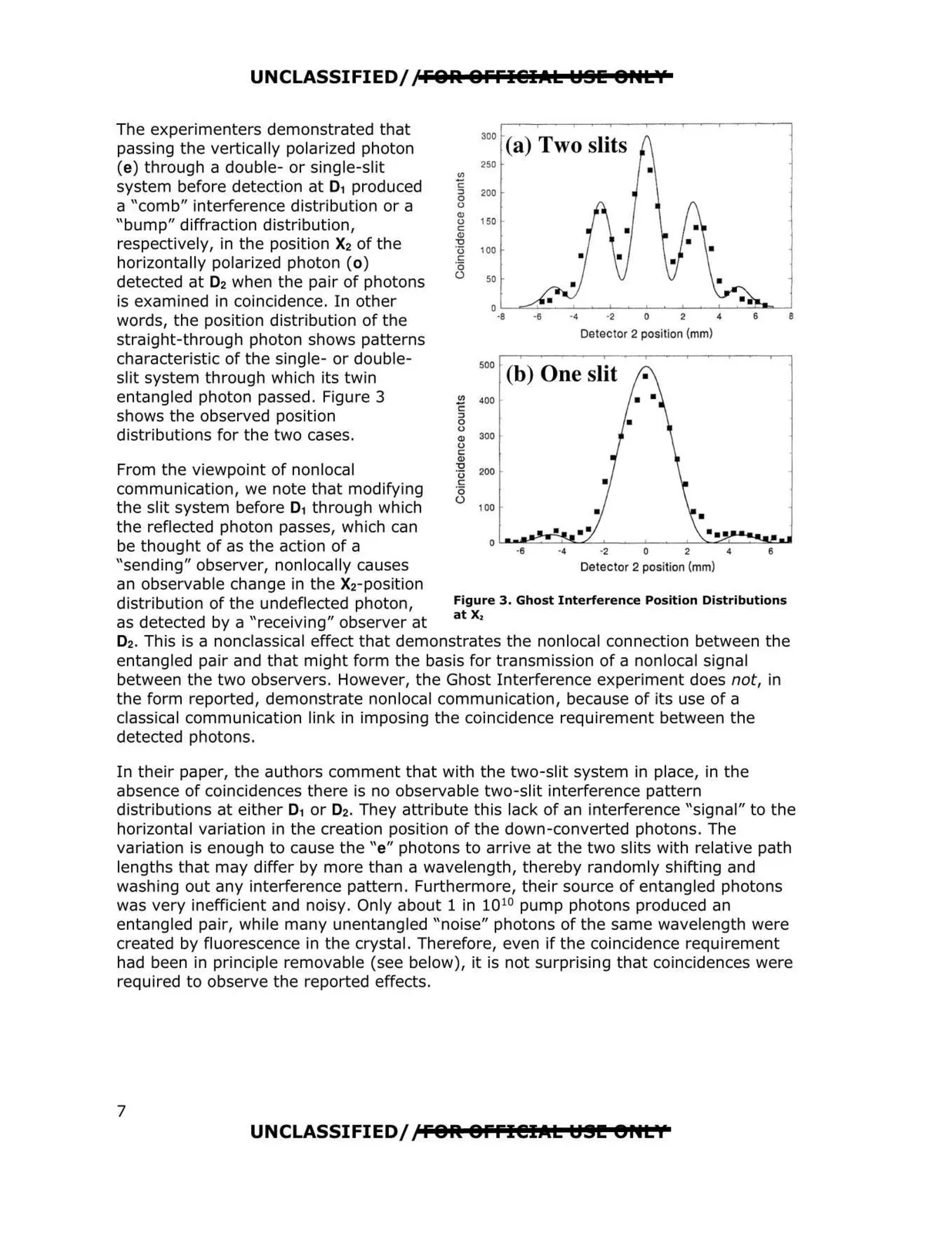
UNCLASSIFIED//FOR 8FFI@IAL l!IS! 8HLY The experimenters demonstrated that 300 passing the vertically polarized photon (e) through a double- or single-slit "' 250 system before detection at D1 produced a "comb" interference distribution or a C: ::, 0 0 Ql 200 "bump" diffraction distribution, respectively, in the position X2 of the (.) C: Ql 'C ·.:; 150 100 horizontally polarized photon (o) detected at D2 when the pair of photons C: ·5 0 so is examined in coincidence. In other words, the position distribution of the straight-through photon shows patterns ·8 ·6 ·4 ·2 0 2 4 Detector 2 position (mm) characteristic of the single- or double slit system through which its twin entangled photon passed. Figure 3 shows the observed position distributions for the two cases. From the viewpoint of nonlocal communication, we note that modifying the slit system before D1 through which the reflected photon passes, which can be thought of as the action of a ·8 ·4 ·2 0 2 4 "sending" observer, nonlocally causes Detector 2 position (mm) an observable change in the Xrposition distribution of the undeflected photon, Figure 3. Ghost Interference Position Distributions as detected by a "receiving" observer at at x, D2. This is a nonclassical effect that demonstrates the nonlocal connection between the entangled pair and that might form the basis for transmission of a nonlocal signal between the two observers. However, the Ghost Interference experiment does not, in the form reported, demonstrate nonlocal communication, because of its use of a classical communication link in imposing the coincidence requirement between the detected photons. In their paper, the authors comment that with the two-slit system in place, in the absence of coincidences there is no observable two-slit interference pattern distributions at either D1 or D2. They attribute this lack of an interference "signal" to the horizontal variation in the creation position of the down-converted photons. The variation is enough to cause the "e" photons to arrive at the two slits with relative path lengths that may differ by more than a wavelength, thereby randomly shifting and washing out any interference pattern. Furthermore, their source of entangled photons was very inefficient and noisy. Only about 1 in 1010 pump photons produced an entangled pair, while many unentangled "noise" photons of the same wavelength were created by fluorescence in the crystal. Therefore, even if the coincidence requirement had been in principle removable (see below), it is not surprising that coincidences were required to observe the reported effects. 0 L__,=..J.----'--~__J_~-----'---~-'--~...,__~~ '---' (a) Two slits "' C: ::, 0 0 a, 0 C: Ql ~ C: ·o 0 500 (b) One slit 400 300 200 100 UNCLASSIFIED/,'FOR. 8fflE!IJltL U:!E fJHL I 7