AAWSAP DIRD, The Space Communication Implications of Quantum Entanglement and Nonlocality, March 2010
DOW-UAP-D133 · page 14 of 32
Text
This text came with the file. It may have mistakes. When the text and the image disagree, the image is right.
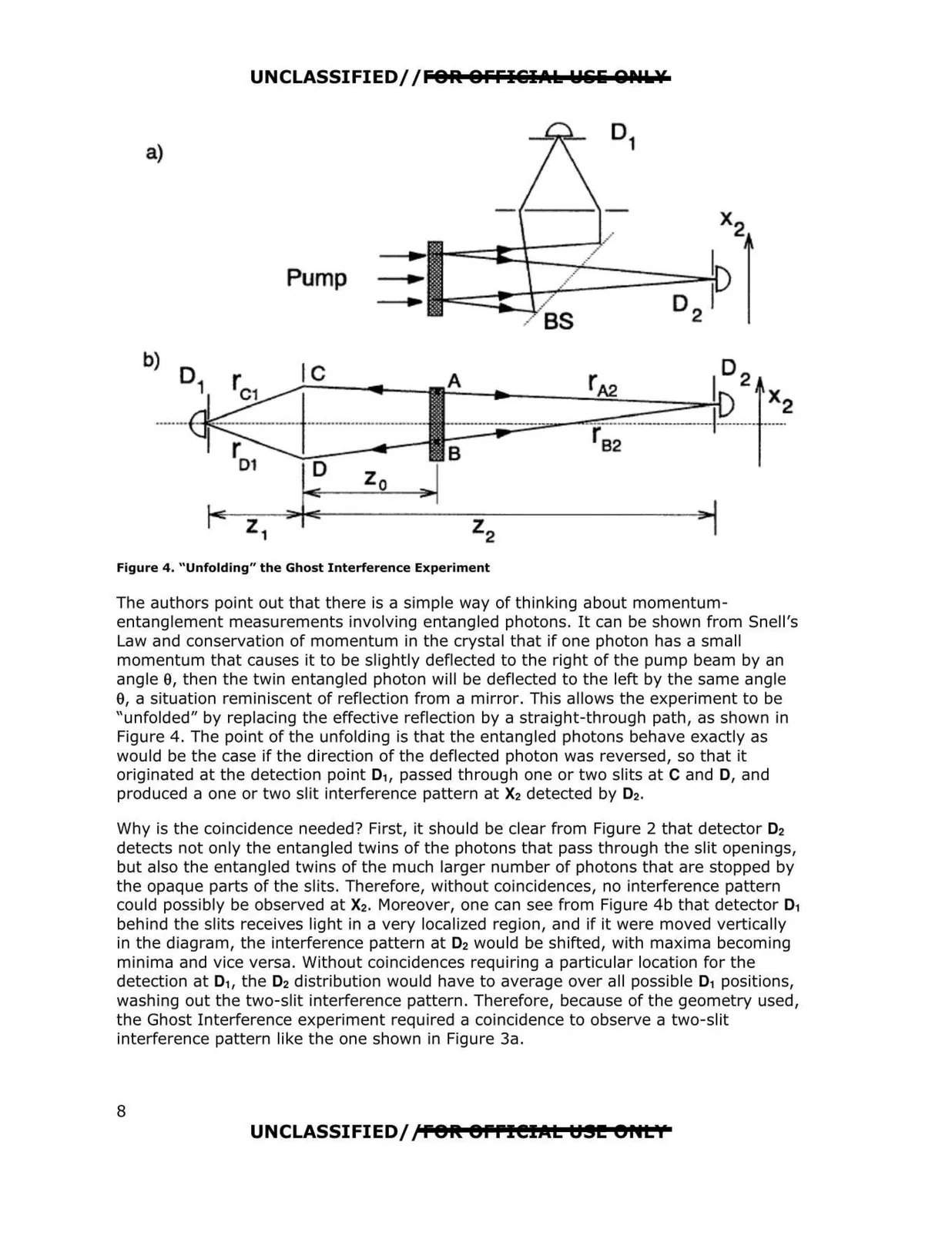
UNCLASSIFIED//FOR OFFl&IAk W&li 8NL¥ a) Pump Figure 4. "Unfolding" the Ghost Interference Experiment The authors point out that there is a simple way of thinking about momentum entanglement measurements involving entangled photons. It can be shown from Snell's Law and conservation of momentum in the crystal that if one photon has a small momentum that causes it to be slightly deflected to the right of the pump beam by an angle 0, then the twin entangled photon will be deflected to the left by the same angle 0, a situation reminiscent of reflection from a mirror. This allows the experiment to be "unfolded" by replacing the effective reflection by a straight-through path, as shown in Figure 4. The point of the unfolding is that the entangled photons behave exactly as would be the case if the direction of the deflected photon was reversed, so that it originated at the detection point D1, passed through one or two slits at C and D, and produced a one or two slit interference pattern at X2 detected by D2. Why is the coincidence needed? First, it should be clear from Figure 2 that detector D2 detects not only the entangled twins of the photons that pass through the slit openings, but also the entangled twins of the much larger number of photons that are stopped by the opaque parts of the slits. Therefore, without coincidences, no interference pattern could possibly be observed at X2, Moreover, one can see from Figure 4b that detector D1 behind the slits receives light in a very localized region, and if it were moved vertically in the diagram, the interference pattern at D2 would be shifted, with maxima becoming minima and vice versa. Without coincidences requiring a particular location for the detection at D1, the D2 distribution would have to average over all possible D1 positions, washing out the two-slit interference pattern. Therefore, because of the geometry used, the Ghost Interference experiment required a coincidence to observe a two-slit interference pattern like the one shown in Figure 3a. UNCLASSIFIED//POil orr1e1Jct U91! er~t I 8