AAWSAP DIRD, The Space Communication Implications of Quantum Entanglement and Nonlocality, March 2010
DOW-UAP-D133 · page 16 of 32
Text
This text came with the file. It may have mistakes. When the text and the image disagree, the image is right.
B Source
Slit
Detector
UNCLASSIFIED//FOR OFFICIAL tt.!I!! 8HL'f
when the coincidence requirement is relaxed. This may be explained by the action of
coherence-entanglement complementarity, as discussed in the next section.
V. Coherence-Entanglement Complementarity
As discussed above, the finite extent of the source is expected to limit the possibility of
observing a two-slit interference pattern, which would be the "signal" if nonlocal
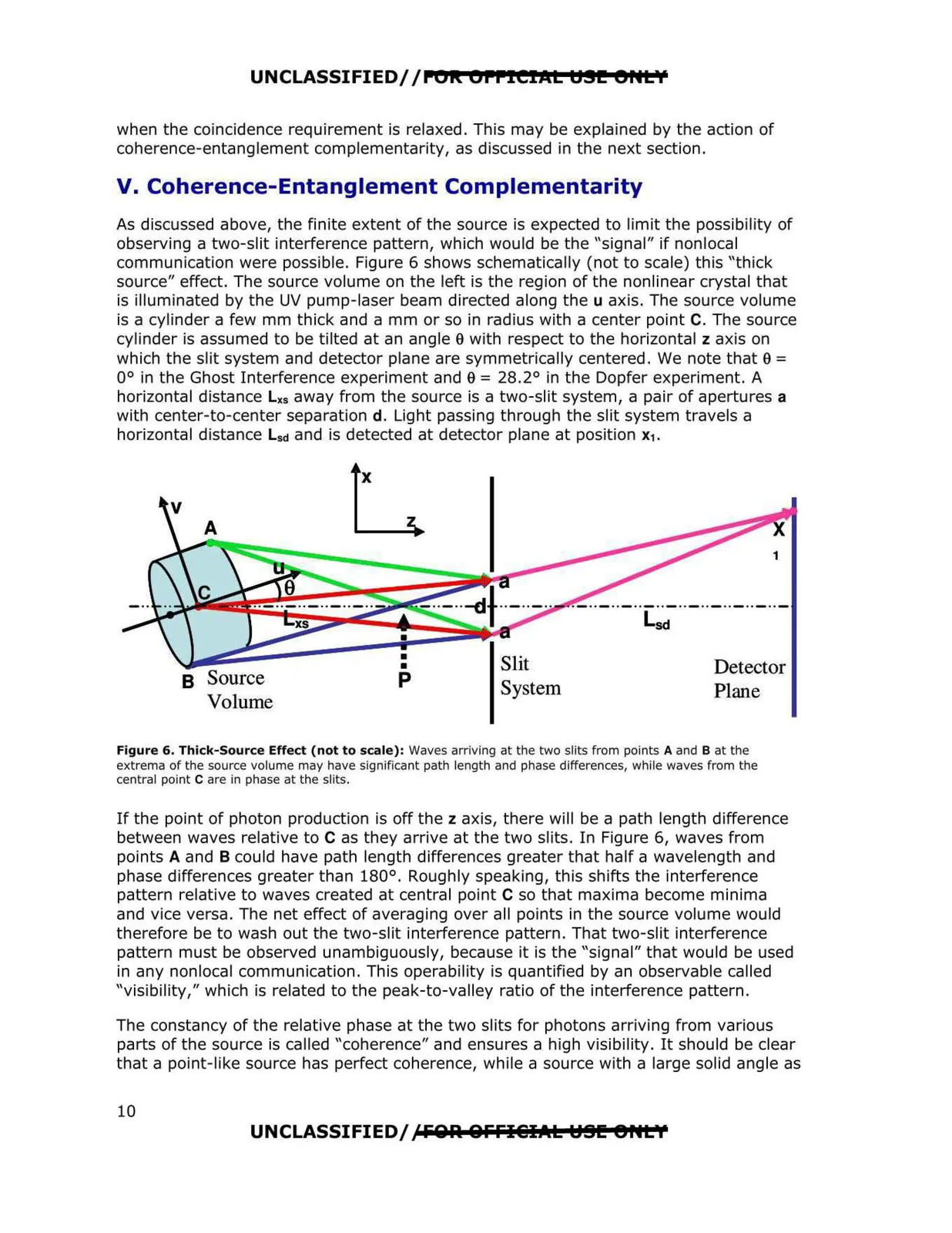
communication were possible. Figure 6 shows schematically (not to scale) this "thick
source" effect. The source volume on the left is the region of the nonlinear crystal that
is illuminated by the UV pump-laser beam directed along the u axis. The source volume
is a cylinder a few mm thick and a mm or so in radius with a center point C. The source
cylinder is assumed to be tilted at an angle 0 with respect to the horizontal z axis on
which the slit system and detector plane are symmetrically centered. We note that 0 =
0° in the Ghost Interference experiment and 0 = 28.2° in the Dopfer experiment. A
horizontal distance Lxs away from the source is a two-slit system, a pair of apertures a
with center-to-center separation d. Light passing through the slit system travels a
horizontal distance Lsd and is detected at detector plane at position x,.
System
Plane
Volume
Figure 6. Thick-Source Effect (not to scale): Waves arriving at the two slits from points A and B at the
extrema of the source volume may have significant path length and phase differences, while waves from the
central point C are in phase at the slits.
If the point of photon production is off the z axis, there will be a path length difference
between waves relative to C as they arrive at the two slits. In Figure 6, waves from
points A and B could have path length differences greater that half a wavelength and
phase differences greater than 180°. Roughly speaking, this shifts the interference
pattern relative to waves created at central point C so that maxima become minima
and vice versa. The net effect of averaging over all points in the source volume would
therefore be to wash out the two-slit interference pattern. That two-slit interference
pattern must be observed unambiguously, because it is the "signal" that would be used
in any nonlocal communication. This operability is quantified by an observable called
"visibility," which is related to the peak-to-valley ratio of the interference pattern.
The constancy of the relative phase at the two slits for photons arriving from various
parts of the source is called "coherence" and ensures a high visibility. It should be clear
that a point-like source has perfect coherence, while a source with a large solid angle as
UNCLASSIFIED/,,roA &FFISIAL 1:181! 8HL'I"
10