AAWSAP DIRD, The Space Communication Implications of Quantum Entanglement and Nonlocality, March 2010
DOW-UAP-D133 · page 15 of 32
Text
This text came with the file. It may have mistakes. When the text and the image disagree, the image is right.
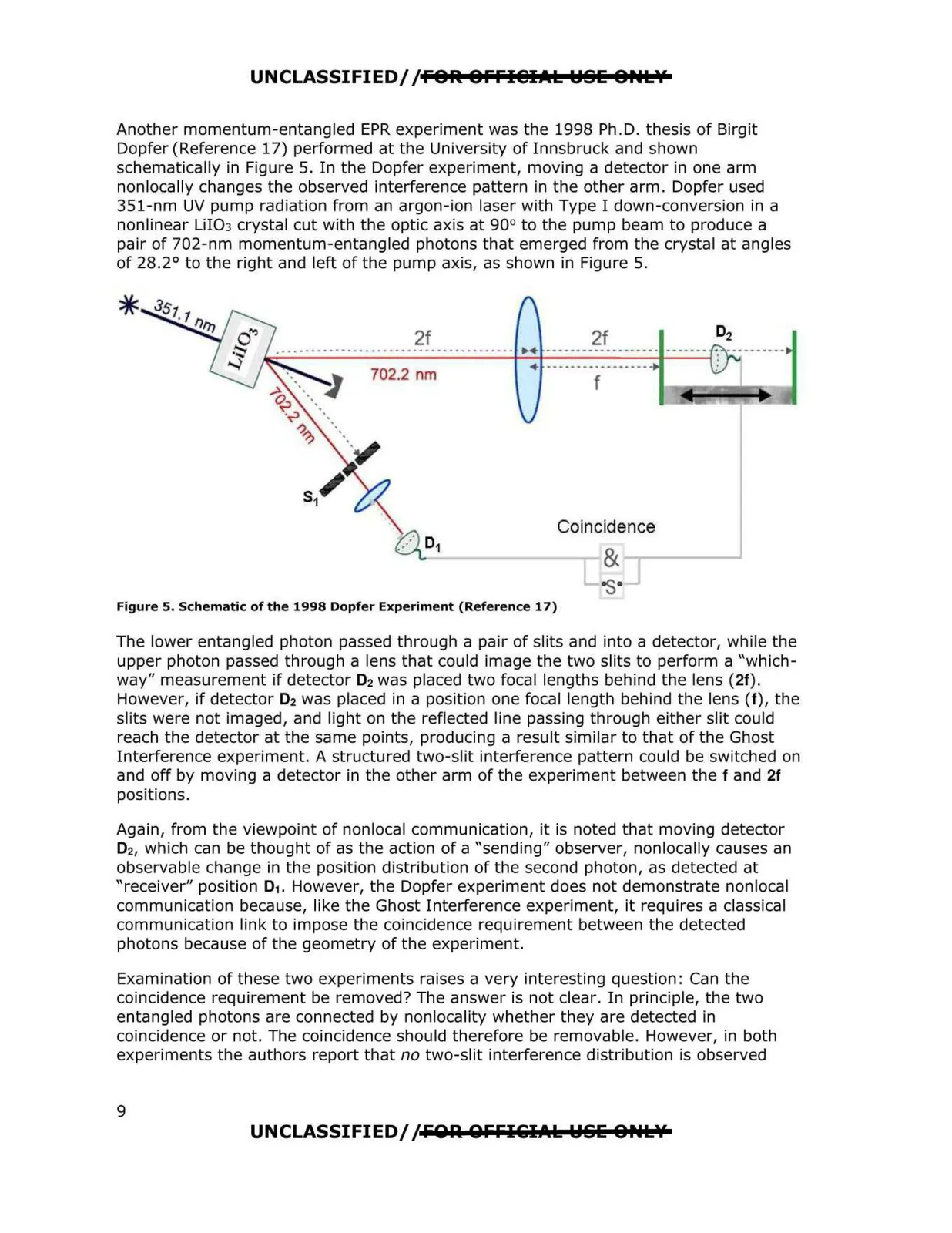
UNCLASSIFIED//FOR OFFI@IAI! WSE OHi!:¥ Another momentum-entangled EPR experiment was the 1998 Ph.D. thesis of Birgit Dopfer (Reference 17) performed at the University of Innsbruck and shown schematically in Figure 5. In the Dopfer experiment, moving a detector in one arm non locally changes the observed interference pattern in the other arm. Dopfer used 351-nm UV pump radiation from an argon-ion laser with Type I down-conversion in a nonlinear Lil03 crystal cut with the optic axis at 90° to the pump beam to produce a pair of 702-nm momentum-entangled photons that emerged from the crystal at angles of 28.2° to the right and left of the pump axis, as shown in Figure 5. Figure 5. Schematic of the 1998 Dopfer Experiment (Reference 17) The lower entangled photon passed through a pair of slits and into a detector, while the upper photon passed through a lens that could image the two slits to perform a "which way" measurement if detector D2 was placed two focal lengths behind the lens (2f). However, if detector D2 was placed in a position one focal length behind the lens (f), the slits were not imaged, and light on the reflected line passing through either slit could reach the detector at the same points, producing a result similar to that of the Ghost Interference experiment. A structured two-slit interference pattern could be switched on and off by moving a detector in the other arm of the experiment between the f and 2f positions. Again, from the viewpoint of nonlocal communication, it is noted that moving detector D2, which can be thought of as the action of a "sending" observer, nonlocally causes an observable change in the position distribution of the second photon, as detected at "receiver" position D1. However, the Dopfer experiment does not demonstrate nonlocal communication because, like the Ghost Interference experiment, it requires a classical communication link to impose the coincidence requirement between the detected photons because of the geometry of the experiment. Examination of these two experiments raises a very interesting question: Can the coincidence requirement be removed? The answer is not clear. In principle, the two entangled photons are connected by nonlocality whether they are detected in coincidence or not. The coincidence should therefore be removable. However, in both experiments the authors report that no two-slit interference distribution is observed 2f . . . . . . . . . . . . . . . . . . . . . . . . .. . . . . . . . . . . . . . . 702.2 nm 2f ~ ~ ....... . .. ....... . . . .... .. ........ . . ♦ -.. . ... . ........ . f Coincidence UNCLASSIFIED//FOA OFFI&il.t.l:: W&lii OHi!:¥ 9