AAWSAP DIRD, Antigravity for Aerospace Applications, March 2010
DOW-UAP-D135 · page 12 of 44
Text
This text came with the file. It may have mistakes. When the text and the image disagree, the image is right.
UNCLASSIFIED/fFOA OFFIEIAL: U&i QPIL:¥
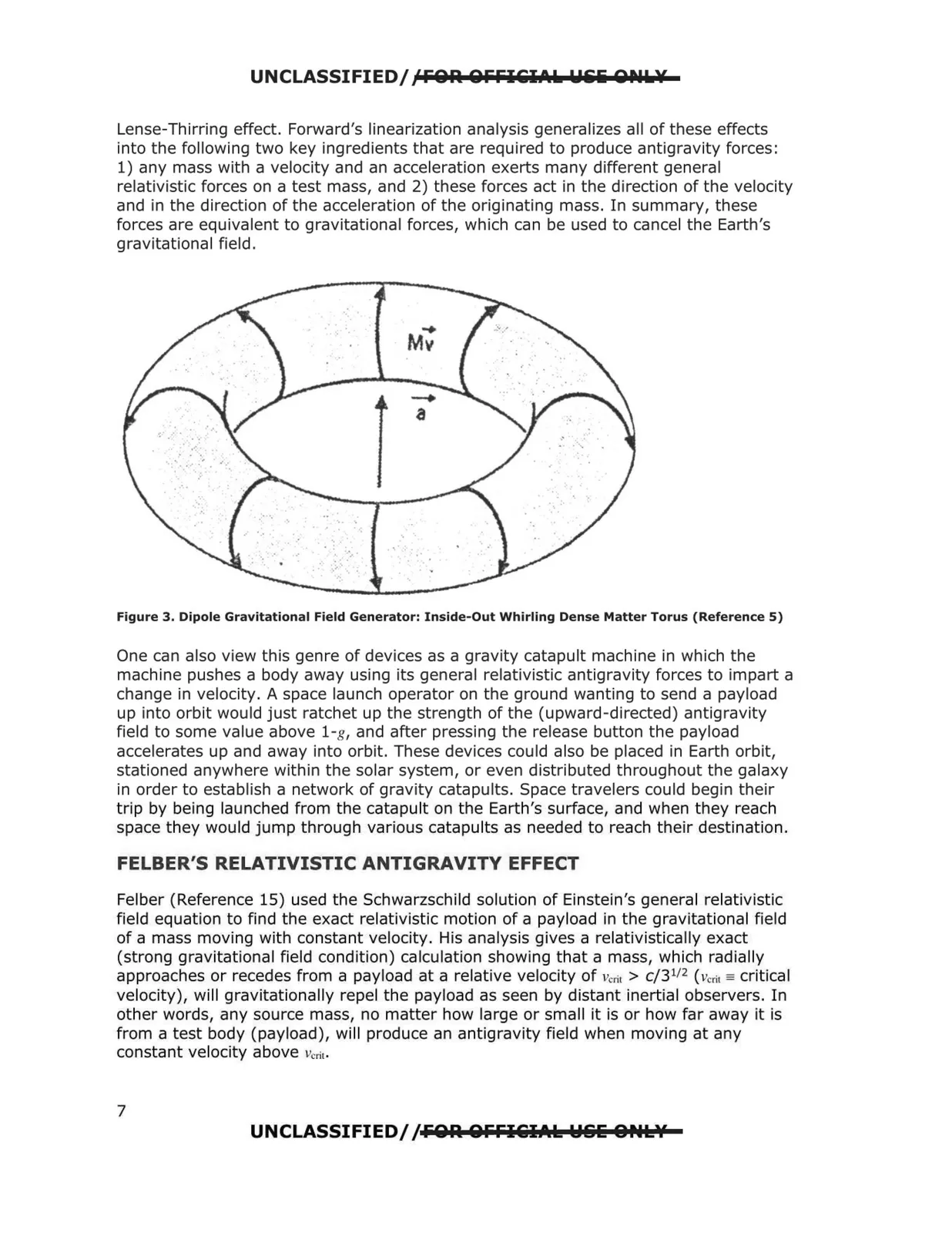
Lense-Thirring effect. Forward's linearization analysis generalizes all of these effects
into the following two key ingredients that are required to produce antigravity forces:
1) any mass with a velocity and an acceleration exerts many different general
relativistic forces on a test mass, and 2) these forces act in the direction of the velocity
and in the direction of the acceleration of the originating mass. In summary, these
forces are equivalent to gravitational forces, which can be used to cancel the Earth's
gravitational field.
Figure 3. Dipole Gravitational Field Generator: Inside-Out Whirling Dense Matter Torus (Reference 5)
One can also view this genre of devices as a gravity catapult machine in which the
machine pushes a body away using its general relativistic antigravity forces to impart a
change in velocity. A space launch operator on the ground wanting to send a payload
up into orbit would just ratchet up the strength of the (upward-directed) antigravity
field to some value above 1-g, and after pressing the release button the payload
accelerates up and away into orbit. These devices could also be placed in Earth orbit,
stationed anywhere within the solar system, or even distributed throughout the galaxy
in order to establish a network of gravity catapults. Space travelers could begin their
trip by being launched from the catapult on the Earth's surface, and when they reach
space they would jump through various catapults as needed to reach their destination.
FELBER'S RELATIVISTIC ANTIGRAVITY EFFECT
Felber (Reference 15) used the Schwarzschild solution of Einstein's general relativistic
field equation to find the exact relativistic motion of a payload in the gravitational field
of a mass moving with constant velocity. His analysis gives a relativistically exact
(strong gravitational field condition) calculation showing that a mass, which radially
approaches or recedes from a payload at a relative velocity of Vcrir > c/3 112 ( vc,i1 = critical
velocity), will gravitationally repel the payload as seen by distant inertial observers. In
other words, any source mass, no matter how large or small it is or how far away it is
from a test body (payload), will produce an antigravity field when moving at any
constant velocity above Vent •
UNCLASSIFIED//FOA OFFI€1.t.k Y&li 8,.LY
7