AAWSAP DIRD, Antigravity for Aerospace Applications, March 2010
DOW-UAP-D135 · page 11 of 44
Text
This text came with the file. It may have mistakes. When the text and the image disagree, the image is right.
UNCLASSIFIED/fFOA OFFIEIAk W&i 0Pilk¥
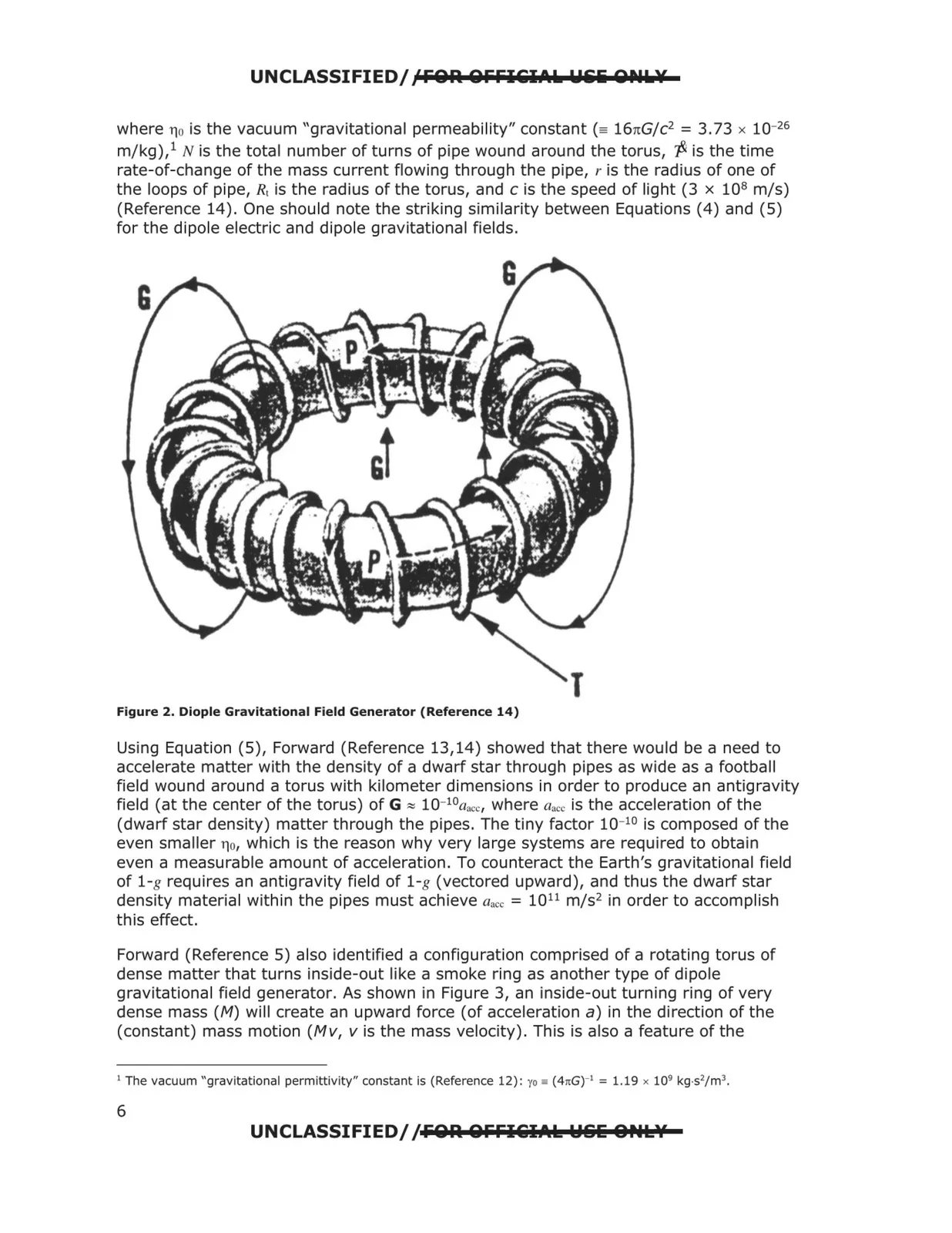
where rio is the vacuum "gravitational permeability" constant(= 16nG/c2 = 3. 73 x 10-26
m/kg), 1 N is the total number of turns of pipe wound around the torus, 'ft. is the time
rate-of-change of the mass current flowing through the pipe, r is the radius of one of
the loops of pipe, R1 is the radius of the torus, and c is the speed of light (3 x 10⁸ m/s)
(Reference 14). One should note the striking similarity between Equations (4) and (5)
for the dipole electric and dipole gravitational fields.
Figure 2. Diople Gravitational Field Generator {Reference 14}
Using Equation (5), Forward (Reference 13,14) showed that there would be a need to
accelerate matter with the density of a dwarf star through pipes as wide as a football
field wound around a torus with kilometer dimensions in order to produce an antigravity
field (at the center of the torus) of G ~ 10-10a acc , where a acc is the acceleration of the
(dwarf star density) matter through the pipes. The tiny factor 10-10 is composed of the
even smaller rio, which is the reason why very large systems are required to obtain
even a measurable amount of acceleration. To counteract the Earth's gravitational field
of 1-g requires an antigravity field of 1-g (vectored upward), and thus the dwarf star
density material within the pipes must achieve a acc = 1011 m/s2 in order to accomplish
this effect.
Forward (Reference 5) also identified a configuration comprised of a rotating torus of
dense matter that turns inside-out like a smoke ring as another type of dipole
gravitational field generator. As shown in Figure 3, an inside-out turning ring of very
dense mass (M) will create an upward force (of acceleration a) in the direction of the
(constant) mass motion (Mv, vis the mass velocity). This is also a feature of the
1 The vacuum "gravitational permittivity" constant is (Reference 12): yo= (41tGJ-' = 1.19 x 10⁹ kg-s2/m3•
UNCLASSIFIED//FOA OFFI&IAb Yi&: 8,.bY
6