AAWSAP DIRD, Antigravity for Aerospace Applications, March 2010
DOW-UAP-D135 · page 16 of 44
Text
This text came with the file. It may have mistakes. When the text and the image disagree, the image is right.
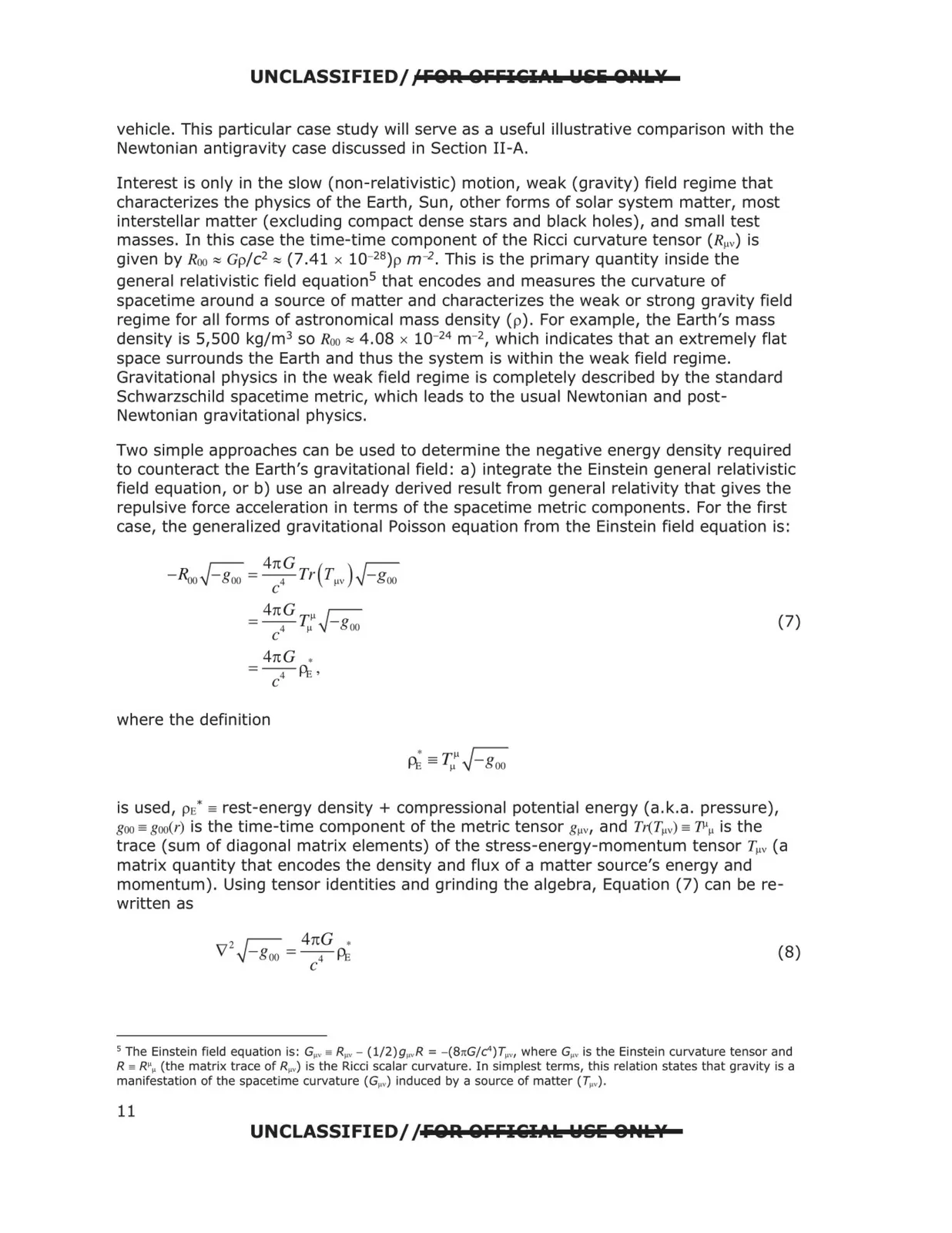
UNCLASSIFIED/fFOA OFFIEIAk W&i 0Pilk¥ vehicle. This particular case study will serve as a useful illustrative comparison with the Newtonian antigravity case discussed in Section II-A. Interest is only in the slow (non-relativistic) motion, weak (gravity) field regime that characterizes the physics of the Earth, Sun, other forms of solar system matter, most interstellar matter (excluding compact dense stars and black holes), and small test masses. In this case the time-time component of the Ricci curvature tensor (Rµv) is given by Roo z Gp/c2 z (7.41 x 10⁻²⁸ )p m-2 . This is the primary quantity inside the general relativistic field equation5 that encodes and measures the curvature of spacetime around a source of matter and characterizes the weak or strong gravity field regime for all forms of astronomical mass density (p). For example, the Earth's mass density is 5,500 kg/m 3 so Roo z 4.08 x 10⁻²⁴ m-2, which indicates that an extremely flat space surrounds the Earth and thus the system is within the weak field regime. Gravitational physics in the weak field regime is completely described by the standard Schwarzschild spacetime metric, which leads to the usual Newtonian and post Newtonian gravitational physics. Two simple approaches can be used to determine the negative energy density required to counteract the Earth's gravitational field: a) integrate the Einstein general relativistic field equation, orb) use an already derived result from general relativity that gives the repulsive force acceleration in terms of the spacetime metric components. For the first case, the generalized gravitational Poisson equation from the Einstein field equation is: (7) where the definition is used, PE*= rest-energy density+ compressional potential energy (a.k.a. pressure), goo= goo(r) is the time-time component of the metric tensor 8r,v, and Tr(Tµv) = P\, is the trace (sum of diagonal matrix elements) of the stress-energy-momentum tensor Tµv (a matrix quantity that encodes the density and flux of a matter source's energy and momentum). Using tensor identities and grinding the algebra, Equation (7) can be re written as v' 2 ,--::- _ 4rcG • \I-goo - -4-Pe (8) C 5 The Einstein field equation is: G". = R". - (1/2)g". R = -(87[G/c:')°fi"'' where G". is the Einstein curvature tensor and R = R"" (the matrix trace of R". ) is the Ricci scalar curvature. In simplest terms, this relation states that gravity is a manifestation of the spacetime curvature (G".) induced by a source of matter (T".). UNCLASSIFIED//FOA OFFI&IAb Yi&: 8,.bY 11