AAWSAP DIRD, Antigravity for Aerospace Applications, March 2010
DOW-UAP-D135 · page 17 of 44
Text
This text came with the file. It may have mistakes. When the text and the image disagree, the image is right.
UNCLASSIFIED/fFOA OFFIEIAk W&i 0Pilk¥
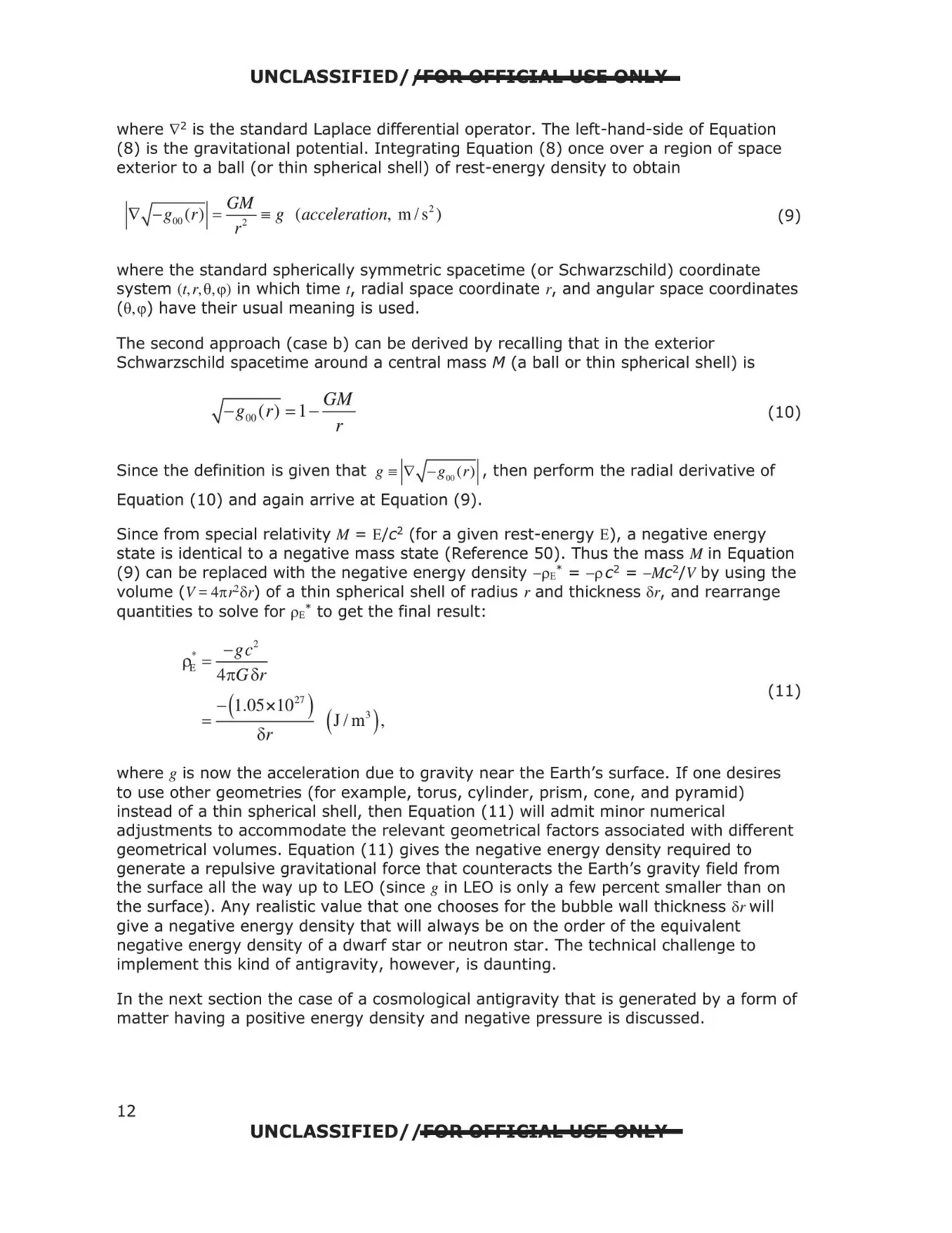
where V2 is the standard Laplace differential operator. The left-hand-side of Equation
(8) is the gravitational potential. Integrating Equation (8) once over a region of space
exterior to a ball (or thin spherical shell) of rest-energy density to obtain
lv.J-g00 (r)I = G~ = g (acceleration, m/s2 )
(9)
r
where the standard spherically symmetric spacetime (or Schwarzschild) coordinate
system (t,r,0,<p) in which time t, radial space coordinate r, and angular space coordinates
(0,<p) have their usual meaning is used.
The second approach (case b) can be derived by recalling that in the exterior
Schwarzschild spacetime around a central mass M (a ball or thin spherical shell) is
,----
GM
✓-g oo (r) =1--
(10)
r
Since the definition is given that g = Iv
.J-g00 (r)I, then perform the radial derivative of
Equation (10) and again arrive at Equation (9).
Since from special relativity M = E/c2 (for a given rest-energy E), a negative energy
state is identical to a negative mass state (Reference 50). Thus the mass Min Equation
(9) can be replaced with the negative energy density - pE * = - p c2 = - Mc2/V by using the
volume (V = 4nr28r) of a thin spherical shell of radius rand thickness 8r, and rearrange
quantities to solve for PE* to get the final result:
•
- gc
2
PE= 41tG8r
(11)
-(1.05 X 1027 )
=
or
where g is now the acceleration due to gravity near the Earth's surface. If one desires
to use other geometries (for example, torus, cylinder, prism, cone, and pyramid)
instead of a thin spherical shell, then Equation (11) will admit minor numerical
adjustments to accommodate the relevant geometrical factors associated with different
geometrical volumes. Equation (11) gives the negative energy density required to
generate a repulsive gravitational force that counteracts the Earth's gravity field from
the surface all the way up to LEO (since g in LEO is only a few percent smaller than on
the surface). Any realistic value that one chooses for the bubble wall thickness 8rwill
give a negative energy density that will always be on the order of the equivalent
negative energy density of a dwarf star or neutron star. The technical challenge to
implement this kind of antigravity, however, is daunting.
In the next section the case of a cosmological antigravity that is generated by a form of
matter having a positive energy density and negative pressure is discussed.
UNCLASSIFIED//FOA OFFI&IAb Yi&: 8,.bY
12