AAWSAP DIRD, Antigravity for Aerospace Applications, March 2010
DOW-UAP-D135 · page 25 of 44
Text
This text came with the file. It may have mistakes. When the text and the image disagree, the image is right.
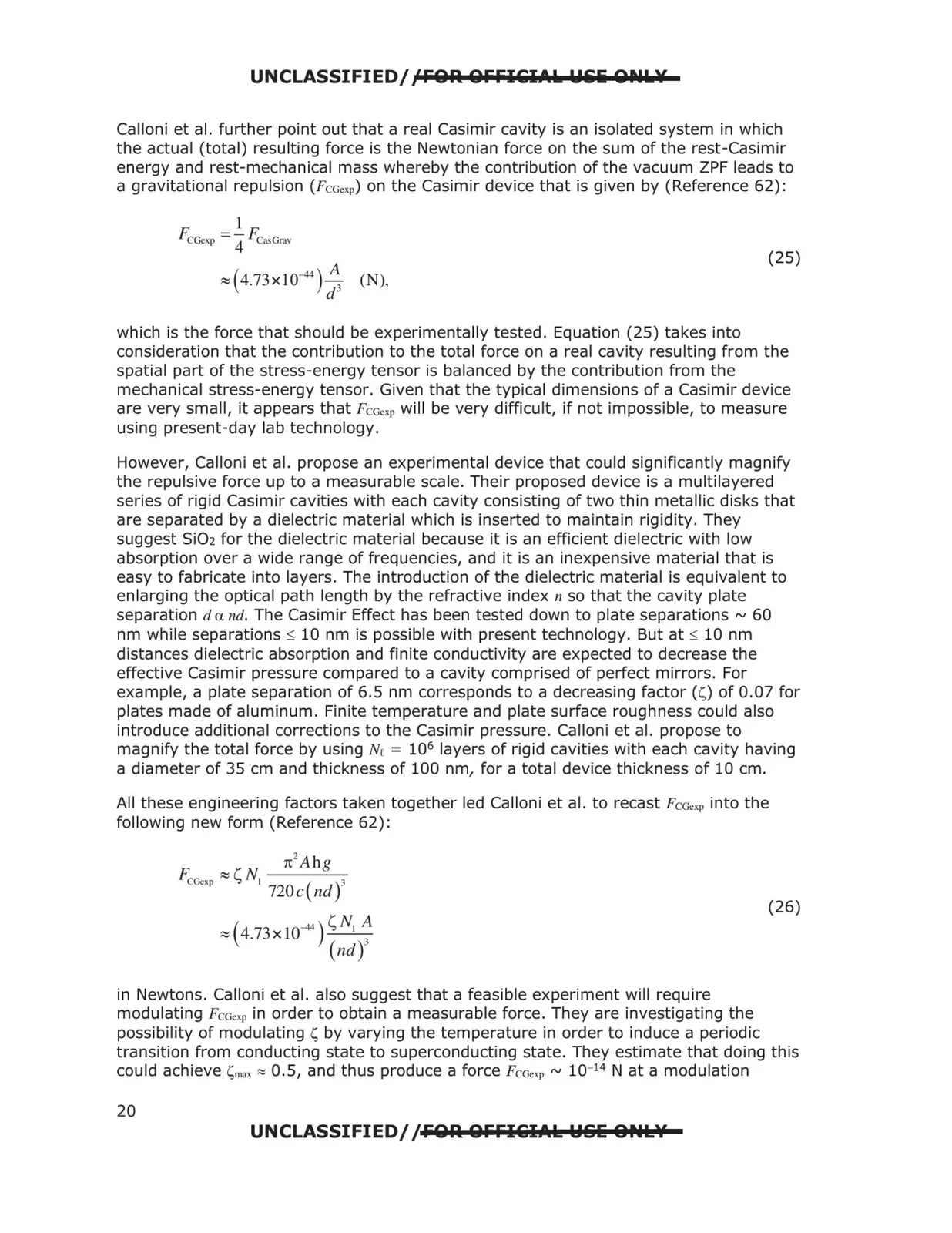
UNCLASSIFIED/fFOA OFFIEIAk W&i 0Pilk¥ Calloni et al. further point out that a real Casimir cavity is an isolated system in which the actual (total) resulting force is the Newtonian force on the sum of the rest-Casimir energy and rest-mechanical mass whereby the contribution of the vacuum ZPF leads to a gravitational repulsion (FcGexp ) on the Casimir device that is given by (Reference 62): 1 FCGexp = 4FcasGrav (25) which is the force that should be experimentally tested. Equation (25) takes into consideration that the contribution to the total force on a real cavity resulting from the spatial part of the stress-energy tensor is balanced by the contribution from the mechanical stress-energy tensor. Given that the typical dimensions of a Casimir device are very small, it appears that FcGexp will be very difficult, if not impossible, to measure using present-day lab technology. However, Calloni et al. propose an experimental device that could significantly magnify the repulsive force up to a measurable scale. Their proposed device is a multilayered series of rigid Casimir cavities with each cavity consisting of two thin metallic disks that are separated by a dielectric material which is inserted to maintain rigidity. They suggest SiO2 for the dielectric material because it is an efficient dielectric with low absorption over a wide range of frequencies, and it is an inexpensive material that is easy to fabricate into layers. The introduction of the dielectric material is equivalent to enlarging the optical path length by the refractive index n so that the cavity plate separation d and. The Casimir Effect has been tested down to plate separations ~60 nm while separations~ 10 nm is possible with present technology. But at :::; 10 nm distances dielectric absorption and finite conductivity are expected to decrease the effective Casimir pressure compared to a cavity comprised of perfect mirrors. For example, a plate separation of 6.5 nm corresponds to a decreasing factor (½) of 0.07 for plates made of aluminum. Finite temperature and plate surface roughness could also introduce additional corrections to the Casimir pressure. Calloni et al. propose to magnify the total force by using Ne = 106 layers of rigid cavities with each cavity having a diameter of 35 cm and thickness of 100 nm, for a total device thickness of 10 cm. All these engineering factors taken together led Calloni et al. to recast FcGexp into the following new form (Reference 62): 1t2Ahg F r::;rN-- cc.e,r "' 1 720 c( nd)3 (26) r:,;(4.73x10-44 )sN, ~ (nd) in Newtons. Calloni et al. also suggest that a feasible experiment will require modulating F cGexp in order to obtain a measurable force. They are investigating the possibility of modulating ½by varying the temperature in order to induce a periodic transition from conducting state to superconducting state. They estimate that doing this could achieve ½max z 0.5, and thus produce a force F cGexp ~ 10-14 N at a modulation UNCLASSIFIED//FOA OFFI&IAb Yi&: 8,.bY 20