AAWSAP DIRD, Antigravity for Aerospace Applications, March 2010
DOW-UAP-D135 · page 24 of 44
Text
This text came with the file. It may have mistakes. When the text and the image disagree, the image is right.
UNCLASSIFIED/ fFOA OFFIEIA~ W&li QPI~¥
However, this isn't the entire story because there are many interesting quantum field
theoretic phenomenon that exist outside of that which arises in quantum corrections to
Newtonian gravity. In what follows, the recent discovery of antigravity forces that arise
within both QED vacuum fluctuation and nonretarded quantum interatomic dispersion
force theories in curved spacetime are reviewed.
ANTIGRAVITY VIA QUANTUM VACUUM ZERO-POINT FLUCTUATION
FORCE
Calloni et al. (Reference 61,62) explored the possibility of verifying the equivalence
principle for the zero-point energy of quantum electrodynamics (QED). They used semi
classical quantum gravity theory to evaluate the net force produced by quantum
vacuum zero-point fluctuations (ZPF) acting on a rigid Casimir cavity in a weak
gravitational field. Their analysis assumed the rigid Casimir cavity to be a non-isolated
system at rest in the Earth's gravitational field, which is modeled using the standard
Schwarzschild spacetime metric geometry, so that they could evaluate the regularized
(or renormalized) stress-energy tensor, ('r,,:: I..,., 11 of the quantized vacuum
electromagnetic field between two plane-parallel ideal metallic plates lying in a
horizontal plane. (r.:::J .. encodes the Casimir Effect which has a negative energy
density and a negative pressure along the vertical (acceleration) axis between the
plates. {See Appendix A for more information about the Casimir Effect.) Their results
agreed with the equivalence principle because they showed that quantum vacuum ZPF
(that is, virtual quanta) do gravitate because the energy of each ZPF mode is redshifted
by the factor (-g00 )"' =[1-(2cM tc'r)J'" even though the modes remain unchanged. In
other words, the electromagnetic vacuum state in a weak gravitational field is
redshifted. This effect remains true for strong gravitational fields.
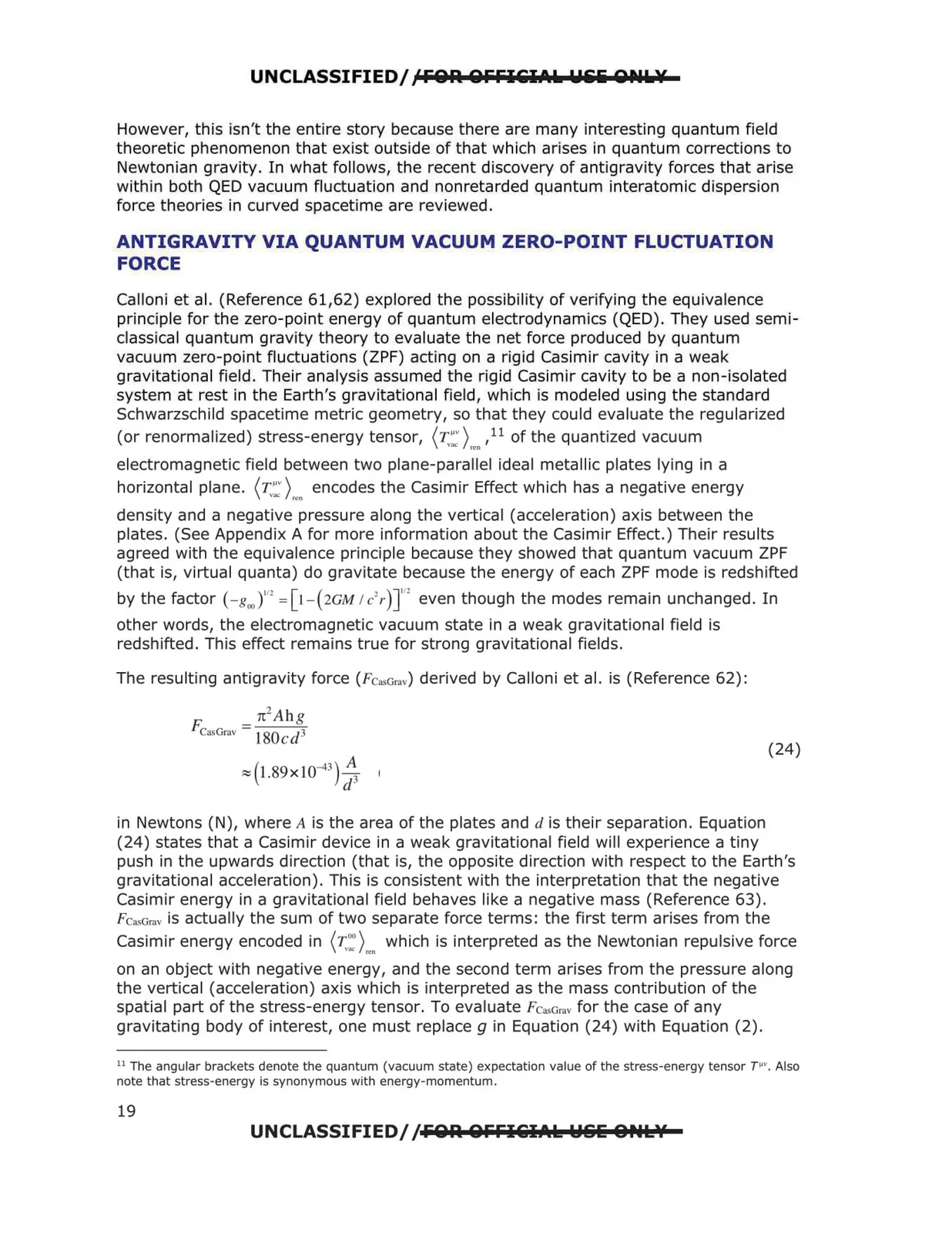
The resulting antigravity force (Fc asGrav) derived by Calloni et al. is (Reference 62):
F.
_ 11:2A hg
CasGrav - 180cd3
(24)
:::; ( 1.89x 10-43); I
in Newtons (N), where A is the area of the plates and dis their separation. Equation
(24) states that a Casimir device in a weak gravitational field will experience a tiny
push in the upwards direction (that is, the opposite direction with respect to the Earth's
gravitational acceleration). This is consistent with the interpretation that the negative
Casimir energy in a gravitational field behaves like a negative mass (Reference 63) .
F ca,arnv is actually the sum of two separate force terms: the first term arises from the
Casimir energy encoded in (r.,: ),,. which is interpreted as the Newtonian repulsive force
on an object with negative energy, and the second term arises from the pressure along
the vertical (acceleration) axis which is interpreted as the mass contribution of the
spatial part of the stress-energy tensor. To evaluate F casGrav for the case of any
gravitating body of interest, one must replace gin Equation (24) with Equation (2).
11 The angular brackets denote the quantum (vacuum state) expectation value of the stress-energy tensor P ". Also
note that stress-energy is synonymous with energy-momentum.
UNCLASSIFIED/ /FOA OFFI&IAk Yi& 8,.k\f
19