AAWSAP DIRD, Antigravity for Aerospace Applications, March 2010
DOW-UAP-D135 · page 35 of 44
Text
This text came with the file. It may have mistakes. When the text and the image disagree, the image is right.
UNCLASSIFIED/ fFOA OFFIEIAL: U&i QPIL:¥
weaker fluctuations and thus less energy density than the vacuum at locations where
cos2 [ro(t - z/c)] =1 and sin2[ro(t - z/c)] << 1; but with greater fluctuations and thus
greater energy density than the vacuum at locations where cos 2[ro(t - z/c)] < < 1 and
sin 2[ro(t - z/c)] =1. Since the vacuum is defined to have vanishing energy density, any
region with less energy density than the vacuum actually has a negative (renormalized)
expectation value for the energy density. Therefore, a squeezed vacuum state consists
of a traveling electromagnetic wave that oscillates back and forth between negative
energy density and positive energy density, but has positive time-averaged energy
density.
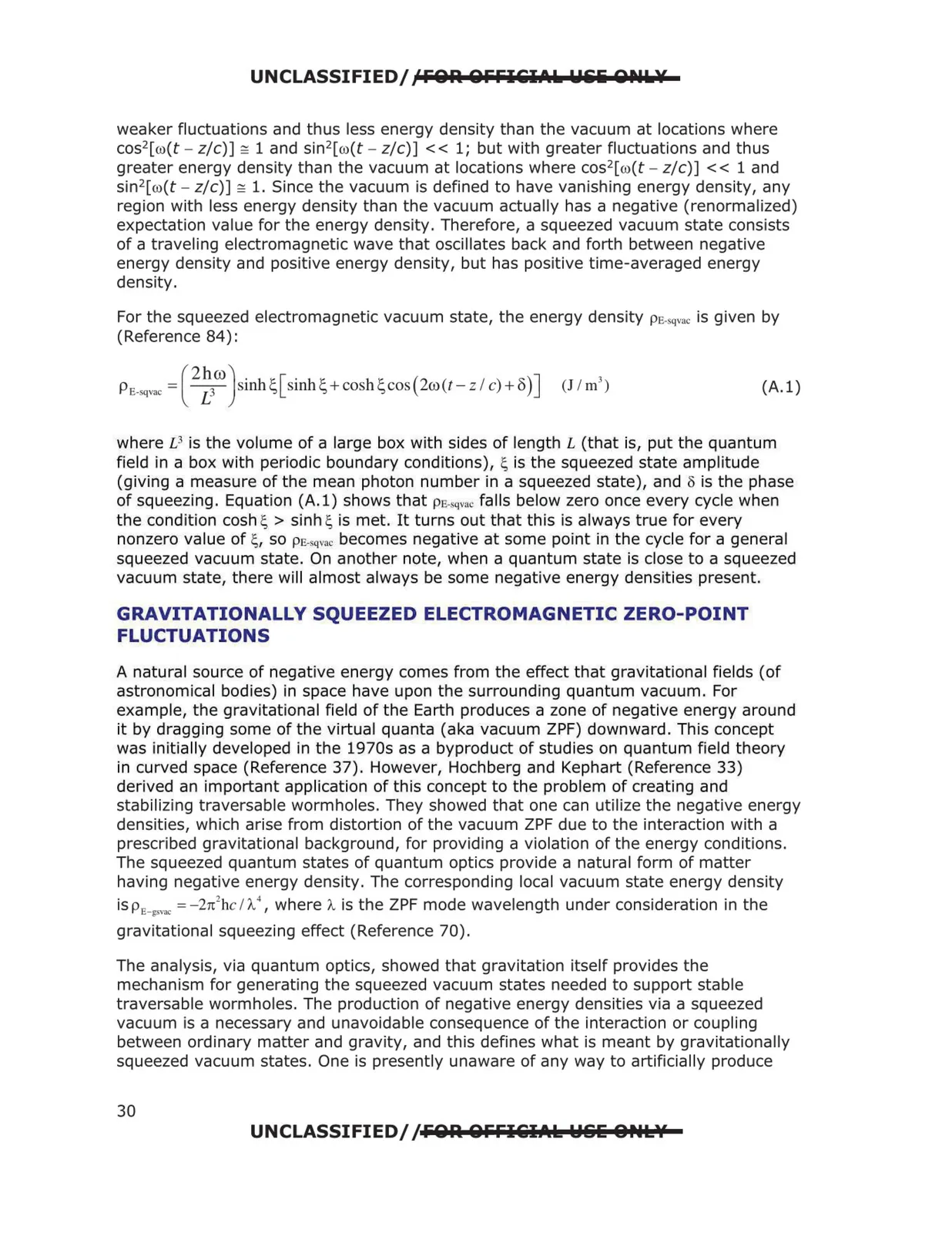
For the squeezed electromagnetic vacuum state, the energy density P E-sqvac is given by
( Reference 84):
P E-sqvac = ( 2~(0} inh ~[sinh ~ + cosh ~cos (2ro(t- z I c) + o)]
(J / m3)
(A.1)
where L3 is the volume of a large box with sides of length L (that is, put the quantum
field in a box with periodic boundary conditions), sis the squeezed state amplitude
(giving a measure of the mean photon number in a squeezed state), and 8 is the phase
of squeezing. Equation (A.1) shows that p -sqvac falls below zero once every cycle when
the condition cosh s > sinh sis met. It turns out that this is always true for every
nonzero value of s, so P E-sqvac becomes negative at some point in the cycle for a general
squeezed vacuum state. On another note, when a quantum state is close to a squeezed
vacuum state, there will almost always be some negative energy densities present.
GRAVITATIONALLY SQUEEZED ELECTROMAGNETIC ZERO-POINT
FLUCTUATIONS
A natural source of negative energy comes from the effect that gravitational fields (of
astronomical bodies) in space have upon the surrounding quantum vacuum. For
example, the gravitational field of the Earth produces a zone of negative energy around
it by dragging some of the virtual quanta (aka vacuum ZPF) downward. This concept
was initially developed in the 1970s as a byproduct of studies on quantum field theory
in curved space (Reference 37). However, Hochberg and Kephart (Reference 33)
derived an important application of this concept to the problem of creating and
stabilizing traversable wormholes. They showed that one can utilize the negative energy
densities, which arise from distortion of the vacuum ZPF due to the interaction with a
prescribed gravitational background, for providing a violation of the energy conditions.
The squeezed quantum states of quantum optics provide a natural form of matter
having negative energy density. The corresponding local vacuum state energy density
is P E-gsvac =-27r2hc IA 4 , where "- is the ZPF mode wavelength under consideration in the
gravitational squeezing effect (Reference 70).
The analysis, via quantum optics, showed that gravitation itself provides the
mechanism for generating the squeezed vacuum states needed to support stable
traversable wormholes. The production of negative energy densities via a squeezed
vacuum is a necessary and unavoidable consequence of the interaction or coupling
between ordinary matter and gravity, and this defines what is meant by gravitationally
squeezed vacuum states. One is presently unaware of any way to artificially produce
UNCLASSIFIED/ /FOA OFFI&IAk Yi& 8,.k\f
30