AAWSAP DIRD, Biosensors and BioMEMS: A Survey of the Present Field, March 2010
DOW-UAP-D136 · page 11 of 45
Text
This text came with the file. It may have mistakes. When the text and the image disagree, the image is right.
UNCLASSIFIED//P'OR: OP'P'l@IAL WS& 8NI.¥
The Neural Probe chip enables precise bi-directional positioning of the microelectrodes
in the brain with a step resolution in the order of 8.8 µm. The thermal microactuators
allow for a movement of the microelectrodes of up to 5 mm in either direction making it
suitable for positioning microelectrodes in deep structures of a rodent brain.
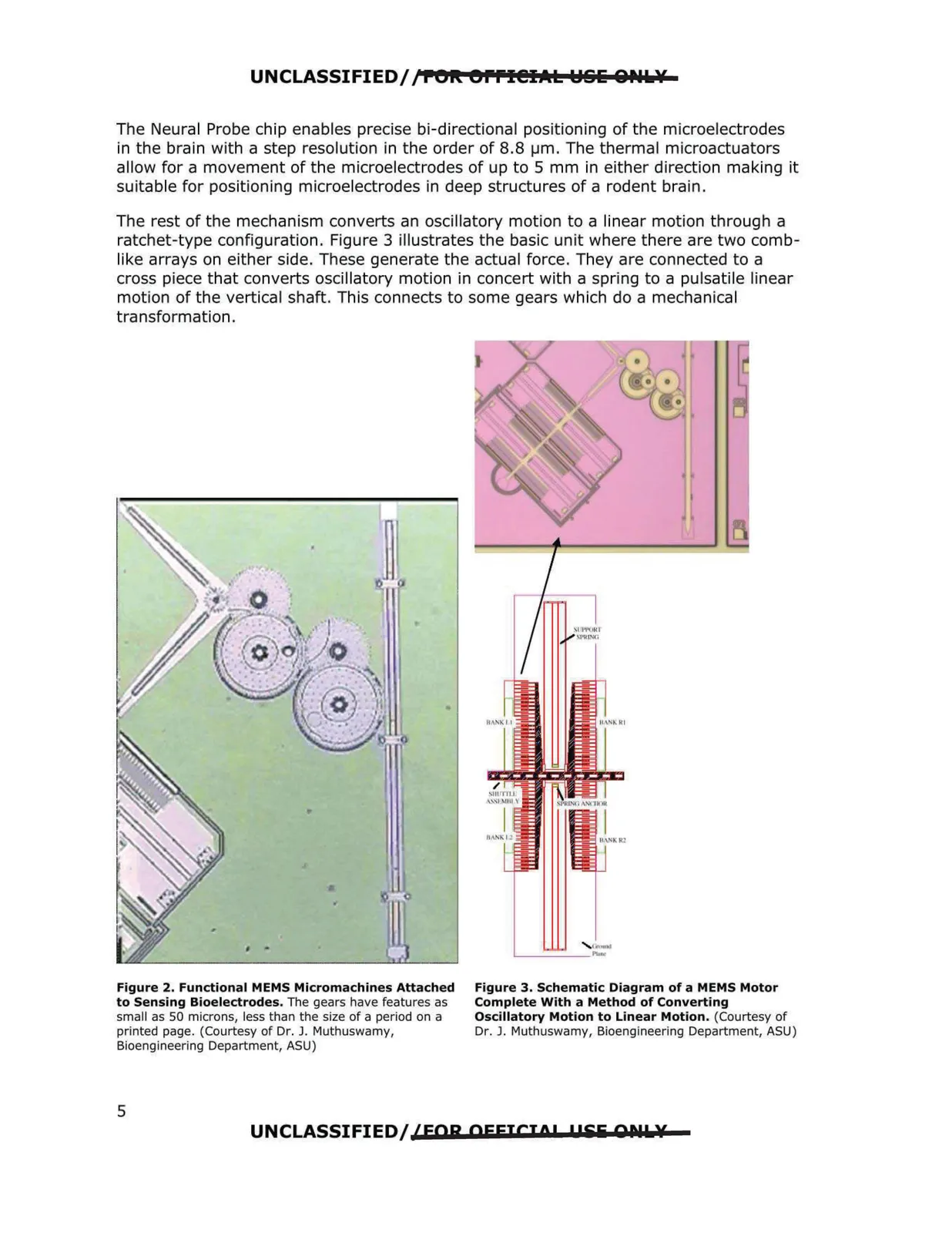
The rest of the mechanism converts an oscillatory motion to a linear motion through a
ratchet-type configuration. Figure 3 illustrates the basic unit where there are two comb
like arrays on either side. These generate the actual force. They are connected to a
cross piece that converts oscillatory motion in concert with a spring to a pulsatile linear
motion of the vertical shaft. This connects to some gears which do a mechanical
transformation.
Figure 2. Functional MEMS Micromachines Attached
to Sensing Bioelectrodes. The gears have features as
small as 50 microns, less than the size of a period on a
printed page. (Courtesy of Dr. J. Muthuswamy,
Bioengineering Department, ASU)
,
fon•11,
~---...~
Figure 3. Schematic Diagram of a MEMS Motor
Complete With a Method of Converting
Oscillatory Motion to Linear Motion. (Courtesy of
Dr. J. Muthuswamy, Bioengineering Department, ASU)
UNCLASSIFIED/ {FOR OFFICIO! !Pfli ODIi.¥
5