AAWSAP DIRD, Biosensors and BioMEMS: A Survey of the Present Field, March 2010
DOW-UAP-D136 · page 12 of 45
Text
This text came with the file. It may have mistakes. When the text and the image disagree, the image is right.
UNCLASSIFIED//P'OR: OP'P'l@IAL WS& 0Nk¥
Figure 4 illustrates the basic physics where the force is generated. A voltage V, is
applied to the horizontal sliding shaft. There arises an electrical field (shown as the
curved arrow) that tends to pull the shaft into the cavity between the two outer combs.
This is the basic motive force of the device. The force generated by each comb is very
small so there are constructed many similar structures that form a comb-array. All of
the forces act in parallel.
(1)
V
(3)
Figure 4. Illustration of the Basic Physical Principle of the BioMEMS Motor (Muthuswamy et al.)
The device is fabricated by using Sandia's Ultraplanar Multi-level MEMS Technology
(SUMMiTV) process, a 5-layer polysilicon micromachining technology. The layers are
chemically sensitive to different processes and can be selectively removed by etching
with different reagents.
For example silicon can be removed
using an etchant which preferentially
removes silicon only along certain
crystalline planes. Other layers can be
undermined through the use of acids.
The components of the micromachine
are patterned on the silicon using
photoresist masks. A mask is a covering
which prevents parts of the silicon from
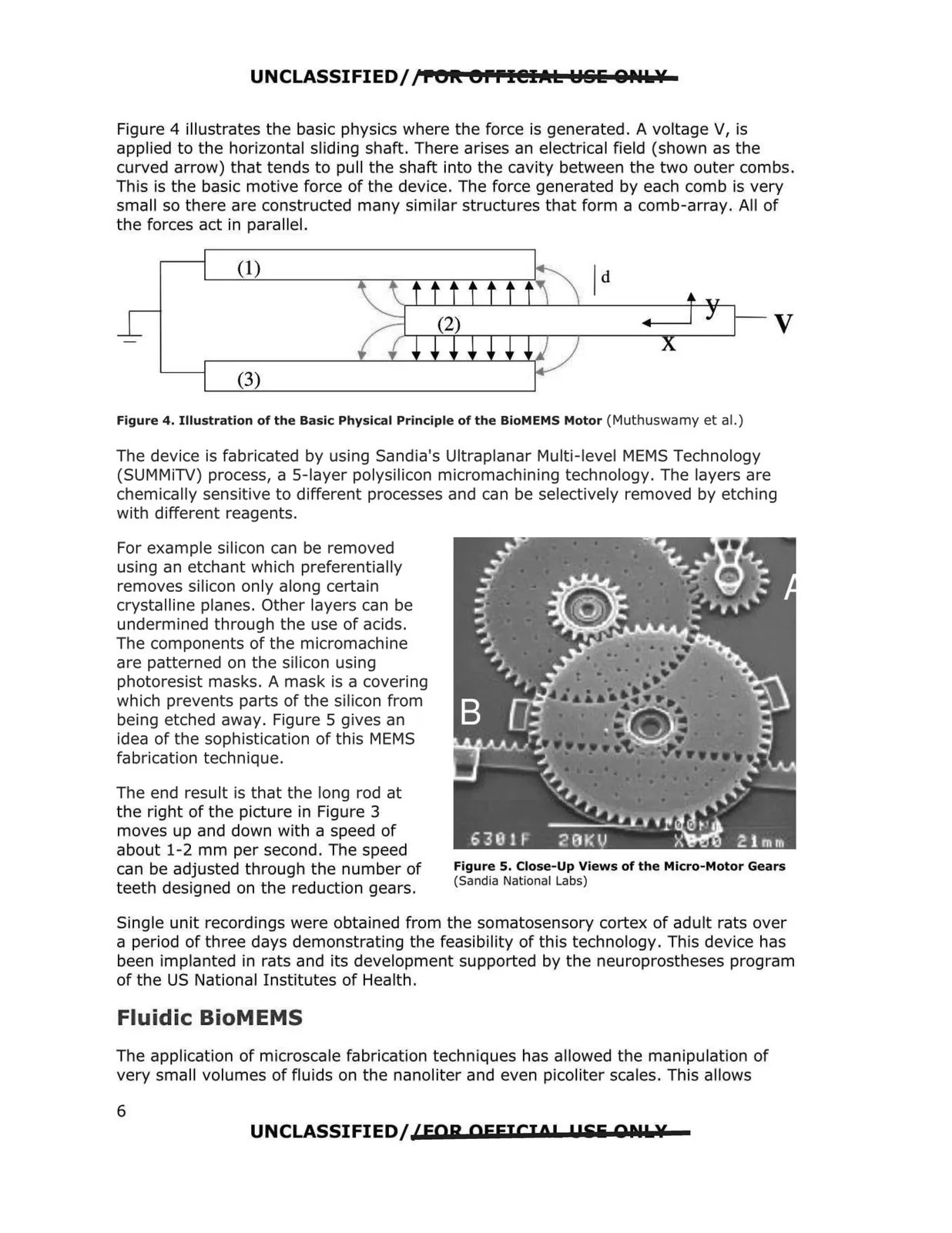
being etched away. Figure 5 gives an
idea of the sophistication of this MEMS
fabrication technique.
The end result is that the long rod at
the right of the picture in Figure 3
moves up and down with a speed of
about 1-2 mm per second. The speed
can be adjusted through the number of
teeth designed on the reduction gears.
Single unit recordings were obtained from the somatosensory cortex of adult rats over
a period of three days demonstrating the feasibility of this technology. This device has
been implanted in rats and its development supported by the neuroprostheses program
of the US National Institutes of Health.
Fluidic BioMEMS
The application of microscale fabrication techniques has allowed the manipulation of
very small volumes of fluids on the nanoliter and even picoliter scales. This allows
6
UNCLASSIFIED/ (FOR OFFICIO! P!Sli Qllk¥
Figure s. Close-Up Views of the Micro-Motor Gears
(Sandia National Labs)