AAWSAP DIRD, Biosensors and BioMEMS: A Survey of the Present Field, March 2010
DOW-UAP-D136 · page 20 of 45
Text
This text came with the file. It may have mistakes. When the text and the image disagree, the image is right.
UNCLASSIFIED//P'OR: OP'P'l@IAL WS& 0Nk¥
COMMERCIAL BLOOD GLUCOSE SENSORS
The present method of blood glucose monitoring depends on a needle puncture of the
skin to withdraw a drop of blood to place on a color changing test strip. The test strip is
read by a small handheld reader. Glucose test strips do not have to necessarily be
small, but by making the sensor very small the amount of blood required for the test is
reduced. The sensors often are made by techniques of photolithography or in some
cases by microscale screen printing in order to achieve reproducibility.
The skin-puncture test is painful and time consuming, and thus noninvasiveness is the
key desired characteristic of glucose sensors. Research is being directed at a
noninvasive glucose sensor that is accurate enough to work external to the body and
through the skin. Short term (a few days) wearable needle glucose sensors are
available from major companies like Medtronic Inc. but fall short of the convenience of
a noninvasive sensor.
ENZYME-BASED BIOSENSORS
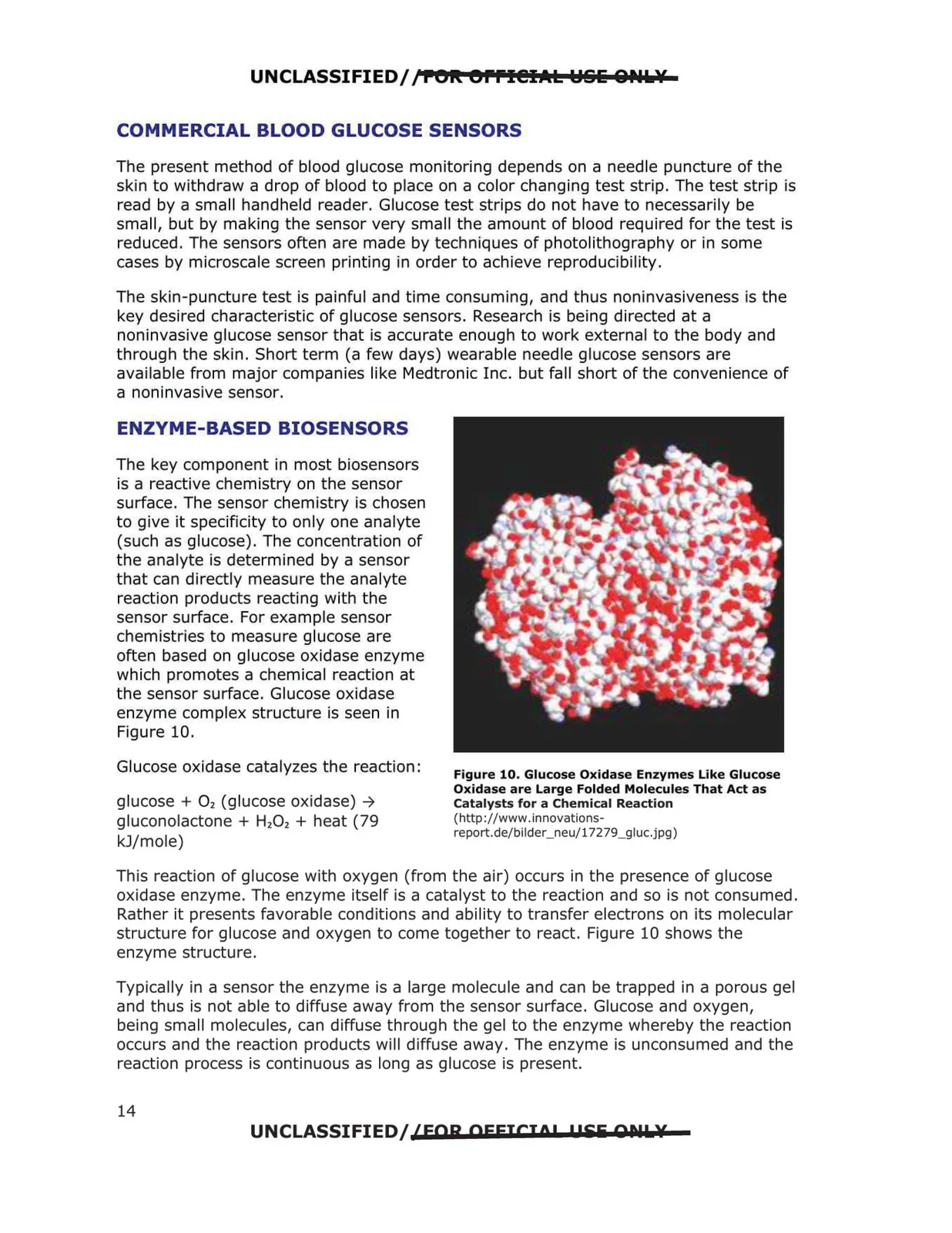
The key component in most biosensors
is a reactive chemistry on the sensor
surface. The sensor chemistry is chosen
to give it specificity to only one analyte
(such as glucose). The concentration of
the analyte is determined by a sensor
that can directly measure the analyte
reaction products reacting with the
sensor surface. For example sensor
chemistries to measure glucose are
often based on glucose oxidase enzyme
which promotes a chemical reaction at
the sensor surface. Glucose oxidase
enzyme complex structure is seen in
Figure 10.
Glucose oxidase catalyzes the reaction:
glucose + 0 2 (glucose oxidase) ➔
gluconolactone + H2O2 + heat (79
kJ/mole)
This reaction of glucose with oxygen (from the air) occurs in the presence of glucose
oxidase enzyme. The enzyme itself is a catalyst to the reaction and so is not consumed.
Rather it presents favorable conditions and ability to transfer electrons on its molecular
structure for glucose and oxygen to come together to react. Figure 10 shows the
enzyme structure.
Typically in a sensor the enzyme is a large molecule and can be trapped in a porous gel
and thus is not able to diffuse away from the sensor surface. Glucose and oxygen,
being small molecules, can diffuse through the gel to the enzyme whereby the reaction
occurs and the reaction products will diffuse away. The enzyme is unconsumed and the
reaction process is continuous as long as glucose is present.
UNCLASSIFIED/ {FOR OFFICIO! !PEii QDlk¥
Figure 10. Glucose Oxidase Enzymes Like Glucose
Oxidase are Large Folded Molecules That Act as
Catalysts for a Chemical Reaction
(http://www. innovations-
report.de/bilder _neu/17279_gluc.jpg)
14