AAWSAP DIRD, Biosensors and BioMEMS: A Survey of the Present Field, March 2010
DOW-UAP-D136 · page 26 of 45
Text
This text came with the file. It may have mistakes. When the text and the image disagree, the image is right.
UNCLASSIFIED//P'OR: OP'P'l@IAL WS& 8NI.¥
thermoelectric sensors have improved reproducibility of the sensors, but there has only
been limited success in applications of implantation into the body.
Neuroengineering by BioMEMS
BioMEMS types of devices, as we understand them today, were used first in
neuroscience. There has been a long history of the study of the electrical nature of body
tissue dating back to the days of Galvani and Volta. Frog nerves were found to be
electrically stimulatable and the first recordings of bioelectrical events were
accomplished very early with the invention of the string galvanometer.
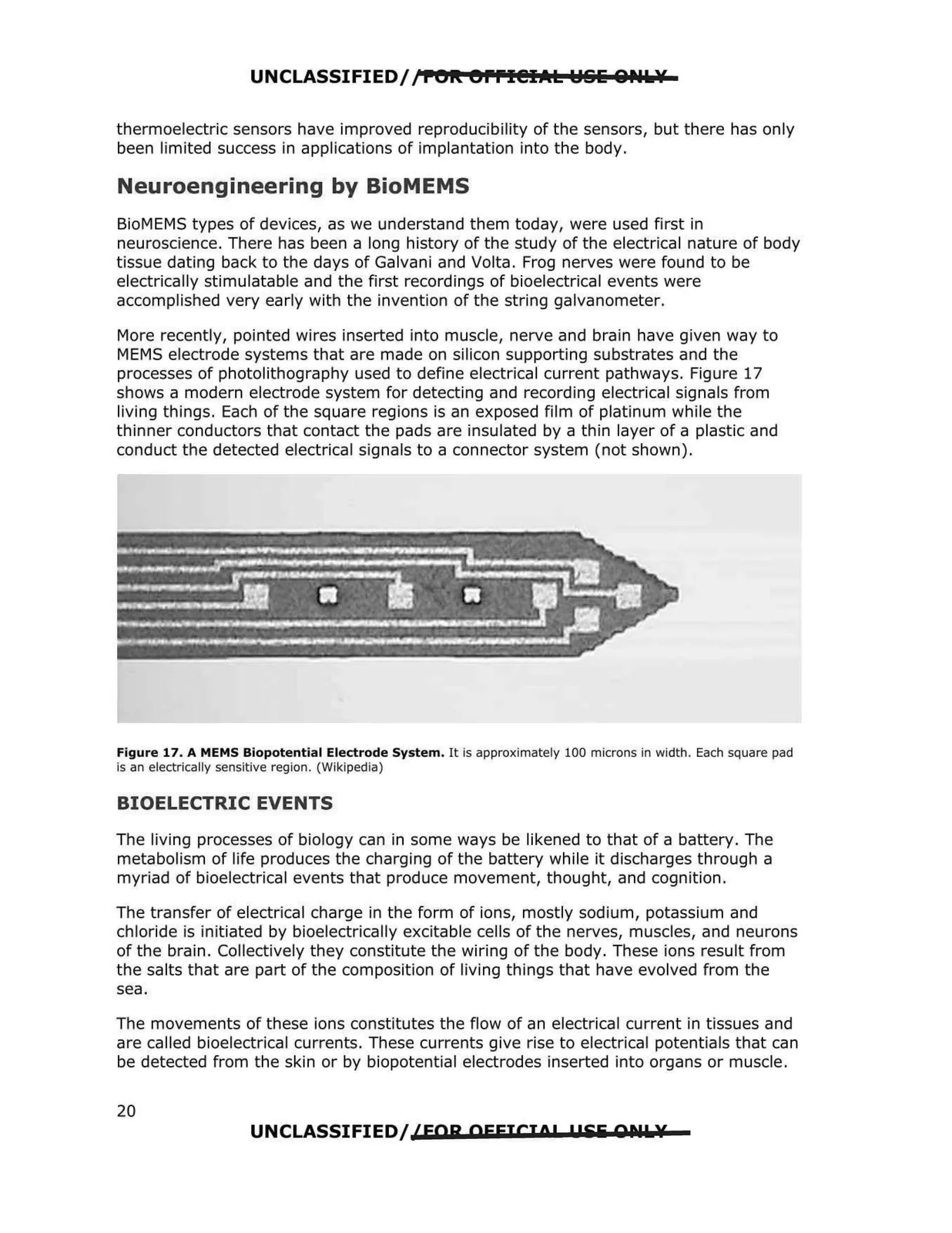
More recently, pointed wires inserted into muscle, nerve and brain have given way to
MEMS electrode systems that are made on silicon supporting substrates and the
processes of photolithography used to define electrical current pathways. Figure 17
shows a modern electrode system for detecting and recording electrical signals from
living things. Each of the square regions is an exposed film of platinum while the
thinner conductors that contact the pads are insulated by a thin layer of a plastic and
conduct the detected electrical signals to a connector system (not shown).
Figure 17. A MEMS Biopotential Electrode System. It is approximately 100 microns in width. Each square pad
is an electrically sensitive region. (Wikipedia)
BIOELECTRIC EVENTS
The living processes of biology can in some ways be likened to that of a battery. The
metabolism of life produces the charging of the battery while it discharges through a
myriad of bioelectrical events that produce movement, thought, and cognition.
The transfer of electrical charge in the form of ions, mostly sodium, potassium and
chloride is initiated by bioelectrically excitable cells of the nerves, muscles, and neurons
of the brain. Collectively they constitute the wiring of the body. These ions result from
the salts that are part of the composition of living things that have evolved from the
sea.
The movements of these ions constitutes the flow of an electrical current in tissues and
are called bioelectrical currents. These currents give rise to electrical potentials that can
be detected from the skin or by biopotential electrodes inserted into organs or muscle.
UNCLASSIFIED/ {FOR OFFICIO! !Pfli ODIi.¥
20