AAWSAP DIRD, Biosensors and BioMEMS: A Survey of the Present Field, March 2010
DOW-UAP-D136 · page 27 of 45
Text
This text came with the file. It may have mistakes. When the text and the image disagree, the image is right.
UNCLASSIFIED//P'OR: OP'Pl@IAL WS& 0NI.¥
Bioelectrical events are generated in tissues when there is an electrochemical change in
the membranes of specialized cells of the brain and nervous systems.
Neuroelectrical devices interface to the brain and nervous systems through electrodes
that touch excitable cell membrane and convert ionic current flows to electron flow in a
wire. Conversely current flows in a wire are converted by electrodes to ionic flows in
tissue.
The function of the entire human body is under control of the brain and the nervous
system. So the use of electrodes of various types as a method of monitoring and
controlling the function of the nervous system through bioelectrical currents and
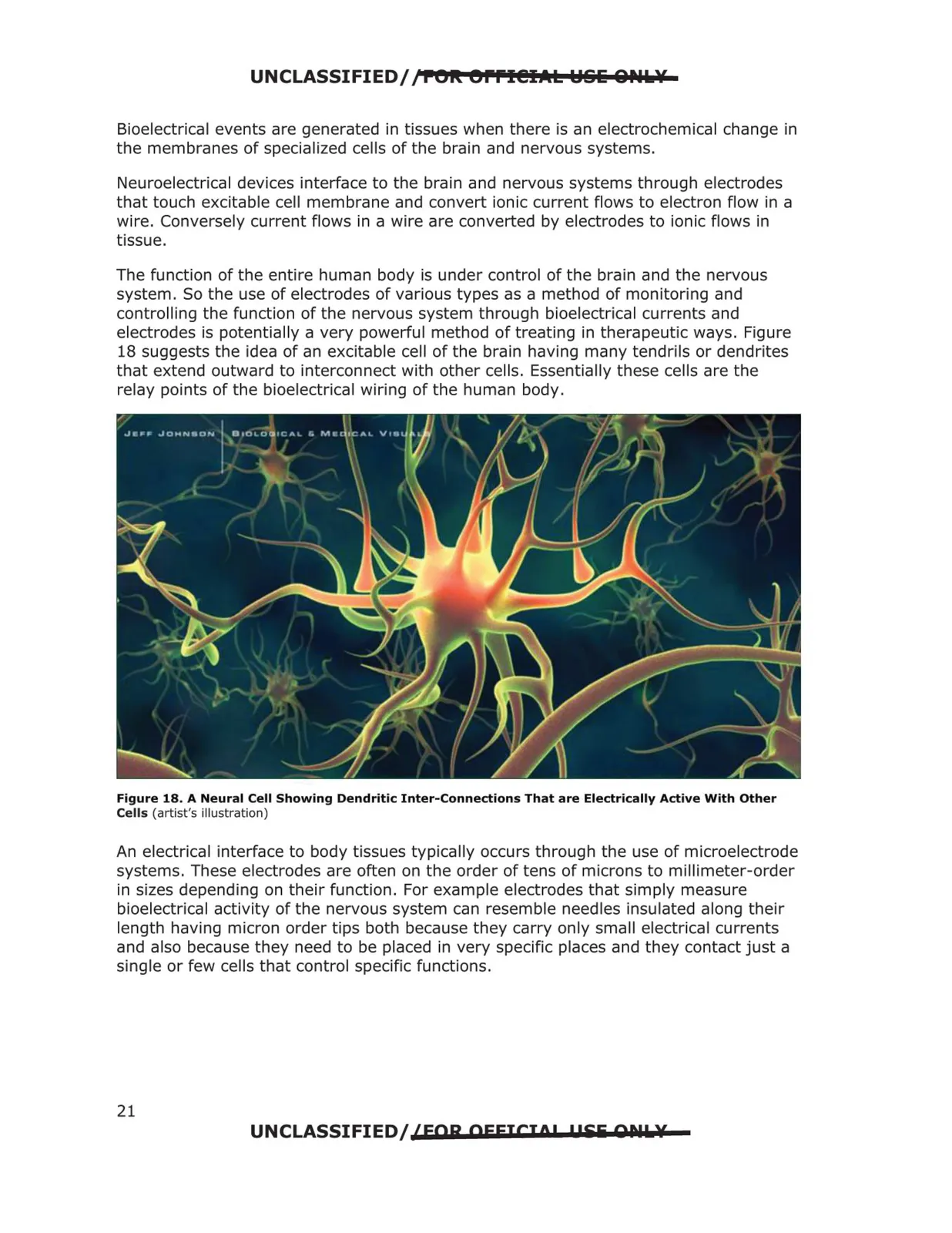
electrodes is potentially a very powerful method of treating in therapeutic ways. Figure
18 suggests the idea of an excitable cell of the brain having many tendrils or dendrites
that extend outward to interconnect with other cells. Essentially these cells are the
relay points of the bioelectrical wiring of the human body.
Figure 18. A Neural Cell Showing Dendritic Inter-Connections That are Electrically Active With Other
Cells (artist's illustration)
An electrical interface to body tissues typically occurs through the use of microelectrode
systems. These electrodes are often on the order of tens of microns to millimeter-order
in sizes depending on their function. For example electrodes that simply measure
bioelectrical activity of the nervous system can resemble needles insulated along their
length having micron order tips both because they carry only small electrical currents
and also because they need to be placed in very specific places and they contact just a
single or few cells that control specific functions.
UNCLASSIFIED/ {FOR OFFICIO! !PEii ODIi.¥
21