AAWSAP DIRD, Biosensors and BioMEMS: A Survey of the Present Field, March 2010
DOW-UAP-D136 · page 29 of 45
Text
This text came with the file. It may have mistakes. When the text and the image disagree, the image is right.
UNCLASSIFIED//P"OR: OP"P"l@IAL WSli 01'11.¥
Electrode arrays are sometimes used, such as in the case of deep brain stimulation for
late-stage Parkinson's disease, which is characterized by tremors of hands. There is a
"brain pacemaker" that sends electrical impulses to specific parts of the patient's brain
via permanently inserted electrodes. This can stop the tremors for reasons that are not
exactly known and for which the best location in a given patient to place the electrode
is also not known beforehand. Thus introducing multiple electrodes and stimulating
each one in-turn until the best result is found allows a greater degree of possible
effectiveness and therapeutic result. MEMS techniques are being employed in this
application to permit a greater number of contacts and to reduce the size of the lead
wire on the electrodes.
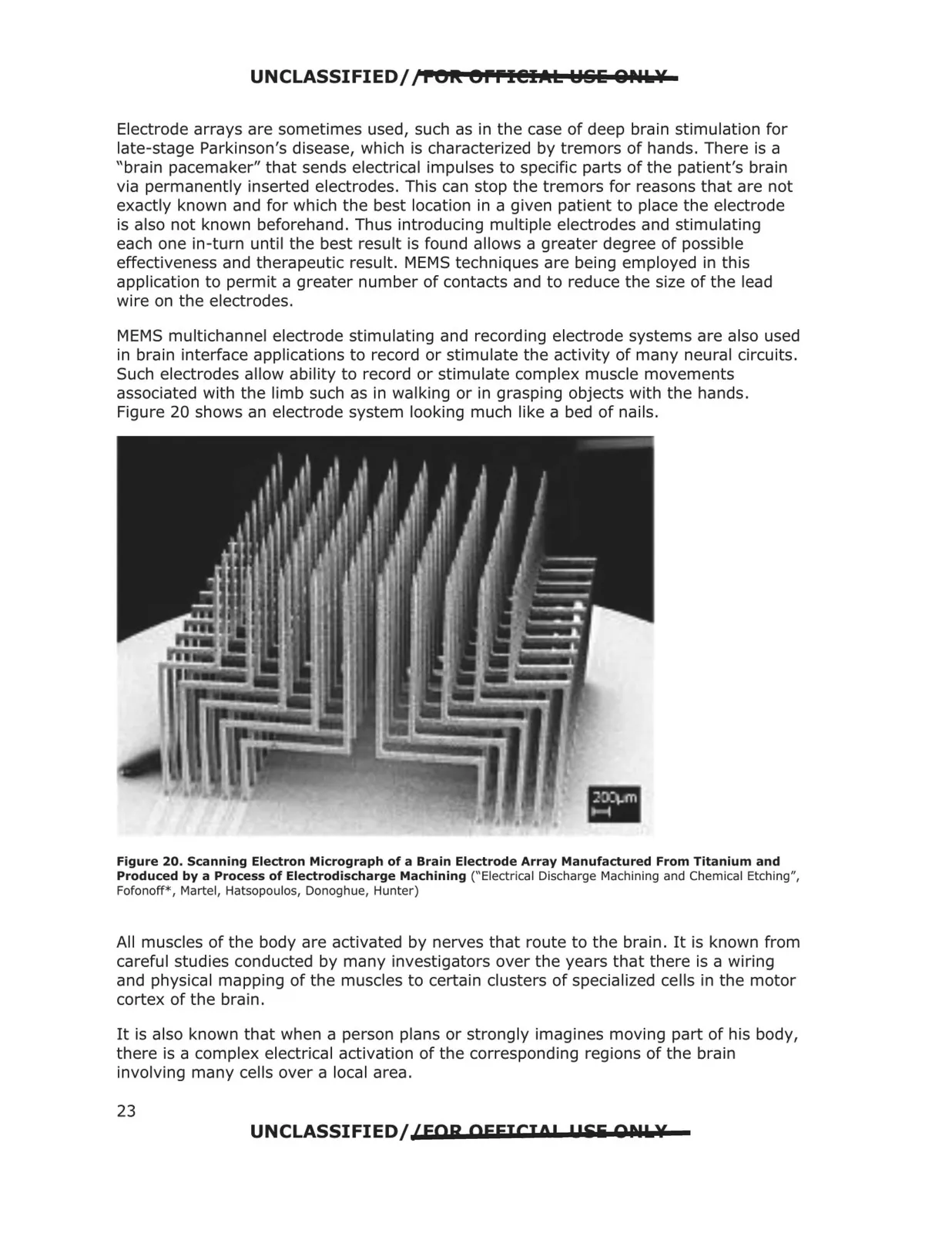
MEMS multichannel electrode stimulating and recording electrode systems are also used
in brain interface applications to record or stimulate the activity of many neural circuits.
Such electrodes allow ability to record or stimulate complex muscle movements
associated with the limb such as in walking or in grasping objects with the hands.
Figure 20 shows an electrode system looking much like a bed of nails.
Figure 20. Scanning Electron Micrograph of a Brain Electrode Array Manufactured From Titanium and
Produced by a Process of Electrodischarge Machining ("Electrical Discharge Machining and Chemical Etching",
Fofonoff* , Martel, Hatsopoulos, Donoghue, Hunter)
All muscles of the body are activated by nerves that route to the brain. It is known from
careful studies conducted by many investigators over the years that there is a wiring
and physical mapping of the muscles to certain clusters of specialized cells in the motor
cortex of the brain.
It is also known that when a person plans or strongly imagines moving part of his body,
there is a complex electrical activation of the corresponding regions of the brain
involving many cells over a local area.
UNCLASSIFIED/ (FOR OFFICJA 1 1155 01!1.¥
23