AAWSAP DIRD, Biosensors and BioMEMS: A Survey of the Present Field, March 2010
DOW-UAP-D136 · page 28 of 45
Text
This text came with the file. It may have mistakes. When the text and the image disagree, the image is right.
UNCLASSIFIED//P'OR: OP'P'l@IAL WS& 0Nk¥
Bionics and Neurointerfaces
Neuroprosthetics (also called neural
prosthetics) is a discipline related to
neuroscience and biomedical
engineering concerned with developing
neural prostheses. Neural prostheses
are devices that attempt to substitute
for a motor, sensory or cognitive
modality that might have been
damaged as a result of an injury or a
disease.
Bionics and neurointerfacing are
relatively new concepts. A
neurointerface is a combination of
software and hardware that translates
electrode signals to something which is
understood by an electronic system.
The term bionics is used when we
connect organic matter with something
artificial (human-made).
The design and development of neural
interface electrodes to the brain or
peripheral nerve has been going on for
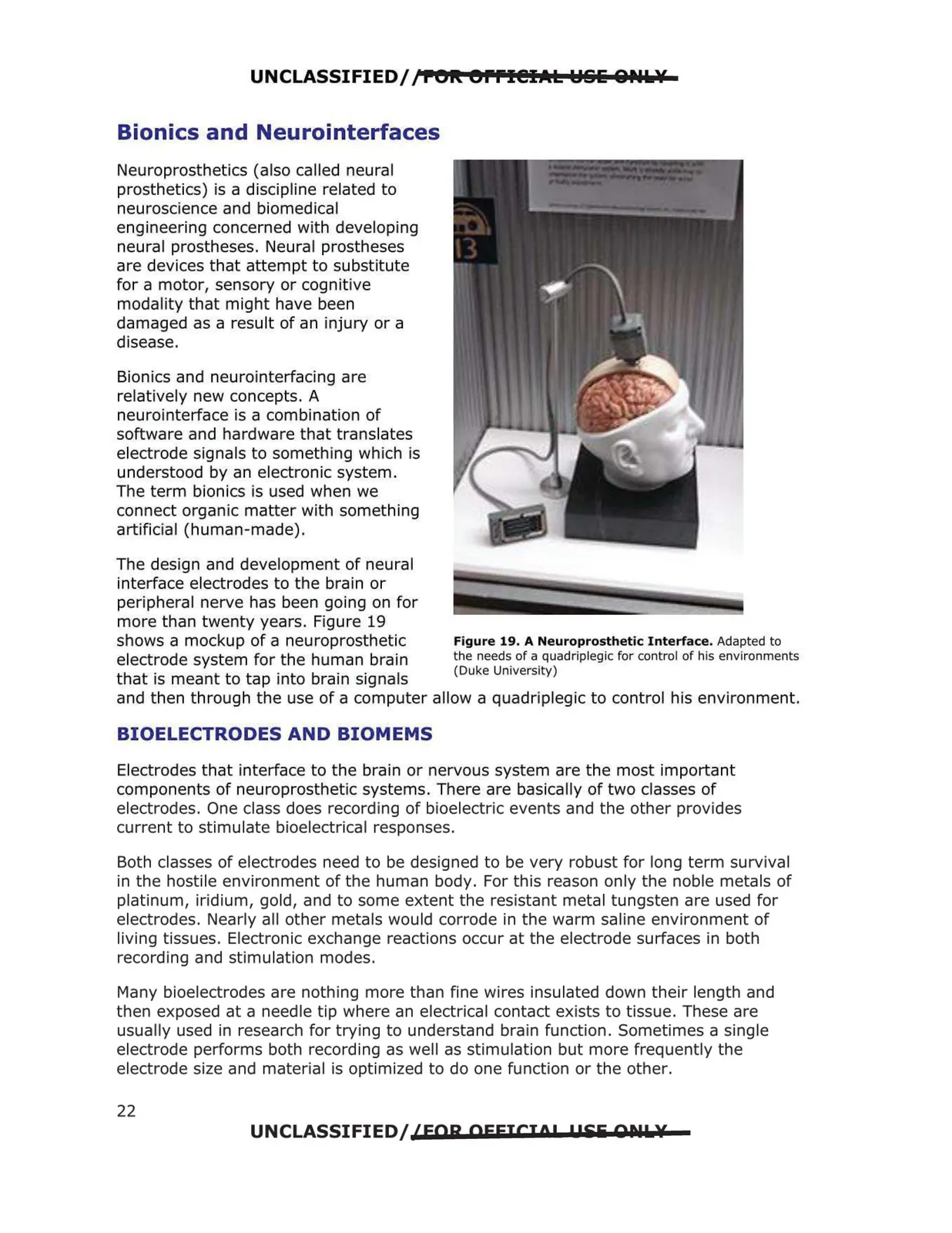
more than twenty years. Figure 19
shows a mockup of a neuroprosthetic
Figure 19. A Neuroprosthetic Interface. Adapted to
the needs of a quadriplegic for control of his environments
electrode system for the human brain
(Duke University)
that is meant to tap into brain signals
and then through the use of a computer allow a quadriplegic to control his environment.
BIOELECTRODES AND BIOMEMS
Electrodes that interface to the brain or nervous system are the most important
components of neuroprosthetic systems. There are basically of two classes of
electrodes. One class does recording of bioelectric events and the other provides
current to stimulate bioelectrical responses.
Both classes of electrodes need to be designed to be very robust for long term survival
in the hostile environment of the human body. For this reason only the noble metals of
platinum, iridium, gold, and to some extent the resistant metal tungsten are used for
electrodes. Nearly all other metals would corrode in the warm saline environment of
living tissues. Electronic exchange reactions occur at the electrode surfaces in both
recording and stimulation modes.
Many bioelectrodes are nothing more than fine wires insulated down their length and
then exposed at a needle tip where an electrical contact exists to tissue. These are
usually used in research for trying to understand brain function. Sometimes a single
electrode performs both recording as well as stimulation but more frequently the
electrode size and material is optimized to do one function or the other.
UNCLASSIFIED/ {FOR OFFICIO! !PEii QDlk¥
22