AAWSAP DIRD, Biosensors and BioMEMS: A Survey of the Present Field, March 2010
DOW-UAP-D136 · page 31 of 45
Text
This text came with the file. It may have mistakes. When the text and the image disagree, the image is right.
UNCLASSIFIED//P'OR: OP'P'l@IAL WS& 0Nk¥
BRAIN-MACHINE INTERFACES
A specific development in MEMS based neuroengineering has been the brain-machine
interface (BMI). These devices use computers to interpret brain signals from implanted
neural arrays and then use the information to control machines and setup an
automated environment.
The development of such devices can have a profound impact on the quality of life for
those individuals practically isolated because of their disabilities. Connected machines
will enable them to enjoy the everyday things we take for granted.
For example, a visual prosthesis could potentially restore partial vision to a blind patient
by stimulating neurons in the visual cortex using an input BMI. Signals could be
recorded from the motor cortex using an output BMI in order to bypass a neural injury
and restore some movement to a paralyzed patient. Even a simpler device that would
allow a patient to move a cursor on a screen would make a significant impact.
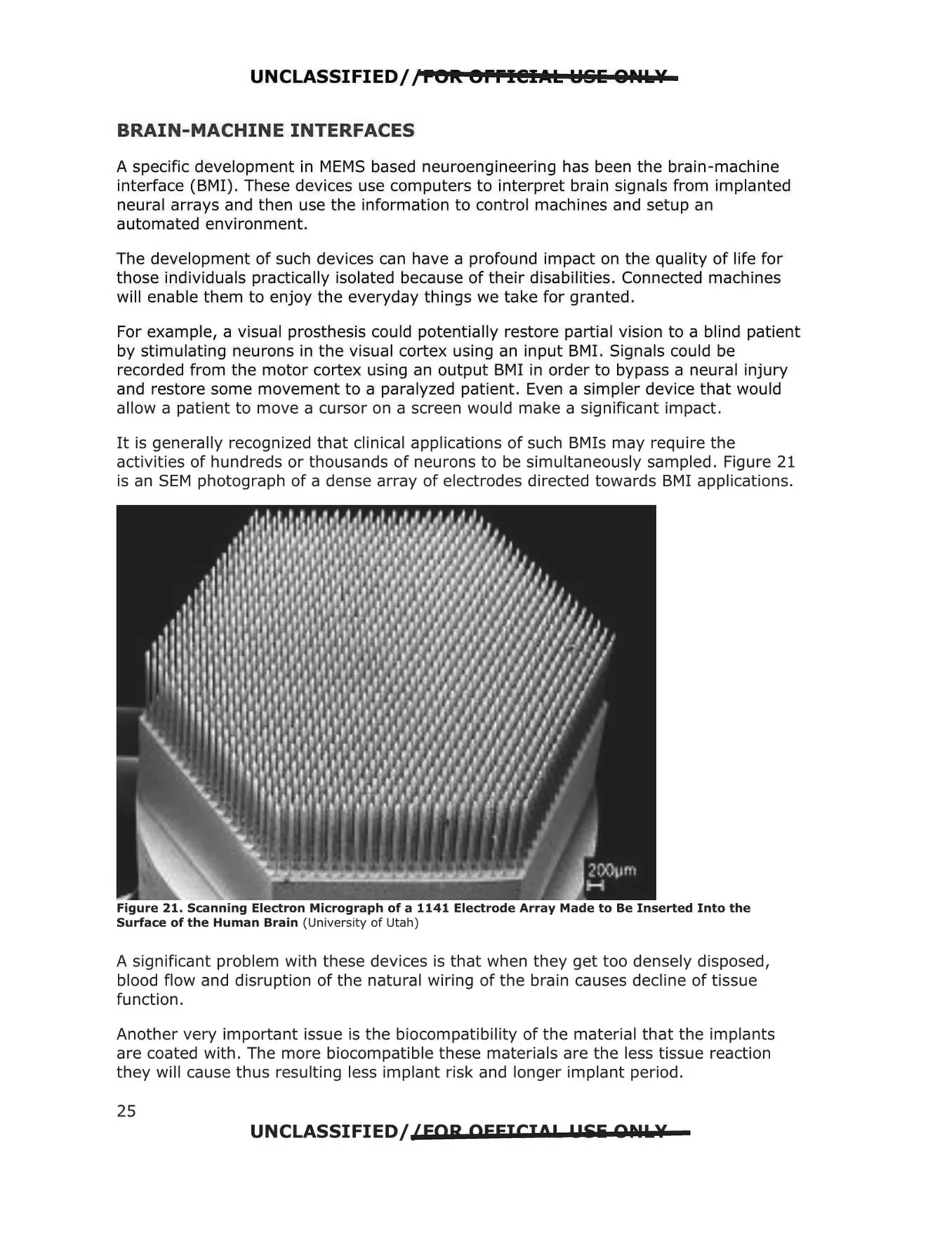
It is generally recognized that clinical applications of such BMis may require the
activities of hundreds or thousands of neurons to be simultaneously sampled. Figure 21
is an SEM photograph of a dense array of electrodes directed towards BMI applications.
Figure 21. Scanning Electron Micrograph of a 1141 Electrode Array Made to Be Inserted Into the
Surface of the Human Brain (University of Utah)
A significant problem with these devices is that when they get too densely disposed,
blood flow and disruption of the natural wiring of the brain causes decline of tissue
function.
Another very important issue is the biocompatibility of the material that the implants
are coated with. The more biocompatible these materials are the less tissue reaction
they will cause thus resulting less implant risk and longer implant period.
UNCLASSIFIED/ {FOR OFFICIO! !PEii QDlk¥
25