AAWSAP DIRD, Biosensors and BioMEMS: A Survey of the Present Field, March 2010
DOW-UAP-D136 · page 32 of 45
Text
This text came with the file. It may have mistakes. When the text and the image disagree, the image is right.
UNCLASSIFIED//P'OR: OP'P'l@IAL WS& 0Nk¥
POLYMER BIOMEMS ELECTRODES
Polymer materials like polyimide are widely used for neuroprostheses because they are
inert, flexible and metal films adhere well to them.
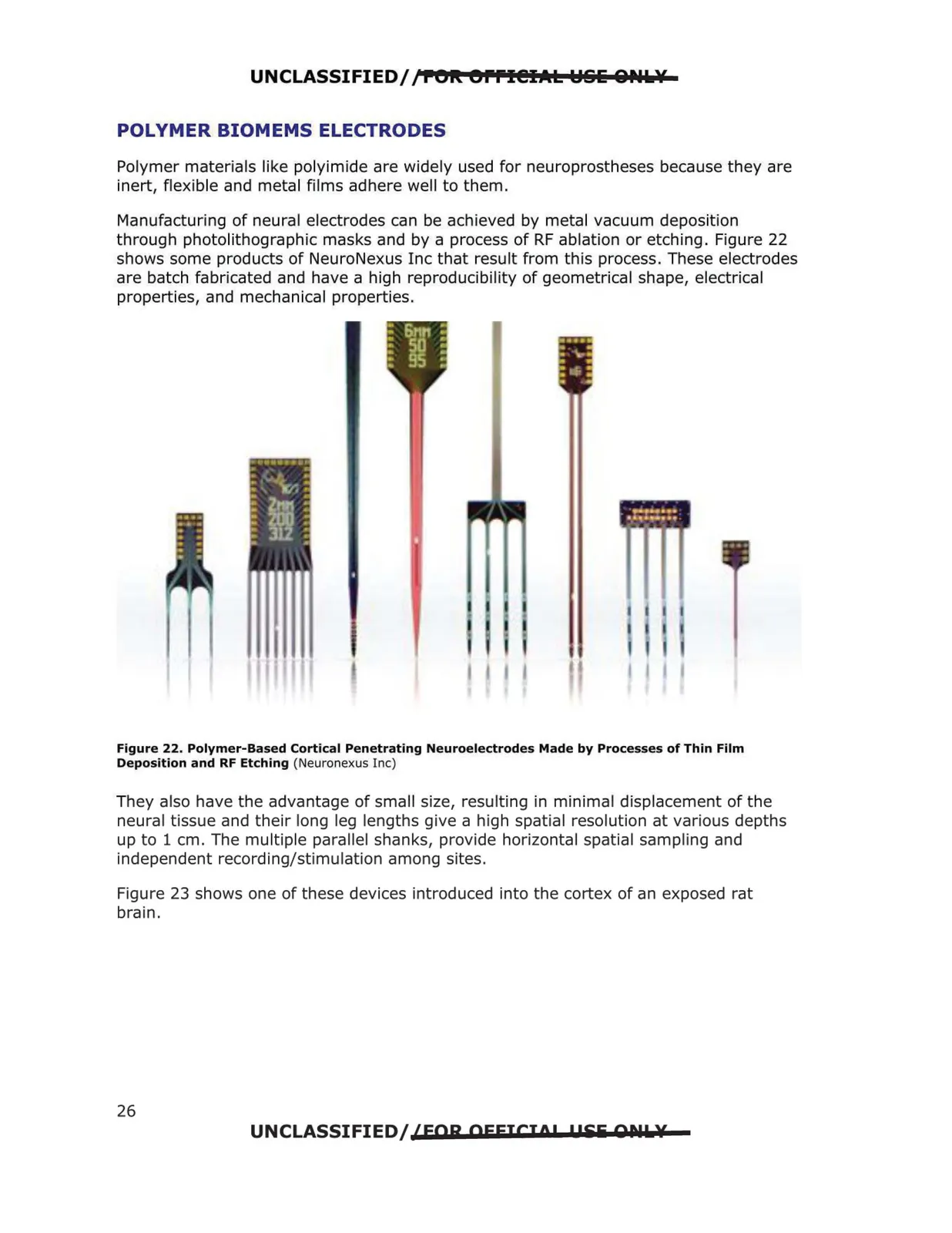
Manufacturing of neural electrodes can be achieved by metal vacuum deposition
through photolithographic masks and by a process of RF ablation or etching. Figure 22
shows some products of NeuroNexus Inc that result from this process. These electrodes
are batch fabricated and have a high reproducibility of geometrical shape, electrical
properties, and mechanical properties.
Figure 22. Polymer-Based Cortical Penetrating Neuroelectrodes Made by Processes of Thin Film
Deposition and RF Etching (Neuronexus Inc)
They also have the advantage of small size, resulting in minimal displacement of the
neural tissue and their long leg lengths give a high spatial resolution at various depths
up to 1 cm. The multiple parallel shanks, provide horizontal spatial sampling and
independent recording/stimulation among sites.
Figure 23 shows one of these devices introduced into the cortex of an exposed rat
brain.
UNCLASSIFIED/ {FOR OFFICIO! !PEii QDlk¥
26