AAWSAP DIRD, Biosensors and BioMEMS: A Survey of the Present Field, March 2010
DOW-UAP-D136 · page 38 of 45
Text
This text came with the file. It may have mistakes. When the text and the image disagree, the image is right.
UNCLASSIFIED//P'OR: OP'P'l@IAL WS& 8NI.¥
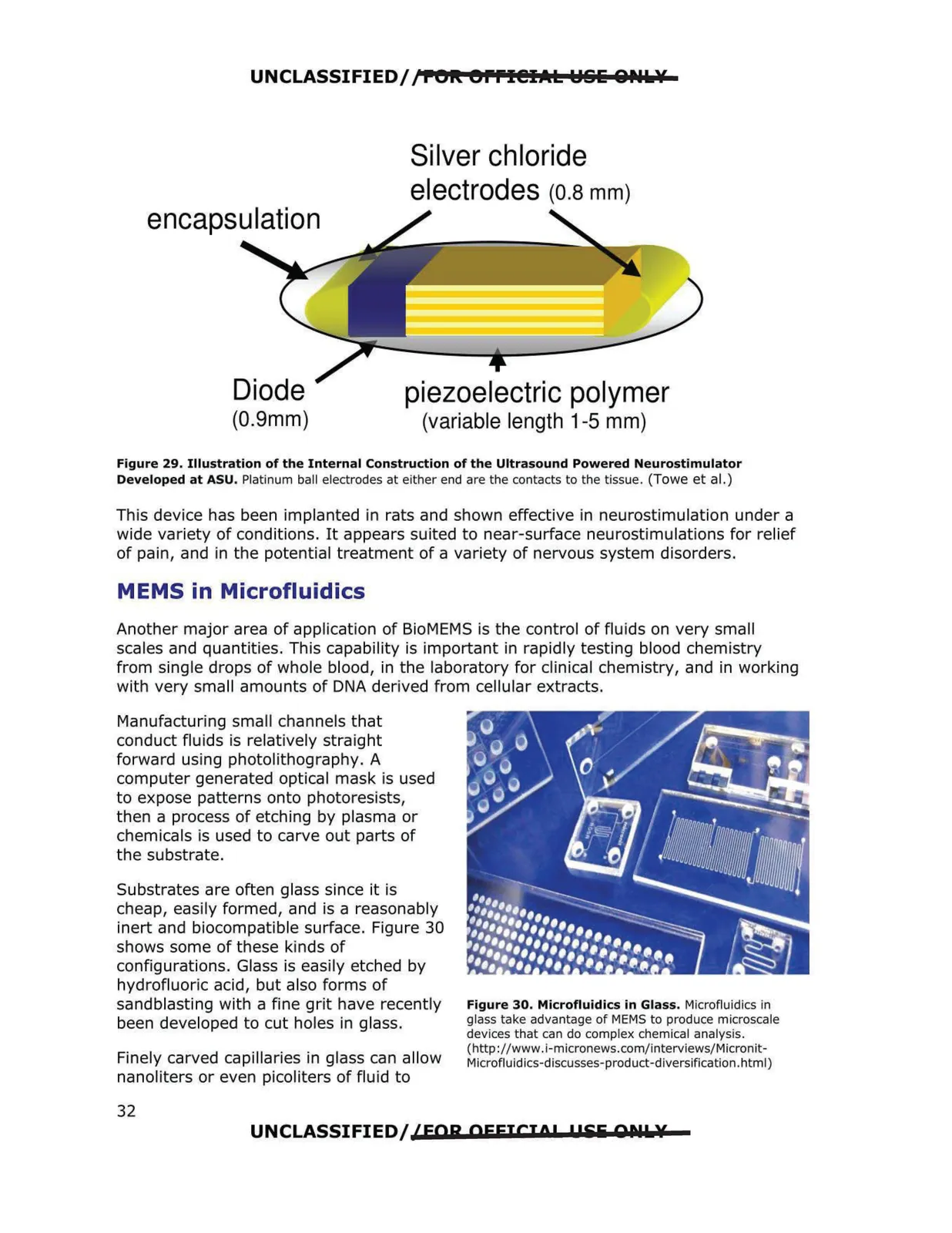
Silver chloride
electrodes (0.8 mm)
encapsulation
Diode
piezoelectric polymer
(0.9mm)
(variable length 1-5 mm)
Figure 29. Illustration of the Internal Construction of the Ultrasound Powered Neurostimulator
Developed at ASU. Platinum ball electrodes at either end are the contacts to the tissue. (Towe et al.)
This device has been implanted in rats and shown effective in neurostimulation under a
wide variety of conditions. It appears suited to near-surface neurostimulations for relief
of pain, and in the potential treatment of a variety of nervous system disorders.
MEMS in Microfluidics
Another major area of application of BioMEMS is the control of flu ids on very small
scales and quantities. This capability is important in rapidly testing blood chemistry
from single drops of whole blood, in the laboratory for clinical chemistry, and in working
with very small amounts of DNA derived from cellular extracts.
Manufacturing small channels that
conduct fluids is relatively straight
forward using photolithography. A
computer generated optical mask is used
to expose patterns onto photoresists,
then a process of etching by plasma or
chemicals is used to carve out parts of
the substrate.
Substrates are often glass since it is
cheap, easily formed, and is a reasonably
inert and biocompatible surface. Figure 30
shows some of these kinds of
configurations. Glass is easily etched by
hydrofluoric acid, but also forms of
sandblasting with a fine grit have recently
been developed to cut holes in glass.
Finely carved capillaries in glass can allow
nanoliters or even picoliters of fluid to
UNCLASSIFIED/ {FOR OFFICIO! !Pfli ODIi.¥
Figure 30. Microfluidics in Glass. Microfluidics In
glass take advantage of MEMS to produce microscale
devices that can do complex chemical analysis.
(http://www.i-micronews. com/interviews/Micronit
Microfluldics-discusses-product-diversification. html)
32