AAWSAP DIRD, Biosensors and BioMEMS: A Survey of the Present Field, March 2010
DOW-UAP-D136 · page 40 of 45
Text
This text came with the file. It may have mistakes. When the text and the image disagree, the image is right.
UNCLASSIFIED//P'OR: OP'P'l@IAL WS& 0Nk¥
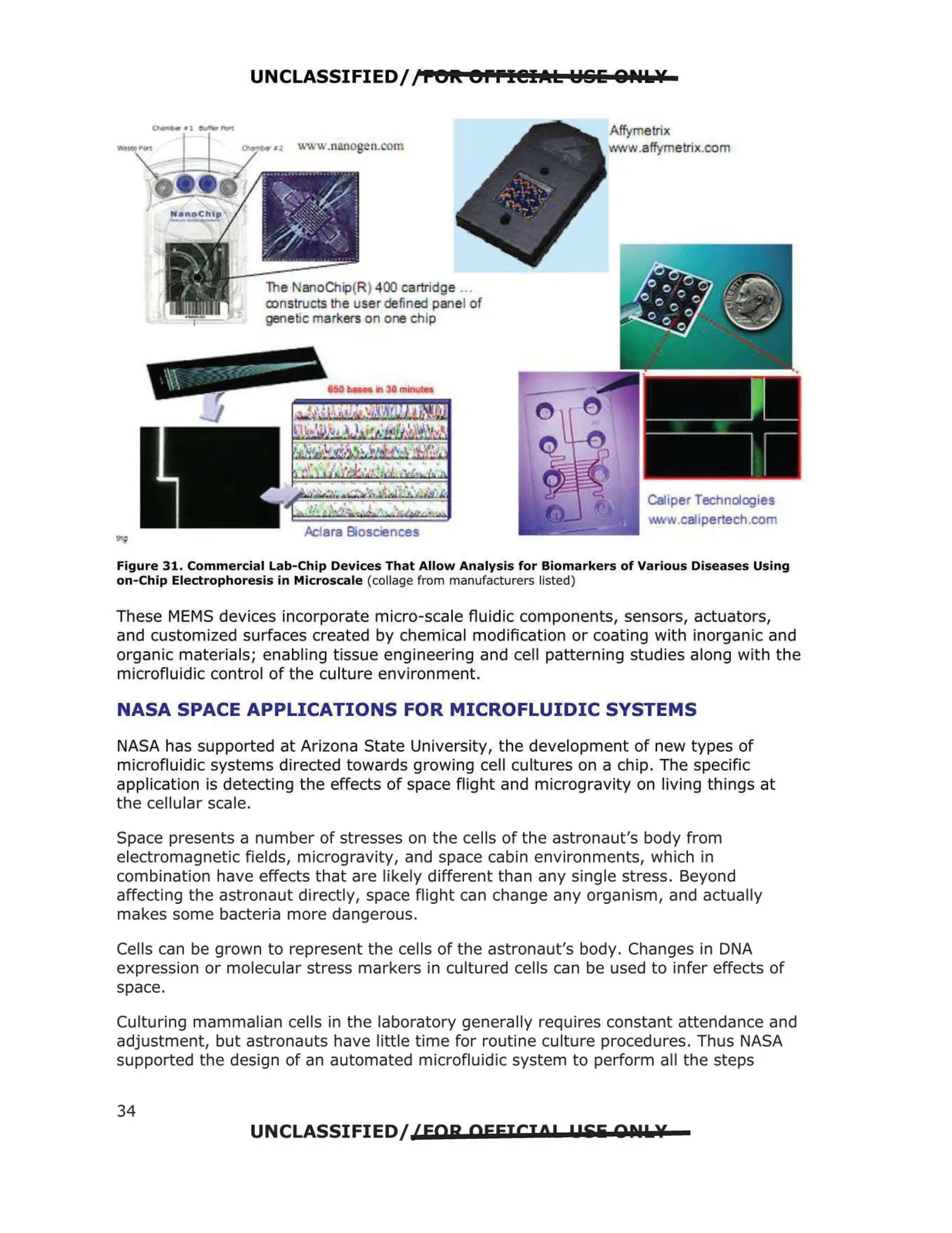
The anoChip(R) 400 cartridge ...
oonstructs the user defined panel of
e c
arkers on one chip
Figure 31. Commercial Lab-Chip Devices That Allow Analysis for Biomarkers of Various Diseases Using
on-Chip Electrophoresis in Microscale (collage from manufacturers listed)
These MEMS devices incorporate micro-scale fluidic components, sensors, actuators,
and customized surfaces created by chemical modification or coating with inorganic and
organic materials; enabling tissue engineering and cell patterning studies along with the
microfluidic control of the culture environment.
NASA SPACE APPLICATIONS FOR MICROFLUIDIC SYSTEMS
NASA has supported at Arizona State University, the development of new types of
microfluidic systems directed towards growing cell cultures on a chip. The specific
application is detecting the effects of space flight and microgravity on living things at
the cellular scale.
Space presents a number of stresses on the cells of the astronaut's body from
electromagnetic fields, microgravity, and space cabin environments, which in
combination have effects that are likely different than any single stress. Beyond
affecting the astronaut directly, space flight can change any organism, and actually
makes some bacteria more dangerous.
Cells can be grown to represent the cells of the astronaut's body. Changes in DNA
expression or molecular stress markers in cultured cells can be used to infer effects of
space.
Culturing mammalian cells in the laboratory generally requires constant attendance and
adjustment, but astronauts have little time for routine culture procedures. Thus NASA
supported the desig n of an automated microfluidic system to perform all the steps
UNCLASSIFIED/ {FOR OFFICIO! !PEii QDlk¥
34