AAWSAP DIRD, Biosensors and BioMEMS: A Survey of the Present Field, March 2010
DOW-UAP-D136 · page 41 of 45
Text
This text came with the file. It may have mistakes. When the text and the image disagree, the image is right.
UNCLASSIFIED//P'OR: OP'P'l@IAL WS& 8NI.¥
needed to culture living cells, in volumes of less than a milliliter. The device contains
thermopneumatic micropumps, microvalves, culture media reservoirs, cell culture
chamber, and optical readout systems to detect fluorescent markers that the cells
express when subjected to certain types of stress.
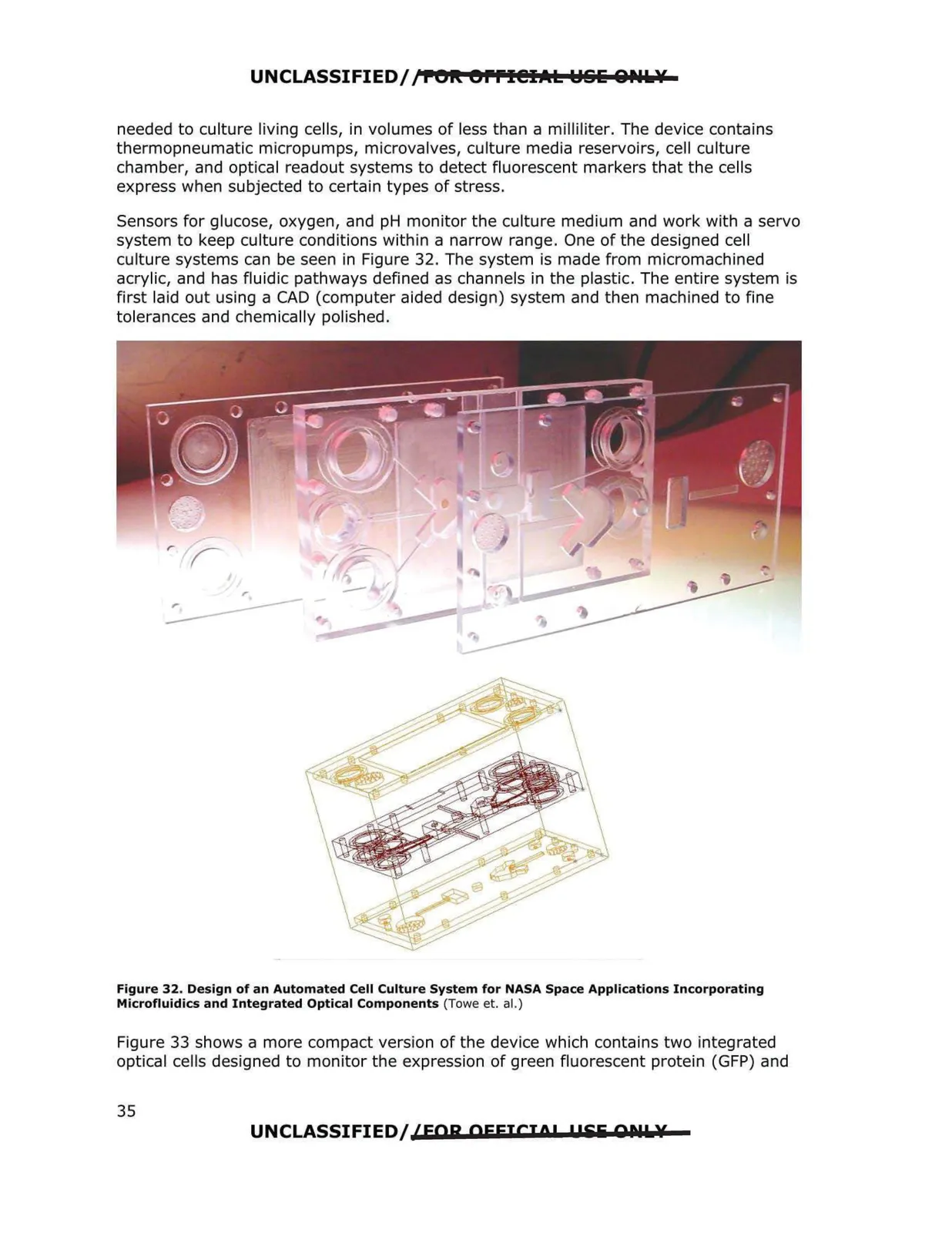
Sensors for glucose, oxygen, and pH monitor the culture medium and work with a servo
system to keep culture cond itions within a narrow range. One of the designed cell
culture systems can be seen in Figure 32. The system is made from micromachined
acrylic, and has fluidic pathways defined as channels in the plastic. The entire system is
first laid out using a CAD (computer aided design) system and then machined to fine
tolerances and chemically polished.
r
r
Figure 32. Design of an Automated Cell Culture System for NASA Space Applications Incorporating
Microfluidics and Integrated Optical Components (Towe et. al.)
Figure 33 shows a more compact version of the device which contains two integrated
optical cells designed to monitor the expression of green fluorescent protein (GFP) and
UNCLASSIFIED/ {FOR OFFICIO! !Pfli ODIi.¥
35