AAWSAP DIRD, Biosensors and BioMEMS: A Survey of the Present Field, March 2010
DOW-UAP-D136 · page 42 of 45
Text
This text came with the file. It may have mistakes. When the text and the image disagree, the image is right.
UNCLASSIFIED//P'OR: OP'P'l@IAL WS& 8NI.¥
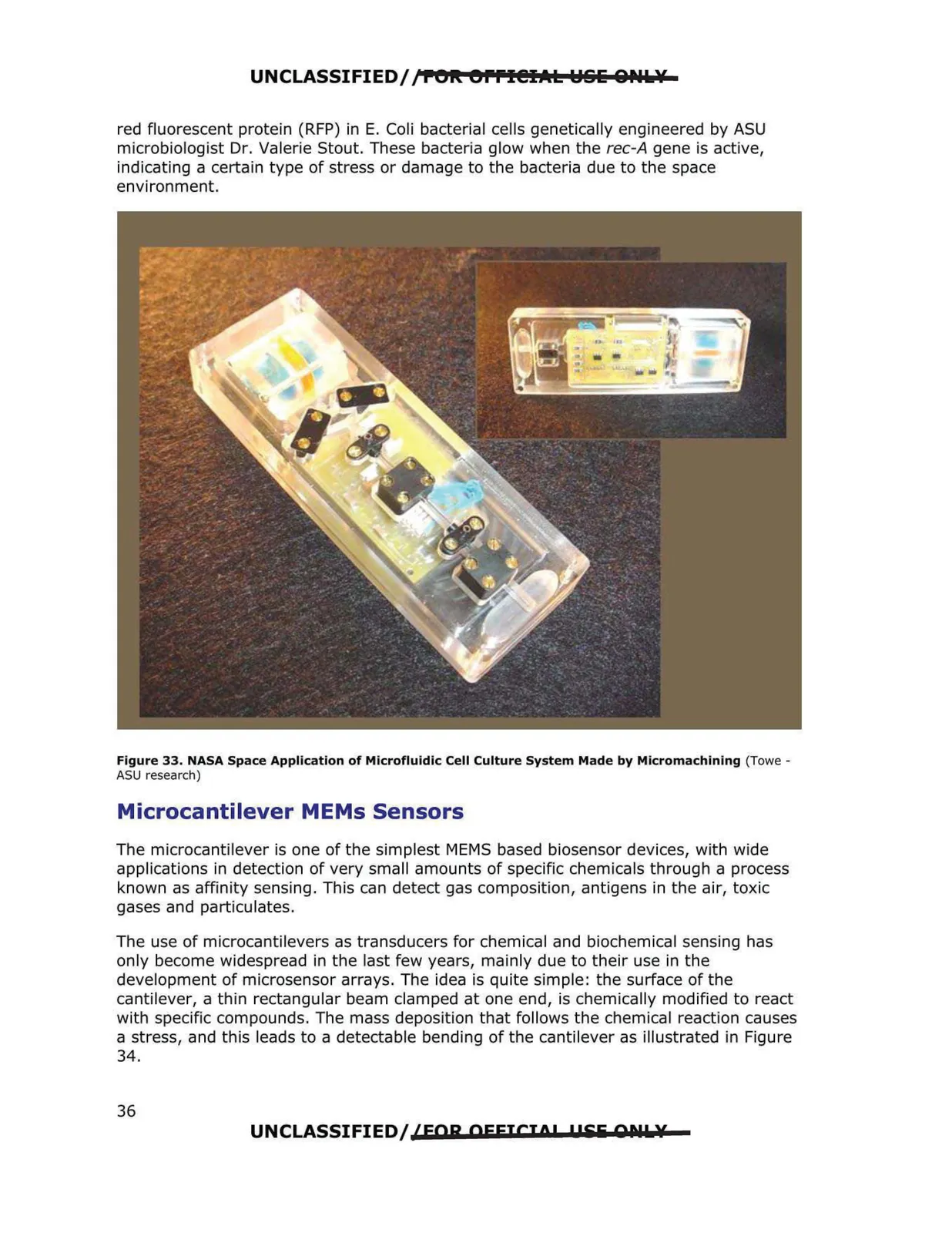
red fluorescent protein (RFP) in E. Coli bacterial cells genetically engineered by ASU
microbiologist Dr. Valerie Stout. These bacteria glow when the rec-A gene is active,
indicating a certain type of stress or damage to the bacteria due to the space
environment.
Figure 33. NASA Space Application of Microfluidic Cell Culture System Made by Micromachining (Towe
ASU research)
Microcantilever MEMs Sensors
The microcantilever is one of the simplest MEMS based biosensor devices, with wide
applications in detection of very small amounts of specific chemicals through a process
known as affinity sensing . This can detect gas composition, antigens in the air, toxic
gases and particulates.
The use of microcantilevers as transducers for chemical and biochemical sensing has
only become widespread in the last few years, mainly due to their use in the
development of microsensor arrays. The idea is quite simple: the surface of the
cantilever, a thin rectangular beam clamped at one end, is chemically modified to react
with specific compounds. The mass deposition that follows the chemical reaction causes
a stress, and this leads to a detectable bending of the cantilever as illustrated in Figure
34.
UNCLASSIFIED/ {FOR OFFICIO! !Pfli ODIi.¥
36