AAWSAP DIRD, State of the Art and Evolution of High-Energy Lasers, March 2010
DOW-UAP-D137 · page 11 of 31
Text
This text came with the file. It may have mistakes. When the text and the image disagree, the image is right.
UNCLASSIFIED/fFOA. OFFI€il.t.L YSE er•tv
Typically in a chemical laser, 10 to 20 percent of the energy released in the chemical
reaction will result in lasing while the other 80 to 90 percent becomes heat.
Fortunately in a flowing gas laser, the heat can be easily removed from the resonator
region of the gain generator by the exhaust gas. It is this efficient heat removal
mechanism which has allowed chemical lasers to be scaled to such high average
powers. If a MW-class laser were required today or in the next few years, chemical
lasers provide the only available options. Because they use large quantities of
hazardous chemicals and need refueling, this type of laser is not a preferred choice by
the military.
The physics and scaling of chemical lasers such as OF, HF, and COIL are well
understood and, in principal, they could be scaled to power levels significantly beyond
the MW level. However, due to the maturity of these technologies, only marginal
further efficiency improvements are likely. As a result, the quantity of chemicals which
must be stored and consumed for a laser beyond ~ 10 MW would make the concept
highly impractical for space-based applications and extremely cumbersome for ground
based lasers. Additionally, the atmospheric degradation of a laser beam propagating
from ground to space makes these wavelengths impractical at power levels beyond 10
MW.
SOLID-STATE LASERS
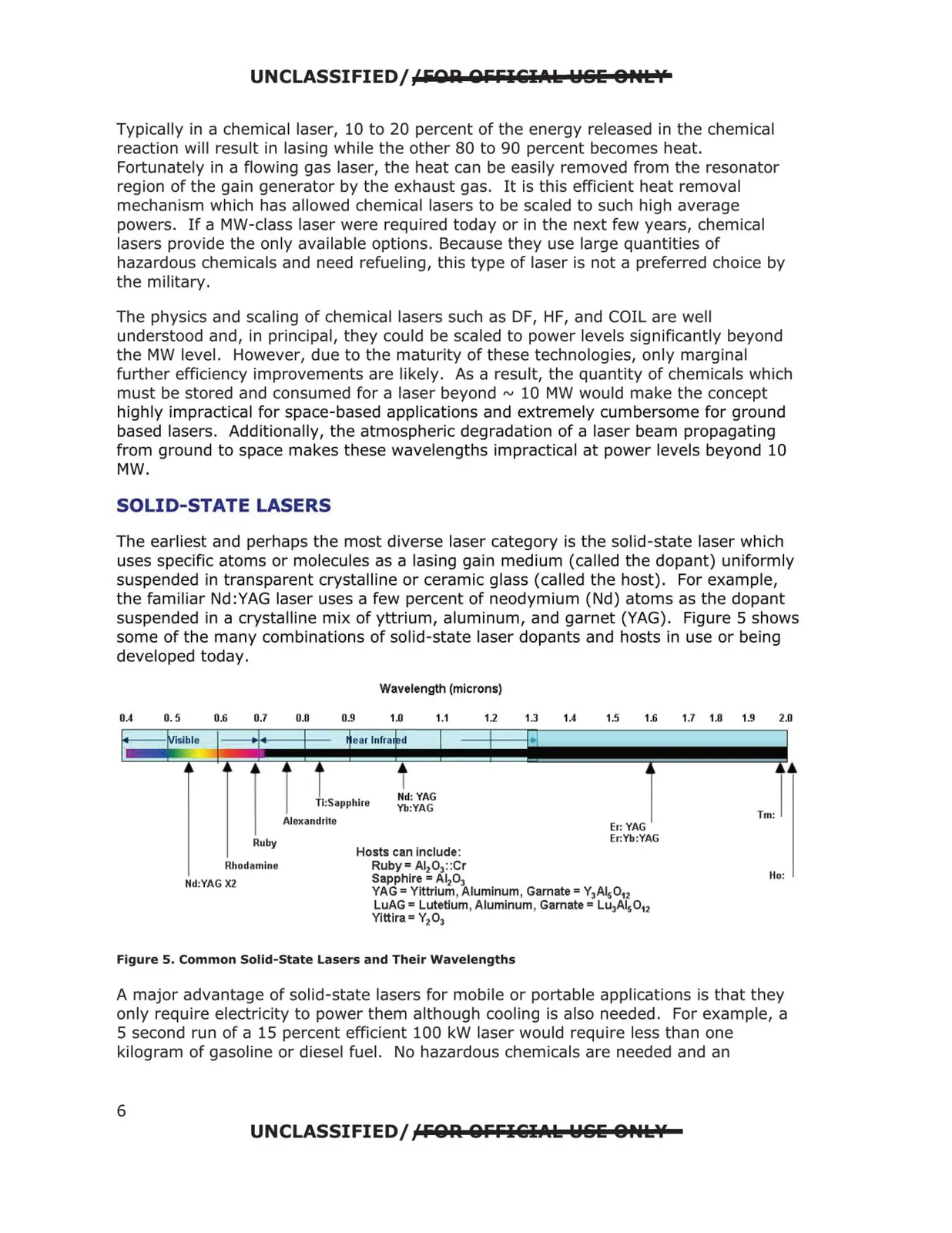
The earliest and perhaps the most diverse laser category is the solid-state laser which
uses specific atoms or molecules as a lasing gain medium (called the dopant) uniformly
suspended in transparent crystalline or ceramic glass (called the host). For example,
the familiar Nd:YAG laser uses a few percent of neodymium (Nd) atoms as the dopant
suspended in a crystalline mix of yttrium, aluminum, and garnet (YAG). Figure 5 shows
some of the many combinations of solid-state laser dopants and hosts in use or being
developed today.
Wavelength (microns)
0.4
0. 5
0.6
0.7
0.8
0.9
1.0
1.1
1.2
1.3
1.4
1.5
1.6
1.7
1.8
1.9
2.0
I
: isible I
I
a
·~
0
Ruby
Rhodamine
I
~ear lnfra~d
I
I
!11
I
I
·~
!,Sapphire •
~~
I
Nd: YAG
Yb:YAG
Alex and rite
Er: YAG
Er:Yb :YAG
Hosts can include:
Ruby~ Al203::Cr
-
Sapphire - Al203
I
,J
Ho:
Nd:YAG X2
YAG"' Yittrium, Aluminum , Gamate"' Y3Al5012
LuAG"' Lutetium, Aluminum, Gamate"' Lu3Al50 12
Yittira"' Y20 3
Figure 5. Common Solid-State Lasers and Their Wavelengths
A major advantage of solid-state lasers for mobile or portable applications is that they
only require electricity to power them although cooling is also needed. For example, a
5 second run of a 15 percent efficient 100 kW laser would require less than one
kilogram of gasoline or diesel fuel. No hazardous chemicals are needed and an
UNCLASSIFIED/fFOA QFFI€il.t.L YSE 8,.L\f
6