AAWSAP DIRD, State of the Art and Evolution of High-Energy Lasers, March 2010
DOW-UAP-D137 · page 10 of 31
Text
This text came with the file. It may have mistakes. When the text and the image disagree, the image is right.
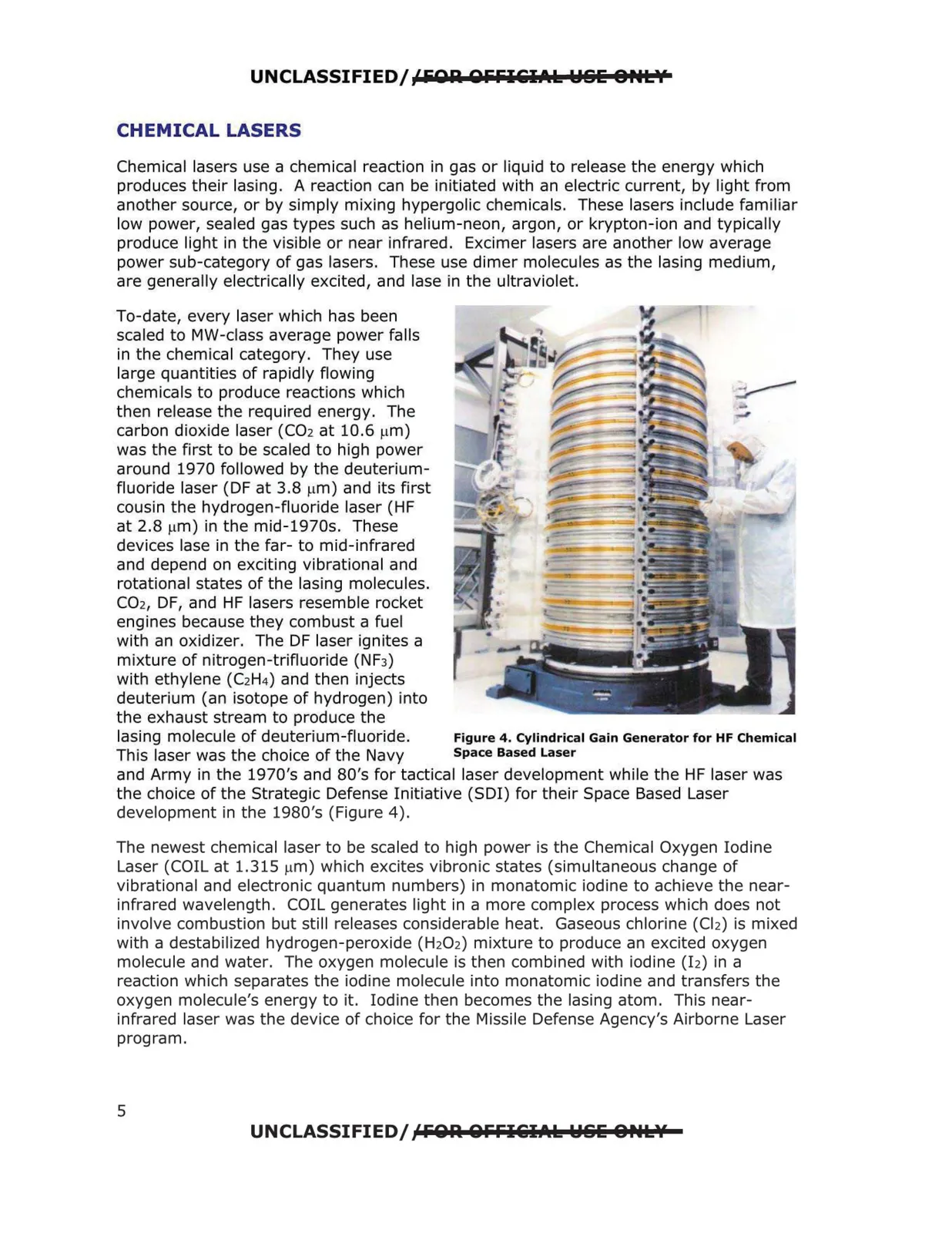
UNCLASSIFIED/ fFOA OFFl&I.t.k YSE &P•tv CHEMICAL LASERS Chemical lasers use a chemical reaction in gas or liquid to release the energy which produces their lasing. A reaction can be initiated with an electric current, by light from another source, or by simply mixing hypergolic chemicals. These lasers include familiar low power, sealed gas types such as helium-neon, argon, or krypton-ion and typically produce light in the visible or near infrared. Excimer lasers are another low average power sub-category of gas lasers. These use dimer molecules as the lasing medium, are generally electrically excited, and lase in the ultraviolet. To-date, every laser which has been scaled to MW-class average power falls in the chemical category. They use large quantities of rapidly flowing chemicals to produce reactions which ,.c:.;_i:::~: ::~=?:.;:~•.i;:;,..~•... ::'.'i ••/~:"'I, ::.-- then release the required energy. The <"-"""'- ~..'"::~~~~ carbon dioxide laser (CO2 at 10.6 ~1m) was the first to be scaled to high power around 1970 followed by the deuterium fluoride laser (DF at 3.8 µm) and its first cousin the hydrogen-fluoride laser (HF at 2.8 µm) in the mid-1970s. These devices lase in the far- to mid-infrared and depend on exciting vibrational and rotational states of the lasing molecules. CO2, DF, and HF lasers resemble rocket engines because they combust a fuel with an oxidizer. The DF laser ignites a mixture of nitrogen-trifluoride (NF3) with ethylene (C2H4) and then injects deuterium (an isotope of hydrogen) into the exhaust stream to produce the lasing molecule of deuterium-fluoride. Figure 4. Cylindrical Gain Generator for HF Chemical This laser was the choice of the Navy Space Based Laser and Army in the 1970's and 80's for tactical laser development while the HF laser was the choice of the Strategic Defense Initiative (SDI) for their Space Based Laser development in the 1980's (Figure 4 ). The newest chemical laser to be scaled to high power is the Chemical Oxygen Iodine Laser (COIL at 1.315 µm) which excites vibronic states (simultaneous change of vibrational and electronic quantum numbers) in monatomic iodine to achieve the near infrared wavelength. COIL generates light in a more complex process which does not involve combustion but still releases considerable heat. Gaseous chlorine (Cl2) is mixed with a destabilized hydrogen-peroxide (H2O2) mixture to produce an excited oxygen molecule and water. The oxygen molecule is then combined with iodine (Iz) in a reaction which separates the iodine molecule into monatomic iodine and transfers the oxygen molecule's energy to it. Iodine then becomes the lasing atom. This near infrared laser was the device of choice for the Missile Defense Agency's Airborne Laser program. UNCLASSIFIED/ fFOA QFFI&I.t.k YSE 8,.L\f 5