AAWSAP DIRD, State of the Art and Evolution of High-Energy Lasers, March 2010
DOW-UAP-D137 · page 16 of 31
Text
This text came with the file. It may have mistakes. When the text and the image disagree, the image is right.
UNCLASSIFIED/fFOA OFFl&I.t.k YSE &P•tv
FREE-ELECTRON LASERS
Free-electron lasers (FELs) are unique in that they are not limited to lasing only at
specific wavelengths dictated by the characteristics of a specific solid, liquid, or gaseous
gain medium. FELs use a stream of "free" (unbound to atoms) electron bunches,
moving at almost the speed of light, to provide the lasing medium. These short
bunches of electrons are generated by a photocathode and accelerated by an RF linear
accelerator which is powered by klystron tubes. The relativistic electron bunches are
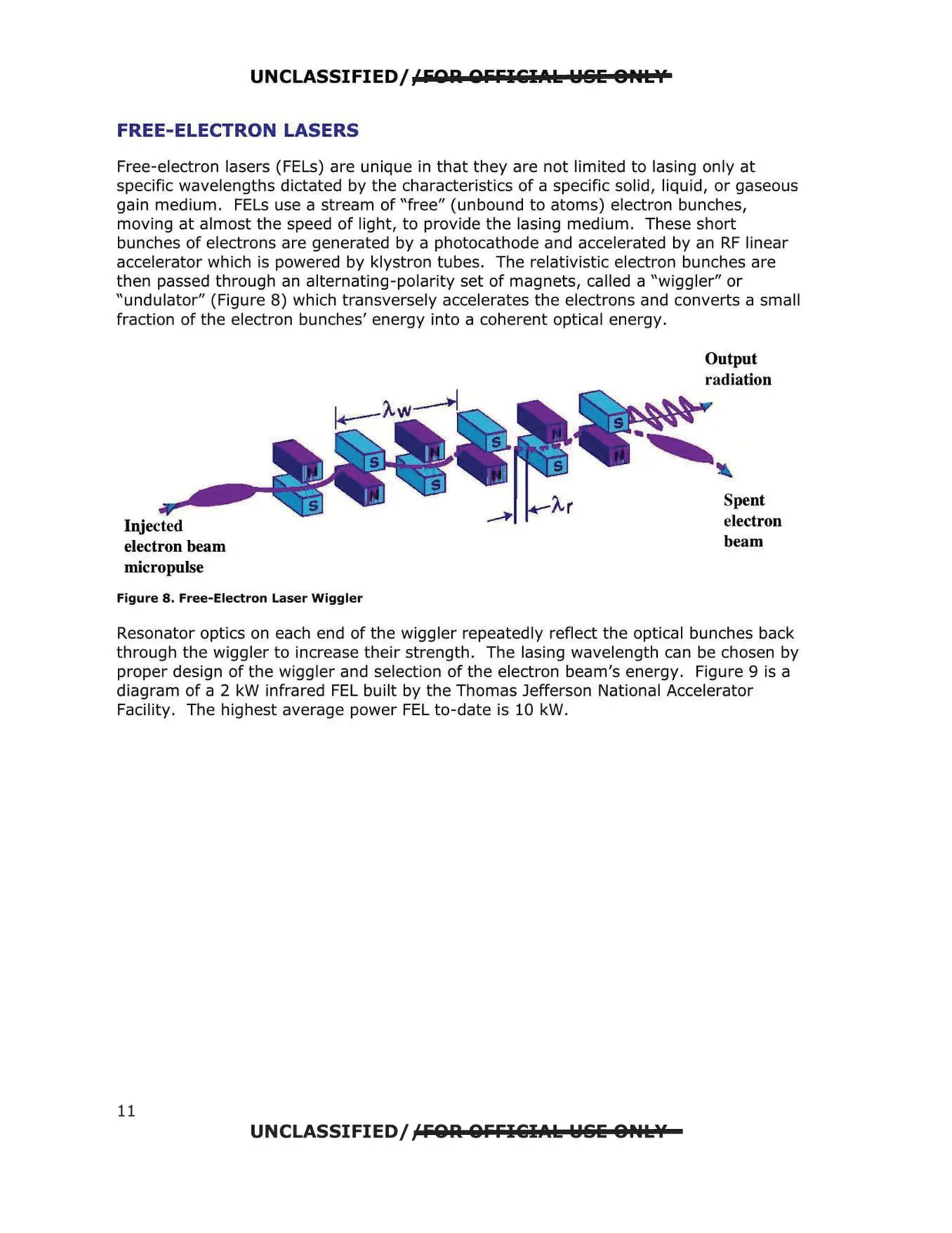
then passed through an alternating-polarity set of magnets, called a "wiggler" or
"undulator" (Figure 8) which transversely accelerates the electrons and converts a small
fraction of the electron bunches' energy into a coherent optical energy.
Output
radiation
Spent
electron
beam
micropulse
Figure 8. Free-Electron Laser Wiggler
Resonator optics on each end of the wiggler repeatedly reflect the optical bunches back
through the wiggler to increase their strength. The lasing wavelength can be chosen by
proper design of the wiggler and selection of the electron beam's energy. Figure 9 is a
diagram of a 2 kW infrared FEL built by the Thomas Jefferson National Accelerator
Facility. The highest average power FEL to-date is 10 kW.
UNCLASSIFIED/fFOA QFFI&I.t.k YSE 8,.L\f
11