AAWSAP DIRD, State of the Art and Evolution of High-Energy Lasers, March 2010
DOW-UAP-D137 · page 17 of 31
Text
This text came with the file. It may have mistakes. When the text and the image disagree, the image is right.
UNCLASSIFIED/fFOA: OFFI€1.t.k YSE &P•tv
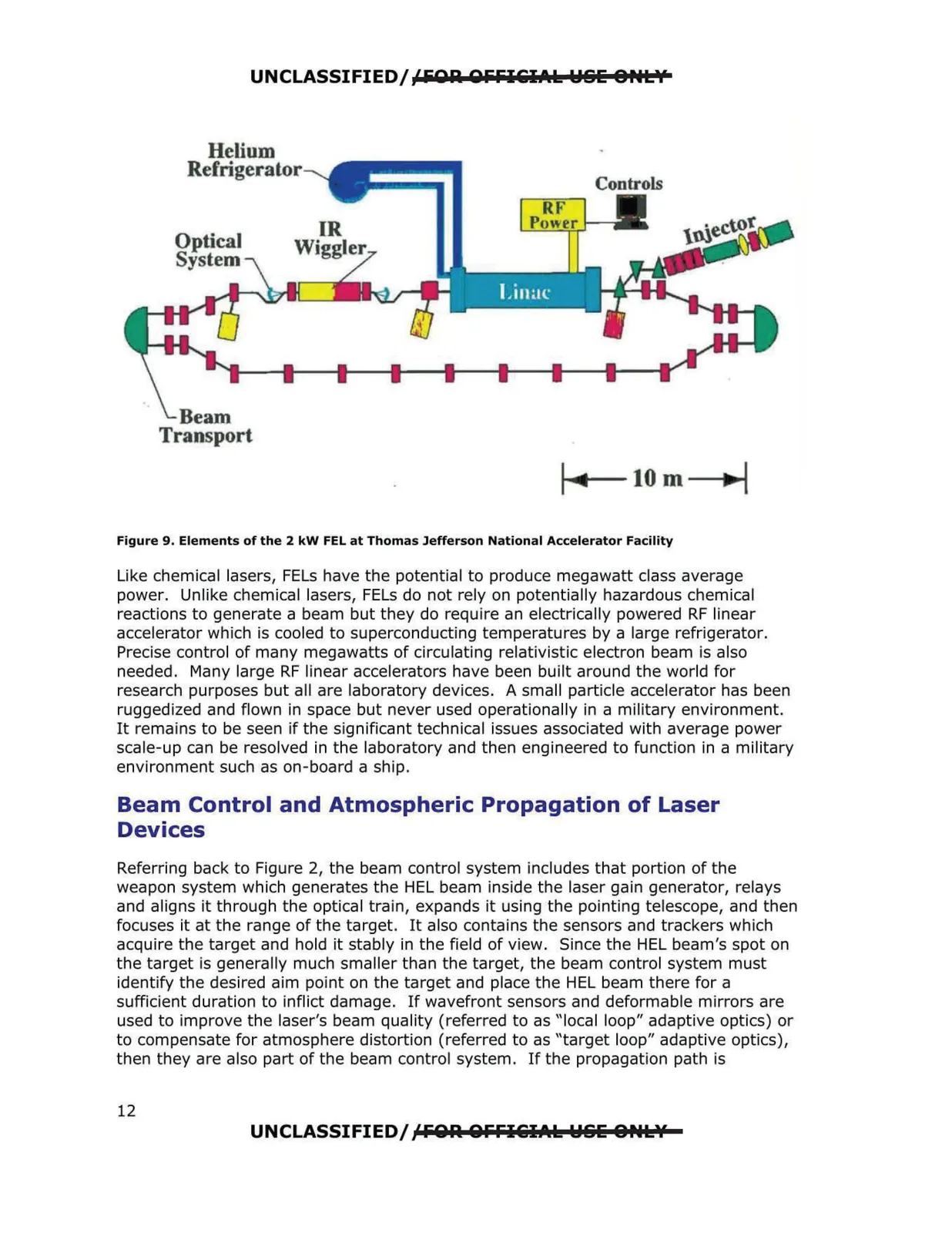
Helium
Refrigerator
Controls
I ◄
tom-.{
Figure 9. Elements of the 2 kW FEL at Thomas Jefferson National Accelerator Facility
Like chemical lasers, FELs have the potential to produce megawatt class average
power. Unlike chemical lasers, FELs do not rely on potentially hazardous chemical
reactions to generate a beam but they do require an electrically powered RF linear
accelerator which is cooled to superconducting temperatures by a large refrigerator.
Precise control of many megawatts of circulating relativistic electron beam is also
needed. Many large RF linear accelerators have been built around the world for
research purposes but all are laboratory devices. A small particle accelerator has been
ruggedized and flown in space but never used operationally in a military environment.
It remains to be seen if the significant technical issues associated with average power
scale-up can be resolved in the laboratory and then engineered to function in a military
environment such as on-board a ship.
Beam Control and Atmospheric Propagation of Laser
Devices
Referring back to Figure 2, the beam control system includes that portion of the
weapon system which generates the HEL beam inside the laser gain generator, relays
and aligns it through the optical train, expands it using the pointing telescope, and then
focuses it at the range of the target. It also contains the sensors and trackers which
acquire the target and hold it stably in the field of view. Since the HEL beam's spot on
the target is generally much smaller than the target, the beam control system must
identify the desired aim point on the target and place the HEL beam there for a
sufficient duration to inflict damage. If wavefront sensors and deformable mirrors are
used to improve the laser's beam quality (referred to as "local loop" adaptive optics) or
to compensate for atmosphere distortion (referred to as "target loop" adaptive optics),
then they are also part of the beam control system. If the propagation path is
UNCLASSIFIED/fFOA OFFI€l.t.k YSE 8,.L\f
12